

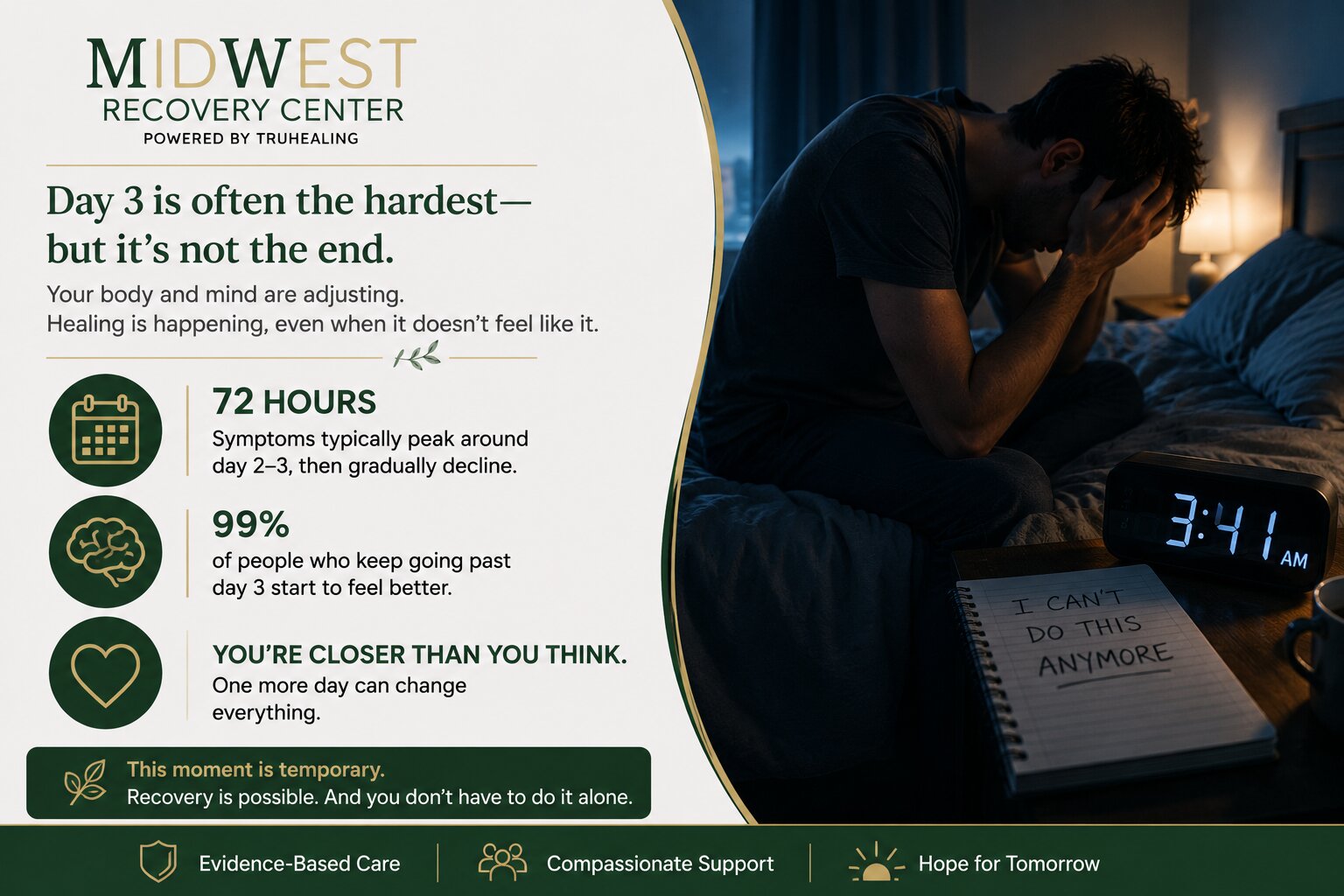
It’s 3:41 a.m.
You haven’t slept.
Or maybe you’ve slept for twenty minutes at a time before waking up again.
Your sheets are tangled. Your legs won’t stay still. Your thoughts keep racing. The clock on your phone seems determined to move slower than normal.
At some point, frustration turns into fear.
You start wondering:
“How long does this last?”
“Why can’t I sleep?”
“Is this normal?”
“Am I doing something wrong?”
As a clinician, I’ve spoken with many people during this exact moment.
Not day one.
Not day ten.
Day three.
And what often surprises them is that the hardest part isn’t always the physical discomfort.
It’s the doubt.
The fear that because they still feel awful, recovery must not be working.
If you’ve tried treatment before, that fear can become even louder.
You remember previous attempts.
Previous setbacks.
Previous disappointments.
You may already be carrying a story that sounds something like:
“Treatment doesn’t work for me.”
By day three, sleep deprivation can make that story feel convincing.
But here’s what I want you to know:
Feeling terrible on day three does not mean treatment failed.
It does not mean you’re failing.
And it certainly does not mean you’re stuck this way forever.
Many people who eventually explore medication-supported recovery options first reach a point where they become convinced they simply cannot keep going.
What often happens next surprises them.
Day Three Is Where Withdrawal Becomes Personal
The first couple of days are often about surviving symptoms.
People expect discomfort.
They expect cravings.
They expect physical symptoms.
By day three, something changes.
The struggle starts feeling personal.
You stop thinking:
“This is withdrawal.”
And start thinking:
“This is me.”
That’s a dangerous shift.
Because when symptoms become personal, people begin attaching meaning to them.
They assume:
- I’m too weak.
- I’m doing this wrong.
- Other people handle this better.
- Recovery isn’t going to work for me.
In reality, many people are experiencing a completely normal response to a difficult process.
The problem isn’t the symptom.
The problem is the story people start building around the symptom.
Sleep Deprivation Changes Everything
Most people underestimate how much poor sleep affects their thinking.
After a few nights of disrupted sleep, your brain starts processing the world differently.
Problems appear larger.
Hope feels smaller.
Anxiety becomes louder.
Patience disappears.
Even simple decisions feel exhausting.
I’ve had patients tell me:
“I thought I was losing my mind.”
What they were often experiencing was extreme exhaustion combined with withdrawal.
When people search for a fentanyl withdrawal timeline, they’re often hoping someone will tell them exactly when they can expect relief.
What they really want is reassurance.
They want confirmation that what they’re experiencing is temporary.
That they’re not broken.
That this difficult moment won’t last forever.
Why Treatment Skeptics Struggle Here More Than Most
One thing I’ve noticed over the years is that treatment skeptics often have an additional burden.
History.
They’ve tried before.
Maybe they stopped using before.
Maybe they completed a program.
Maybe they made promises to themselves.
Then things didn’t go according to plan.
When those experiences exist, withdrawal becomes more than physical discomfort.
It becomes evidence.
Evidence the brain tries to use against itself.
The thought process often sounds like this:
“See?”
“This is exactly what happened last time.”
“Nothing is different.”
“I’m going to fail again.”
These thoughts can feel incredibly convincing at three in the morning.
The problem is that they aren’t facts.
They’re fears.
And fear tends to sound very confident when you’re exhausted.
The Clock Starts Controlling Your Mood
One of the strangest things about withdrawal is how much attention people pay to time.
You check the clock.
Twenty minutes have passed.
It feels like two hours.
You check again.
Only seven more minutes.
Frustration grows.
You start calculating.
If I fall asleep now, I’ll get four hours.
Now three.
Now two.
Now one.
The clock slowly becomes an enemy.
Every glance feels like proof that you’re stuck.
What many people don’t realize is that this experience is incredibly common.
The more desperately someone chases sleep, the more elusive it often feels.
And the more tired they become, the more emotional the experience gets.
Why Comparisons Make Everything Worse
At some point, many people start searching online.
They read stories.
They read timelines.
They compare experiences.
And suddenly they’re convinced something is wrong because someone else reported feeling better sooner.
Comparison creates problems in recovery.
Not because information is bad.
Because recovery isn’t standardized.
Two people can have very different experiences.
Different histories.
Different health factors.
Different withdrawal experiences.
Different recovery journeys.
Reading another person’s story may help you feel less alone.
It should not become a measuring stick for your own progress.
The Mistake People Make About Progress
Many people expect recovery to feel good immediately.
That expectation creates disappointment.
Especially during withdrawal.
People think progress should feel like:
- More energy
- Better mood
- Better sleep
- Increased motivation
- Immediate relief
Instead, progress often feels like discomfort.
Healing is not always pleasant.
Growth is not always rewarding in the beginning.
Think about recovering from surgery.
Pain doesn’t automatically mean the procedure failed.
Sometimes pain is simply part of healing.
Recovery often works the same way.
What We See Every Day
At Midwest Recovery Center, we’ve seen many people reach this exact stage.
They call feeling defeated.
Exhausted.
Frustrated.
Certain that they cannot keep going.
Many are convinced their experience is unique.
That everyone else is handling things better.
That recovery works for other people.
Not them.
Then something happens.
Another day passes.
Then another.
Sleep gradually improves.
Thinking becomes clearer.
The intensity begins to change.
Not overnight.
Not dramatically.
Gradually.
Which is often how recovery works.
Many people expect a miracle.
What they experience instead is momentum.
Small changes accumulating over time.
Why Day Three Feels Longer Than It Is
Withdrawal has a strange effect on perception.
It stretches time.
One difficult night feels endless.
One difficult day feels permanent.
This is one reason people become discouraged.
They’re judging their entire future based on one painful moment.
But painful moments are terrible predictors.
They convince people that today’s reality will last forever.
Most of the time, they’re wrong.
If you’ve ever looked back on a difficult chapter of your life and wondered how you survived it, you’ve already experienced this phenomenon.
While you were inside it, it felt endless.
Afterward, it became part of your story.
Withdrawal often follows a similar pattern.
The Thought That Keeps People Stuck
There is one thought I hear repeatedly:
“If I still feel this bad, something must be wrong.”
Usually, the opposite is true.
What you’re experiencing may be evidence that your body is working hard to adapt.
Recovery is rarely comfortable.
The body is adjusting.
The brain is adjusting.
The nervous system is adjusting.
None of that feels pleasant.
But discomfort and failure are not the same thing.
Many people confuse the two.
You Are Probably Closer Than You Think
One thing people rarely realize is how close they often are when they feel like quitting.
Day three has a way of convincing people they are stuck.
Many are not.
Many are simply exhausted.
And exhaustion is a terrible lens through which to judge the future.
Whether you’re seeking care in locations or looking for additional support in Youngstown, remember this:
The point where you feel most discouraged is not necessarily the point where recovery stops working.
Sometimes it’s the point where recovery is asking you to keep going.
Frequently Asked Questions
Why is day three often so difficult?
Many people experience a combination of physical symptoms, emotional distress, cravings, and sleep disruption around this stage of withdrawal.
Is it normal to still be unable to sleep?
Sleep difficulties are extremely common during withdrawal and can contribute significantly to emotional exhaustion.
Why do I feel so anxious?
Withdrawal affects the brain and nervous system. Anxiety, restlessness, and emotional sensitivity are common experiences.
Does poor sleep mean treatment isn’t working?
No. Sleep disruption during withdrawal does not automatically indicate treatment failure.
How long does this stage usually last?
Experiences vary. Factors such as health history, substance use patterns, and individual circumstances influence recovery experiences.
Why do I feel worse at night?
Fatigue, isolation, fewer distractions, and increased focus on symptoms often make evenings and overnight hours feel more challenging.
Is it normal to want to quit?
Many people feel discouraged during withdrawal. Those feelings do not necessarily reflect the reality of their progress.
Why does time feel so slow?
Pain, anxiety, and sleep deprivation can significantly affect how people perceive time.
What if I’ve tried treatment before?
Previous attempts do not determine future outcomes. Many people who achieve recovery had earlier experiences that did not go as planned.
Can recovery still work for me?
Yes. Many individuals who once believed treatment wouldn’t help eventually discovered that recovery was still possible.
This Night Is Not Your Future
If you’re lying awake wondering how much longer this will last, remember something important:
This moment is real.
The discomfort is real.
The exhaustion is real.
But it is not the entire story.
Many people who once sat awake on day three convinced they couldn’t do it eventually discovered that recovery wasn’t failing.
It was unfolding.
One difficult night at a time.
Call (833) 657-0858 or visit our Medication-Assisted Treatment services to learn more about our Medication-Assisted Treatment services Cincinnati, Ohio.