
The Moment You Realize the Relief Has Become Part of the Problem

When Relief Starts Becoming the Problem

There is a moment many parents describe almost the same way.

Not a dramatic moment.

Not a crisis.

A realization.

You begin noticing that every conversation somehow comes back to anxiety.

Your son is anxious about school.

Anxious about work.

Anxious about relationships.

Anxious about the future.

Then you notice something else.

Alcohol keeps showing up too.

At first, it seems connected.

They tell you drinking helps them relax.

Helps them calm down.

Helps them stop overthinking.

That explanation makes sense.

Until it doesn’t.

Because months later, the anxiety hasn’t improved.

In fact, it often seems worse.

The drinking has increased.

The mood swings are stronger.

The isolation is deeper.

And you’re left wondering:

“How can something that supposedly helps be making everything harder?”

As a clinician, I’ve sat with many parents carrying this exact question.

And what often brings them relief isn’t hearing that they’re overreacting.

It’s learning that what they’re seeing is actually a very common pattern.

Many families exploring live-in treatment options arrive after realizing they are not dealing with two separate problems.

They may be dealing with one cycle feeding itself.

Understanding that cycle can become the first step toward hope.

Why Alcohol Often Feels Like It Works

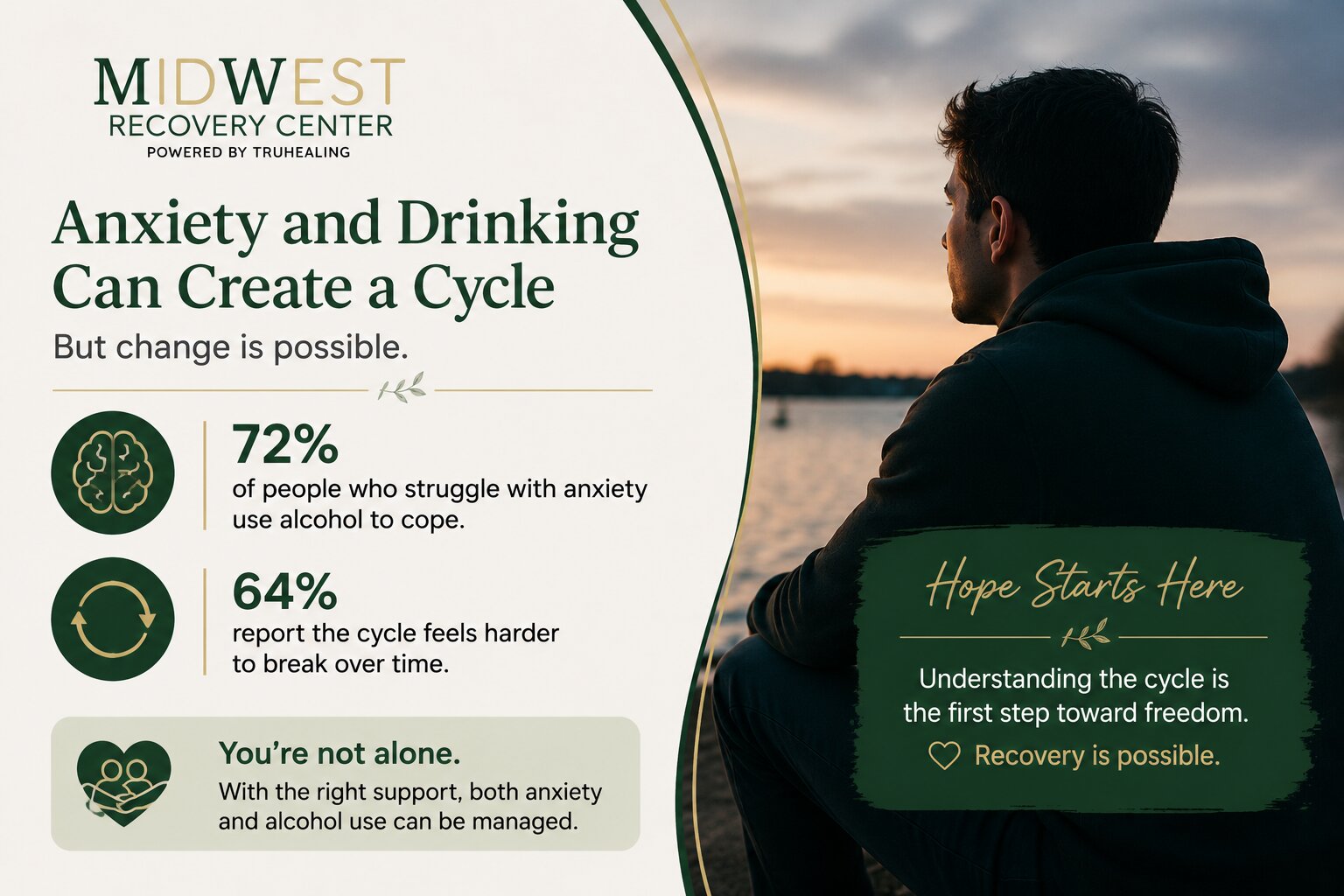
One reason this situation becomes so confusing is because alcohol frequently provides immediate relief.

That’s important to acknowledge.

Many young adults are not imagining that effect.

When someone feels anxious, overwhelmed, tense, or emotionally exhausted, alcohol can temporarily create a sense of calm.

The racing thoughts slow down.

The tension eases.

The discomfort decreases.

For a short period of time, it feels like a solution.

If you’re a parent watching from the outside, this can create mixed emotions.

Part of you sees the temporary relief.

Another part sees the consequences.

And both observations are true.

The challenge is that short-term relief and long-term improvement are not the same thing.

Many people mistake one for the other.

The Cycle Most Families Don’t See at First

Think about anxiety like a fire alarm.

Its job is to alert us when something feels threatening.

When anxiety becomes overwhelming, people naturally want relief.

Alcohol can temporarily lower the volume of that alarm.

The problem is what happens afterward.

Once alcohol wears off, many people experience:

  • Increased nervousness
  • Restlessness
  • Irritability
  • Poor sleep
  • Emotional instability
  • Heightened worry

The original anxiety often returns.

Sometimes stronger.

Now the person feels worse than before.

So they drink again.

And the cycle continues.

This is why anxiety and alcohol addiction often become so difficult to untangle.

Each problem begins feeding the other.

The anxiety encourages drinking.

The drinking contributes to anxiety.

The cycle repeats.

What Parents Often Notice Before Their Child Does

Parents frequently become aware of the pattern long before their child recognizes it.

You may notice:

The anxiety is becoming more frequent.

The drinking is becoming more frequent.

Neither problem seems to be improving.

You may hear your child say:

“I’m stressed.”

“I’m overwhelmed.”

“I just need to relax.”

Meanwhile, you’re watching their world become smaller.

They stop doing things they used to enjoy.

They spend more time alone.

Their confidence decreases.

Their motivation changes.

The irony is that many young adults continue reaching for alcohol because they genuinely believe it’s helping.

From their perspective, it is solving an immediate problem.

What they often cannot see is the longer-term impact.

That perspective usually takes time to develop.

Why This Pattern Creates So Much Hopelessness

One reason families become discouraged is because the situation feels contradictory.

If anxiety is the problem, alcohol should help.

If alcohol is the problem, stopping should solve everything.

Instead, both issues seem to get worse together.

This creates confusion.

And confusion often creates hopelessness.

I’ve worked with many parents who tell me:

“I don’t even know which issue we’re supposed to focus on anymore.”

The answer is often both.

Because when mental health and substance use collide, separating them completely can be difficult.

Imagine two vines growing around each other.

Eventually, it becomes hard to tell where one ends and the other begins.

That’s often what families are witnessing.

The Hidden Exhaustion Behind the Behavior

One thing parents sometimes miss is how exhausting this cycle becomes.

Your child may appear unmotivated.

Detached.

Lazy.

Disconnected.

Underneath, many are working incredibly hard just to get through the day.

They’re managing anxiety.

Managing cravings.

Managing consequences.

Managing guilt.

Managing expectations.

Managing fear.

It’s like carrying two heavy backpacks at the same time and wondering why walking feels difficult.

Many young adults become trapped in survival mode.

They’re not building a life.

They’re trying to make it through another day.

That distinction matters.

Because survival mode often looks very different from healing.
When Relief Starts Becoming the Problem

The Success Stories Families Rarely Hear

Most parents only hear about addiction when something goes wrong.

A relapse.

An arrest.

A crisis.

A setback.

What rarely makes headlines are the quieter victories.

The young adult who begins sleeping through the night again.

The son who starts answering family texts.

The daughter who rediscovers hobbies she abandoned years earlier.

The person who learns how to manage anxiety without relying on alcohol.

These stories exist.

In fact, they happen every day.

One young man I worked with spent years convinced alcohol was helping him manage anxiety.

Every stressful event triggered drinking.

Every drinking episode increased his anxiety afterward.

For years, he believed anxiety was the reason he drank.

Eventually, he discovered the relationship went both ways.

Once he began addressing both issues together, things changed.

Not overnight.

But steadily.

Today, his life looks dramatically different.

Not because anxiety disappeared completely.

Because he learned healthier ways to respond to it.

Why Parents Sometimes Blame Themselves

If you’re reading this as a parent, there is a good chance you’ve asked yourself difficult questions.

Did I miss something?

Did I do something wrong?

Could I have prevented this?

These questions are common.

They are also heavy.

Parents naturally search for explanations.

Sometimes that search turns inward.

But anxiety and substance use challenges are rarely created by a single event, conversation, or parenting decision.

Life is more complicated than that.

Blame rarely creates solutions.

Understanding often does.

The goal is not identifying who caused the problem.

The goal is understanding what support may help now.

What Recovery Often Looks Like

Many families imagine recovery beginning with a dramatic realization.

A breakthrough moment.

A heartfelt conversation.

A sudden decision.

Sometimes that happens.

More often, recovery begins quietly.

Someone becomes curious.

They start noticing patterns.

They ask questions.

They begin connecting dots.

They realize alcohol may not be helping as much as they thought.

That awareness can become incredibly powerful.

Because once someone understands the cycle, they gain an opportunity to interrupt it.

Why Hope Is More Reasonable Than It Feels

Parents often arrive carrying years of disappointment.

Promises broken.

Plans abandoned.

Attempts that didn’t work.

When that history exists, hope can feel risky.

You don’t want to get your hopes up again.

That’s understandable.

But hope is not pretending everything is fine.

Hope is recognizing that patterns can change.

People can learn new skills.

Treatment approaches can evolve.

Support can increase.

Recovery can happen.

Not because it’s easy.

Because human beings are capable of remarkable change.

Families seeking care in locations or exploring additional support in Youngstown often discover that understanding the relationship between anxiety and alcohol becomes one of the most important turning points in the recovery process.

Frequently Asked Questions

Can anxiety really make someone drink more?

Yes. Many people use alcohol as a way to temporarily reduce anxiety, stress, or emotional discomfort.

Can alcohol make anxiety worse?

It can. While alcohol may create short-term relief, many people experience increased anxiety after its effects wear off.

Why does my child seem more anxious now than before?

Alcohol use, sleep disruption, life stress, and emotional challenges can all contribute to increased anxiety over time.

Is this a common pattern?

Very common. Many individuals experience a cycle where anxiety and drinking reinforce one another.

Which problem should be treated first?

Every situation is unique, but many people benefit from support that addresses both concerns together.

Does this mean my child has an addiction?

Only a professional assessment can determine that. However, ongoing alcohol use combined with significant life impacts deserves attention.

Why does my child keep saying alcohol helps?

Because it often provides temporary relief. The challenge is that temporary relief does not always lead to long-term improvement.

Can someone recover if they’ve struggled for years?

Absolutely. Many people who once felt trapped eventually found healthier ways to manage anxiety and build recovery.

How can I talk to my child about this?

Lead with curiosity and concern rather than accusations. Listening often opens more doors than arguing.

Is there still hope?

Yes. Many families who once felt stuck eventually found support, understanding, and meaningful progress.

The Cycle Is Real—But It Isn’t Permanent

If your family feels trapped between anxiety and alcohol, you are not imagining the pattern.

It can be real.

It can be exhausting.

And it can feel impossible to untangle.

But patterns are not permanent.

The moment someone begins understanding the cycle is often the moment change becomes possible.

Call (833) 657-0858 or visit our residential treatment program services to learn more about our residential treatment program services Cincinnati, Ohio.

*The stories shared in this blog are meant to illustrate personal experiences and offer hope. Unless otherwise stated, any first-person narratives are fictional or blended accounts of others’ personal experiences. Everyone’s journey is unique, and this post does not replace medical advice or guarantee outcomes. Please speak with a licensed provider for help.

Level Of Care

PHP (Partial Hospitalization Program)
Daytime treatment with structure, therapy, and support—return home each night.

IOP (Intensive Outpatient Program)
Flexible therapy a few days a week to balance life and recovery.

OP (Outpatient Program)
Ongoing therapy and support to maintain progress.

MAT (Medication-Assisted Treatment)
Evidence-based care using medication and counseling to reduce cravings.

Ready to Start?
Call (833) 657-0858: to learn which program fits your recovery goals.

Who are you seeking help for? *

We’re here to listen and help you find the right path forward. Please tell us who needs care so we can match you with the best program and support.

💬 Your responses are 100% confidential and never shared outside our admissions team.

Recovery Shouldn’t Have to Wait — Begin Treatment Today.

At Ohio Treatment Center in Toledo, Ohio, we make it simple to take that first step toward healing. Our streamlined admissions process can often lead to same-day placement in treatment for MAT, PHP, IOP and more..

Call today for a free, confidential consultation with our caring admissions team — we’ll walk you through every step with compassion and clarity.

Call (833) 657-0858
Why call us?

Check Your Insurance Coverage in Minutes

We’ll handle the insurance details — so you can focus on getting better.

At Ohio Treatment Center, we work with most major private insurance providers to make treatment affordable and accessible. Complete our quick, confidential form below, and we’ll let you know if your plan is in-network — without contacting your insurance company.

Commonly accepted providers include:
Blue Cross Blue Shield (BCBS) • Aetna • Cigna • UnitedHealthcare • Humana • Anthem • Tricare

What Happens Next

  • Fill out the short form below
  • Our team reviews your benefits
  • We’ll contact you with your coverage details

Getting help shouldn’t be stressful. Let’s find out what your insurance can cover today.

Level Of Care

Detox
Begin recovery safely with 24/7 medical support. Our detox program helps you manage withdrawal comfortably and prepares you for the next step.

Residential Treatment
Continue healing in a supportive, structured setting with daily therapy, wellness activities, and round-the-clock care.

Aftercare
Before you leave, we’ll help you create a plan for ongoing support and lasting recovery.

Ready to Start?
Call (833) 657-0858: to learn which program fits your recovery goals.

Who are you seeking help for? *

We’re here to listen and help you find the right path forward. Please tell us who needs care so we can match you with the best program and support.

💬 Your responses are 100% confidential and never shared outside our admissions team.

Recovery Shouldn’t Have to Wait — Begin Treatment Today.

At Midwest Detox Center in Maumee, Ohio, we make it simple to take that first step toward healing. Our streamlined admissions process can often lead to same-day placement in treatment for medically supervised detox and residential treatment programs.

Call today for a free, confidential consultation with our caring admissions team — we’ll walk you through every step with compassion and clarity.

Call (833) 657-0858
Why call us?

Check Your Insurance Coverage in Minutes

We’ll handle the insurance details — so you can focus on getting better.

At Midwest Detox, we work with most major private insurance providers to make treatment affordable and accessible. Complete our quick, confidential form below, and we’ll let you know if your plan is in-network — without contacting your insurance company.

Commonly accepted providers include:
Blue Cross Blue Shield (BCBS) • Aetna • Cigna • UnitedHealthcare • Humana • Anthem • Tricare

What Happens Next

  • Fill out the short form below
  • Our team reviews your benefits
  • We’ll contact you with your coverage details

Getting help shouldn’t be stressful. Let’s find out what your insurance can cover today.

Level Of Care

Medical Detox
24/7 medically supervised detox to help you safely withdraw from drugs or alcohol while managing symptoms and preventing complications.

Inpatient Treatment
A structured, residential setting that provides continuous medical care, counseling, and therapeutic support to build a foundation for long-term recovery.

Residential Program
Comfortable, home-like housing where you can focus fully on healing with daily therapy, peer support, and holistic recovery services.

Ready to Start?
Call (833) 657-0858: to learn which program fits your recovery goals.

Who are you seeking help for? *

We’re here to listen and help you find the right path forward. Please tell us who needs care so we can match you with the best program and support.

💬 Your responses are 100% confidential and never shared outside our admissions team.

Recovery Shouldn’t Have to Wait — Begin Detox Today

At Ohio Detox Center in Maumee, Ohio, we make it simple to take that first step toward healing. Our streamlined admissions process can often lead to same-day placement in detox or inpatient treatment for substance use and co-occurring mental health conditions.

Call today for a free, confidential consultation with our caring admissions team — we’ll walk you through every step with compassion and clarity.

Call (833) 657-0858
Why call us?

Check Your Insurance Coverage in Minutes

We’ll handle the insurance details — so you can focus on getting better.

We’ll take care of the details — so you can focus on getting better.
At Ohio Detox Center, we work with Ohio Medicaid and most major insurance providers to make treatment affordable and accessible.

Here’s how it works:

  1. Fill out the short form below
  2. Our team reviews your benefits
  3. We’ll contact you with your coverage details

Getting help shouldn’t be stressful. Let’s find out what your insurance can cover today.

Levels of Care

Detox
We understand that taking the first step can feel overwhelming. Our detox program offers a compassionate, medically supported environment where you can rest, heal, and begin recovery safely. You’ll never go through it alone — our team is with you every step of the way.

IOP (Intensive Outpatient Program)
A flexible treatment option that lets you maintain work, school, or family responsibilities while attending therapy several days a week. IOP focuses on relapse prevention, coping skills, and long-term recovery through group and individual sessions.

Residential
Residential care gives you the time and space to focus fully on healing. Surrounded by supportive staff and peers, you’ll work through underlying causes of addiction, rebuild healthy routines, and rediscover confidence in your recovery journey.

MAT (Medication-Assisted Treatment)
Combining FDA-approved medications with counseling and behavioral therapy, MAT helps reduce cravings and withdrawal symptoms related to opioid or alcohol use. Each treatment plan is closely monitored to ensure comfort, safety, and lasting recovery.

Ready to Start?
Call (833) 657-0858: to learn which program fits your recovery goals.

Who are you seeking help for? *

We’re here to listen and help you find the right path forward. Please tell us who needs care so we can match you with the best program and support.

Myself

A loved one or family member

💬 Your responses are 100% confidential and never shared outside our admissions team.

Check Your Insurance Coverage in Minutes

We’ll handle the insurance details — so you can focus on getting better.

At Midwest Centers at Youngstown, we work with most major private insurance providers to make treatment affordable and accessible. Complete our quick, confidential form below, and we’ll let you know if your plan is in-network — without contacting your insurance company.

Commonly accepted providers include:
Blue Cross Blue Shield (BCBS) • Aetna • Cigna • UnitedHealthcare • Humana • Anthem • Tricare

What Happens Next

  • Fill out the short form below
  • Our team reviews your benefits
  • We’ll contact you with your coverage details

Getting help shouldn’t be stressful. Let’s find out what your insurance can cover today.

Recovery Shouldn’t Have to Wait — Begin Treatment Today.

At Midwest Centers at Youngstown in Ohio, we make it simple to take that first step toward healing. Our streamlined admissions process can often lead to same-day placement in treatment for substance use or co-occurring mental health disorders.

Call today for a free, confidential consultation with our caring admissions team — we’ll walk you through every step with compassion and clarity.

Level Of Care

Partial Hospitalization Program (PHP)
Our PHP offers a highly structured, supportive environment where you can focus on recovery during the day and return home at night. It’s an ideal step between inpatient and outpatient care, providing daily therapy, accountability, and a strong recovery routine.

Intensive Outpatient Program (IOP)
Our IOP gives you the flexibility to continue work, school, or family life while receiving evidence-based treatment several days a week. You’ll participate in group and individual therapy focused on relapse prevention, coping skills, and long-term healing.

Outpatient Program (OP)
For those transitioning from a higher level of care or seeking ongoing support, our outpatient program offers continued therapy at a pace that fits your lifestyle. It’s a supportive bridge that helps you maintain recovery and stay connected to care.

Medication-Assisted Treatment (MAT)
MAT combines FDA-approved medications with therapy and counseling to reduce cravings and support long-term recovery from opioid or alcohol addiction. Our team monitors each plan closely to ensure safety, comfort, and effectiveness.

Ready to Start?
Call (833) 657-0858: to learn which program fits your recovery goals.

Who are you seeking help for? *

We’re here to listen and help you find the right path forward. Please tell us who needs care so we can match you with the best program and support.

Myself

A loved one or family member

💬 Your responses are 100% confidential and never shared outside our admissions team.

Recovery Shouldn’t Have to Wait — Begin Treatment Today.

At Midwest Recovery Center in Toledo, Ohio, we make it simple to take that first step toward healing. Our streamlined admissions process can often lead to same-day placement in treatment for substance use or co-occurring mental health disorders.

Call today for a free, confidential consultation with our caring admissions team — we’ll walk you through every step with compassion and clarity.

Check Your Insurance Coverage in Minutes

We’ll handle the insurance details — so you can focus on getting better.

At Midwest Recovery Center, we work with most major private insurance providers to make treatment affordable and accessible. Complete our quick, confidential form below, and we’ll let you know if your plan is in-network — without contacting your insurance company.

Commonly accepted providers include:
Blue Cross Blue Shield (BCBS) • Aetna • Cigna • UnitedHealthcare • Humana • Anthem • Tricare

What Happens Next

  • Fill out the short form below
  • Our team reviews your benefits
  • We’ll contact you with your coverage details

Getting help shouldn’t be stressful. Let’s find out what your insurance can cover today.