

There is a specific kind of guilt that comes with disappearing.
Not from your job.
Not from your family.
From treatment.
Maybe you stopped showing up after a few weeks.
Maybe you missed a session because work got busy.
Then another.
Then a third.
Eventually, enough time passed that returning felt awkward.
Embarrassing.
Maybe even impossible.
So you stopped answering calls.
Stopped checking messages.
Stopped thinking about it whenever possible.
Until now.
As a clinician, I’ve spoken with many people who left treatment before they planned to. Some relapsed. Some didn’t. Some convinced themselves they no longer needed support. Others knew they still needed help but couldn’t figure out how to make it fit into their lives.
What nearly all of them had in common was this:
They believed leaving treatment meant they had failed.
It didn’t.
And if you’ve been searching for answers about balancing recovery and employment, or looking into evening recovery support options, this article is for you.
Because the future you’re worried about is not the only future available.
Step 1: Stop Telling Yourself the Story That You’re “Bad at Recovery”
One of the first things I hear from people who left treatment is:
“I guess I’m just not good at this.”
That belief is understandable.
It’s also rarely accurate.
Let’s be honest about something.
Recovery is difficult.
Work is demanding.
Life is unpredictable.
Most people who leave treatment aren’t doing it because they don’t care.
They’re doing it because something got in the way.
Sometimes it’s scheduling.
Sometimes it’s stress.
Sometimes it’s shame.
Sometimes it’s a relapse they don’t want to talk about.
Sometimes it’s simply feeling overwhelmed.
The problem begins when a temporary setback gets turned into a permanent identity.
Missing sessions does not mean you’re incapable of recovery.
It means something happened that deserves attention.
Step 2: Understand Why Work Becomes the Easy Explanation
Many treatment dropouts say they left because work became too demanding.
Sometimes that’s true.
But often work becomes a socially acceptable explanation for deeper struggles.
Think about it.
Saying:
“I got busy.”
Feels easier than saying:
“I was scared.”
“I relapsed.”
“I felt judged.”
“I wasn’t sure treatment was helping.”
“I felt ashamed.”
Work is often the explanation we use because it protects us from looking at more uncomfortable truths.
That’s why one of the most important steps in returning to recovery is asking yourself:
What actually happened?
Not the convenient answer.
The honest one.
Understanding the real obstacle gives you a better chance of addressing it moving forward.
Step 3: Stop Waiting for Life to Slow Down
This is where many people stay stuck for months.
Sometimes years.
They tell themselves they’ll come back after:
- The busy season
- The next project
- The promotion
- The move
- The holidays
- The kids’ activities
- The financial stress
The problem is that life never sends an email announcing that things have finally settled down.
There is always another responsibility.
Another deadline.
Another reason to postpone recovery.
I’ve worked with people who delayed returning for six months waiting for life to become manageable.
When we talked again six months later, life was just as complicated.
The only difference was that their drinking had become more difficult to manage.
Recovery doesn’t usually happen because life becomes easier.
It happens because people decide they’re tired of waiting.
Step 4: Remember Why You Searched for Help in the First Place
Think back to the day you first reached out.
Not the day you stopped attending.
The day you started.
What was happening?
Were you drinking more than you intended?
Were relationships suffering?
Were you waking up with anxiety?
Were you worried about your health?
Were you exhausted from trying to control something that felt increasingly difficult to control?
Most people don’t search for treatment because everything is going well.
They search because something inside them knows change is needed.
One mistake many people make after leaving treatment is assuming the original problem disappeared.
Usually, it didn’t.
It simply stopped being discussed.
Step 5: Understand That Recovery Can Fit Into a Working Life
This is one of the biggest misconceptions treatment dropouts carry.
They believe recovery and employment exist on opposite sides of a scale.
If one goes up, the other must come down.
But for many people, employment is not the obstacle.
It’s actually part of the solution.
Work can provide:
- Structure
- Routine
- Accountability
- Purpose
- Financial stability
The challenge isn’t having a job.
The challenge is finding support that acknowledges the reality of your responsibilities.
Many people searching for outpatient alcohol treatment Toledo options aren’t looking to disappear from their lives.
They’re looking for support that works within their lives.
That’s a very different goal.
And it’s one worth exploring.
Step 6: Stop Measuring Progress By Perfection
One reason people leave treatment is because they expect recovery to feel dramatic.
They expect constant improvement.
Continuous motivation.
Immediate results.
When those things don’t happen, they assume treatment isn’t working.
Recovery rarely looks like that.
Progress often looks ordinary.
A better conversation with your spouse.
A week without drinking.
A difficult craving that passes.
A stressful day handled differently.
A little more honesty.
A little more peace.
Recovery is usually built from hundreds of small victories that don’t feel impressive in the moment.
Until one day you realize your life is different.
Step 7: If You Ghosted Treatment, You’re Not the First
I wish more people understood this.
Treatment providers are not shocked when someone disappears.
They’ve seen it before.
Many times.
People leave.
People relapse.
People get scared.
People come back.
What surprises clients most is how little judgment they encounter when they return.
Most treatment professionals are not interested in punishing you for leaving.
They’re interested in helping you move forward.
The conversation is often much simpler than people imagine:
“How have things been?”
“What got in the way?”
“What would help now?”
That’s usually where recovery starts again.
Step 8: Think About the Next Year, Not the Next Week
When people consider returning to treatment, they often focus on immediate inconvenience.
The schedule.
The commitment.
The discomfort.
The logistics.
Instead, try asking a different question:
What happens if nothing changes?
What does the next year look like?
What does your stress look like?
Your drinking?
Your relationships?
Your health?
Your peace of mind?
Sometimes the most powerful recovery decision comes from imagining two futures and asking which one you want to keep building.
You Are Not Starting Over
This may be the most important thing in this article.
You are not starting from scratch.
The things you learned still matter.
The conversations still matter.
The awareness still matters.
Even if you stopped attending.
Even if you relapsed.
Even if you’re embarrassed.
Experience is not erased simply because progress was interrupted.
Think of recovery like hiking a mountain.
If you stop halfway up and walk back down, you still know more about the trail than someone standing at the bottom.
You are returning with information you didn’t have before.
That matters.
For people exploring treatment options in locations or seeking additional support in Youngstown, that experience can become one of your greatest assets moving forward.
Frequently Asked Questions
What if I stopped treatment months ago?
Many people return after weeks, months, or even years away. The important thing is focusing on what support you need now.
Will I have to explain why I left?
You may be asked what got in the way, but most treatment providers are focused on helping you move forward rather than judging the past.
Can I continue working while receiving treatment?
Many people seek support while maintaining employment and family responsibilities. Treatment options vary based on individual needs.
What if I relapsed after leaving?
Relapse is a common reason people return to treatment. A setback does not eliminate the possibility of recovery.
Is it normal to feel embarrassed?
Yes. Shame often keeps people away longer than necessary. Many clients feel nervous about returning.
What if work is still stressful?
Work stress is one of the most common challenges people face. Treatment can help individuals develop healthier ways to manage that stress.
How do I know if I still need support?
If alcohol continues affecting your health, relationships, emotions, work performance, or quality of life, it may be worth exploring your options.
What if I don’t want to start from the beginning again?
You aren’t starting from the beginning. You’re returning with additional insight and experience that can strengthen your recovery.
Can treatment help if I’ve left before?
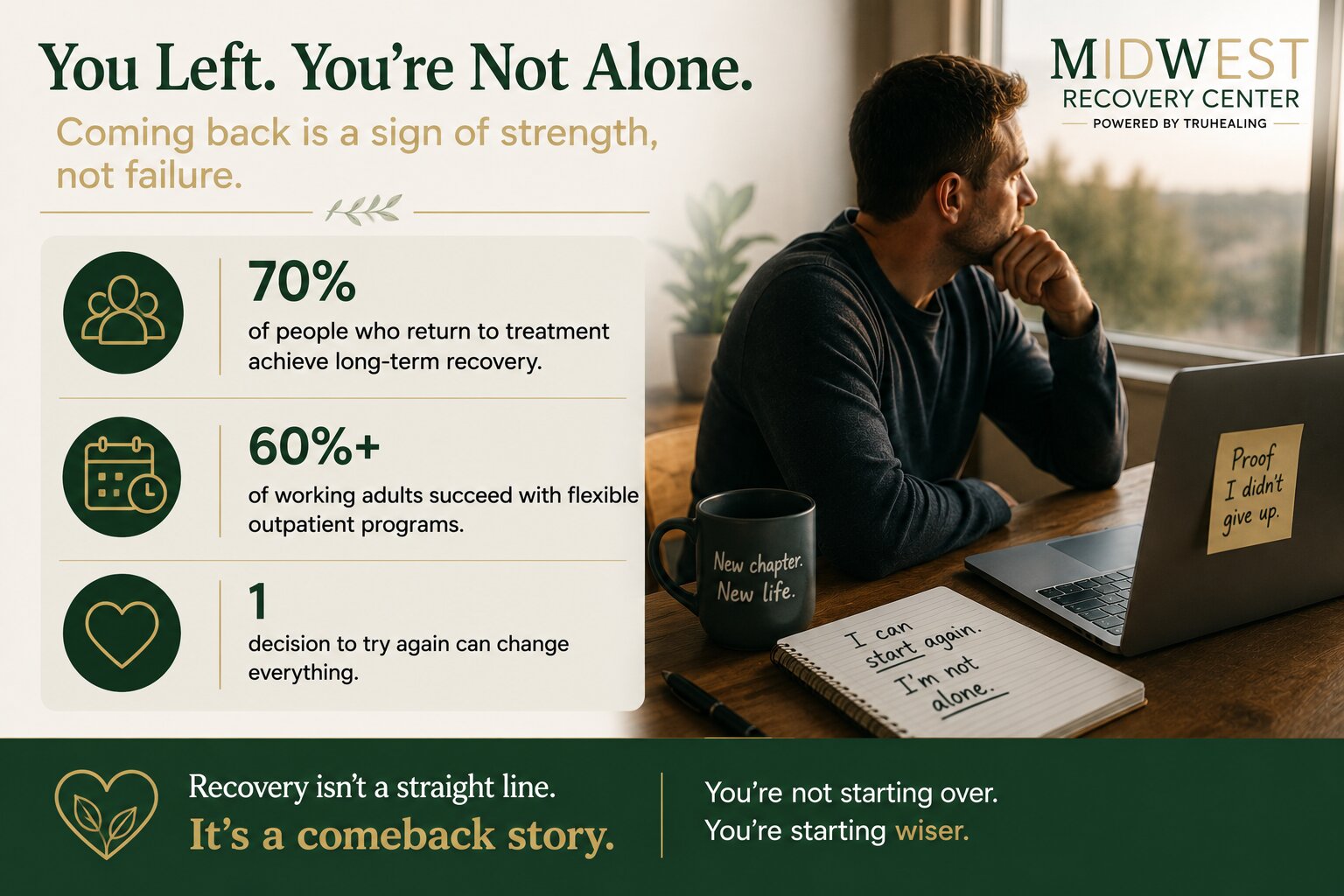
Absolutely. Many people who achieve long-term recovery have experienced interruptions in treatment along the way.
What’s the first step?
The first step is often a conversation. You don’t have to solve everything today. You only need enough willingness to ask a question.
The Next Chapter Doesn’t Have to Repeat the Last One
Leaving treatment does not mean your story is over.
It doesn’t mean recovery isn’t possible.
It doesn’t mean you’ve ruined your chances.
Sometimes people need another attempt.
Another conversation.
Another opportunity.
The future isn’t created by what happened six months ago.
It’s created by what happens next.
Call (833) 657-0858 or visit our Intensive Outpatient Program services to learn more about our Intensive Outpatient Program services Cincinnati, Ohio.