
Some Januarys hit with a spark.
Others arrive quietly—with that strange mix of expectation, fatigue, and the sneaking question:
Shouldn’t I feel more excited about this by now?
If you’ve been sober for a while and the new year feels more “meh” than meaningful… I want you to know something:
You’re not alone. You’re not failing. You’re not broken.
Sobriety is a gift—but it’s not a constant high.
And if you’re feeling stuck, emotionally flat, or quietly disconnected, that’s not a sign you’ve gone backward. It might just be a nudge that it’s time to reconnect—to yourself, your why, your people.
At Midwest Recovery Center, the goal of alcohol addiction treatment was never just to get us clean.
It was to help us build a life worth returning to.
A life that can still hold us in the quiet seasons.
Here’s how we keep coming back to that.
The High of Early Sobriety Fades. That Doesn’t Mean It’s Over.
When I first got sober, everything was intense.
The first full night of sleep. The taste of black coffee. Crying in group. Laughing and meaning it. Texting someone at 2am instead of drinking.
It was raw. It was real. It was electric.
But two, three, five years later? That electricity dulled.
And I thought something was wrong with me.
What I didn’t realize was that early sobriety is a kind of survival mode—and when things stabilize, you’re left to figure out how to live.
The buzz wears off. The world quiets down. And you’re faced with real life: laundry, taxes, grocery runs, relationships that don’t fix themselves.
That’s not failure. That’s phase two.
Alcohol Addiction Treatment Was the Floor—Not the Ceiling
I once heard a clinician at Midwest Recovery say:
“Sobriety isn’t the prize. It’s the starting point.”
And that changed everything.
Because for a while, I treated recovery like a finish line. I hit my one-year chip and thought, Now what?
The truth is, that “now what” is the whole point.
Alcohol addiction treatment gave me the skills to stay sober.
But it also helped me rebuild my inner world—piece by piece.
It helped me notice when the flatness meant I was disconnected.
It reminded me that when I stop reaching out, I start shutting down.
That’s why, even years later, I still lean on the tools. I still check in with my group. I still journal. I still return.
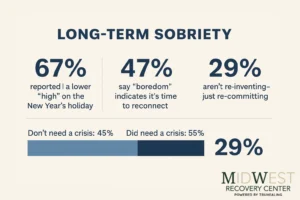
You Don’t Need a Crisis to Reconnect
A lot of long-term alumni think they have to fall apart to ask for help again. That unless you’re back to day-one drinking, you don’t “deserve” support.
That’s not true.
I’ve walked into Midwest Recovery Center’s outpatient program in Toledo during good months—just because I felt a little off. I’ve texted alumni peers in Maumee and Perrysburg, Ohio just to say, “Hey, I’m feeling disconnected. You too?”
And almost every time, someone replies:
“Same. Let’s talk.”
You don’t need to be in relapse to return.
You just need to be honest.
That’s recovery, too.
Boredom Isn’t Failure. It’s a Fork in the Road.
Sometimes, I confuse “I’m bored” with “I must be doing something wrong.”
But boredom is just information.
It’s a sign you’re ready to evolve, shift, stretch into a new season of growth.
And alcohol addiction treatment gives you a structure to do that without burning it all down.
So if your life feels steady—but stale—don’t panic.
Ask yourself:
- When’s the last time I created something?
- Am I numbing again—just with screens or food instead of booze?
- Who am I talking to lately who gets it?
Flatness might not be failure.
It might be the sign it’s time to grow again.
You’re Not the Same Person Who Started This
One of the weirdest parts of long-term recovery is realizing you’ve outgrown parts of your identity—but you don’t know what replaces them.
You’re not the chaos.
You’re not the newly-sober success story anymore either.
You’re just… here. Living.
That middle space is disorienting.
For me, that’s where Midwest Recovery helped most—not just at the start, but in the years after. Because recovery isn’t one arc. It’s a series of circles. You keep coming back—deeper, wiser, more honest each time.
It’s Okay to Recommit Without Reinventing
The world loves a New Year, New You story.
But what if you don’t want a new you?
What if you just want to feel close to the you that’s already here?
This year, I’m not chasing reinvention. I’m returning.
To the basics that worked: connection, movement, silence, truth.
To the relationships that hold me without pressure.
To the person I became in those first treatment sessions—raw, ready, scared, open.
And if you’re in Oregon, Ohio, or anywhere near Toledo, I hope you know: that space still exists. You can walk back into it anytime.
FAQs for the Quiet Middle of Recovery
I’ve been sober for years. Why do I feel numb?
Because numbness is a human emotion—not just a withdrawal symptom. When the chaos settles, we sometimes meet the quieter stuff: grief, disconnection, uncertainty. It’s normal. It’s not a sign you’re “slipping.”
Can I return to treatment even if I’m not using?
Absolutely. Many long-term alumni revisit therapy, group sessions, or outpatient services to process life changes, emotional ruts, or spiritual flatness. You don’t need a relapse to deserve support.
Is boredom a sign I’m doing something wrong?
Not necessarily. It could mean you’re ready for more depth, more challenge, or more purpose. It’s often the nudge we need to reconnect—not a red flag.
What does support look like after 2, 3, or 5 years?
It might mean joining alumni meetups, seeing a therapist again, revisiting expressive outlets like journaling or creative work. It could also mean leading others—sponsorship, mentoring, or simply being real in a group.
I feel guilty that recovery isn’t lighting me up anymore. Is that normal?
Yes. The emotional high of early sobriety fades. That’s natural. But meaning can still grow in the steady parts. Guilt has no place in a process that’s already so brave.
Ready to Return—No Reinvention Required
You don’t need to become someone new this year.
You just need to come home to yourself.
Whether it’s been six months or six years since your last group, you’re welcome here.
Whether you’re thriving or flatlining emotionally, we’ve got space for you.
Because alcohol addiction treatment isn’t a one-time fix.
It’s a foundation we return to—again and again.
Call (888) 657-0858 or visit Midwest Recovery Center’s Alcohol Addiction Treatment page to reconnect with the support you already earned.