
I remember sitting in my car after work one Tuesday evening, staring at my steering wheel longer than usual.
I wasn’t having a breakdown.
I wasn’t in crisis.
I wasn’t even sure I had a drinking problem.
What I knew was this:
I was tired.
Not physically tired.
The kind of tired that comes from carrying a secret.
The kind of tired that comes from constantly asking yourself whether you’re still in control.
The kind of tired that makes you search treatment websites late at night and immediately close them when reality starts feeling too real.
If you’re reading this, there’s a good chance you’ve had similar moments.
Maybe you have a career you’re proud of.
Maybe people depend on you.
Maybe your calendar is packed with meetings, deadlines, family responsibilities, and commitments.
From the outside, everything looks fine.
Inside, however, you’re beginning to wonder how long you can keep doing this.
For many high-functioning professionals, the biggest barrier isn’t admitting alcohol has become a problem.
It’s believing they can get help without sacrificing everything they’ve built.
That fear kept me stuck for much longer than I want to admit.
Eventually, my search led me to explore evening recovery support options, and it completely changed the way I thought about recovery.
The People Searching for Help Are Often Still Successful
One of the biggest myths I believed was that treatment was only for people whose lives were falling apart.
People who had lost everything.
People in obvious crisis.
People whose struggles were impossible to hide.
That belief was comforting.
Because if treatment was only for those people, then I could keep telling myself I didn’t need it.
The problem was that my reality didn’t match my story.
I was succeeding professionally.
But success and wellness are not the same thing.
I was showing up to work.
But I wasn’t showing up fully in my life.
I was meeting deadlines.
But I wasn’t sleeping well.
I was earning promotions.
But I was becoming increasingly dependent on alcohol to manage stress, anxiety, frustration, boredom, and even celebration.
Many of the people I eventually met in recovery had similar experiences.
They weren’t failing at life.
They were exhausted from maintaining it.
The Fear Was Never About Treatment
It Was About Exposure
When I finally started considering treatment, my biggest fear wasn’t stopping drinking.
It wasn’t therapy.
It wasn’t recovery.
It was being seen.
I worried about what coworkers would think.
I worried about what my boss would think.
I worried about whether people would view me differently.
For high-achieving people, identity becomes deeply connected to competence.
We become the reliable one.
The responsible one.
The dependable one.
The person who always has it together.
Admitting we need help can feel like threatening that identity.
But here’s what I eventually realized:
Pretending I had everything together was taking more energy than getting help ever would.
I spent years protecting an image while quietly struggling behind it.
The image stayed intact.
I didn’t.
Why High-Functioning Drinking Is So Easy to Rationalize
High-functioning people are often incredibly skilled at finding reasons not to change.
I know because I was an expert at it.
I told myself:
- I never drank before work.
- I never missed a deadline.
- I paid my bills.
- I took care of my responsibilities.
- Nobody was complaining.
- Things weren’t “that bad.”
The problem is that addiction rarely asks whether you’re successful.
It asks whether it can keep growing unnoticed.
Many people think the absence of consequences means the absence of a problem.
That’s not always true.
Sometimes consequences arrive slowly.
Like rust.
You don’t notice it day to day.
Then one day you realize something important has been deteriorating for a long time.
I Kept Waiting for a Bigger Problem
This is another mistake many professionals make.
We tell ourselves we’ll get help later.
After the next project.
After the next promotion.
After the holidays.
After things calm down.
After one more month.
The problem is that life rarely becomes less busy.
There is always another responsibility.
Another deadline.
Another reason to postpone the conversation.
I kept waiting for a moment when getting help would be convenient.
It never arrived.
What arrived instead was the realization that alcohol was quietly becoming part of every solution I had for stress.
That realization mattered.
Because if alcohol is becoming the answer to every problem, eventually it becomes a problem itself.
Why Keeping My Job Became an Advantage
Before exploring treatment, I assumed employment was an obstacle.
I thought work and recovery were competing priorities.
I was wrong.
Work actually provided structure.
Routine.
Purpose.
Accountability.
The issue wasn’t my job.
The issue was believing my only treatment option involved disappearing from my life entirely.
For many people, recovery can fit around responsibilities rather than replacing them.
Learning that changed everything for me.
Suddenly I wasn’t choosing between my career and my health.
I was finding a way to support both.
The Evening Schedule Changed My Thinking
I almost never made the call.
Not because I didn’t need help.
Because I thought treatment only happened during work hours.
That assumption kept me stuck.
I imagined explaining extended absences.
I imagined losing opportunities.
I imagined jeopardizing everything I had worked so hard to build.
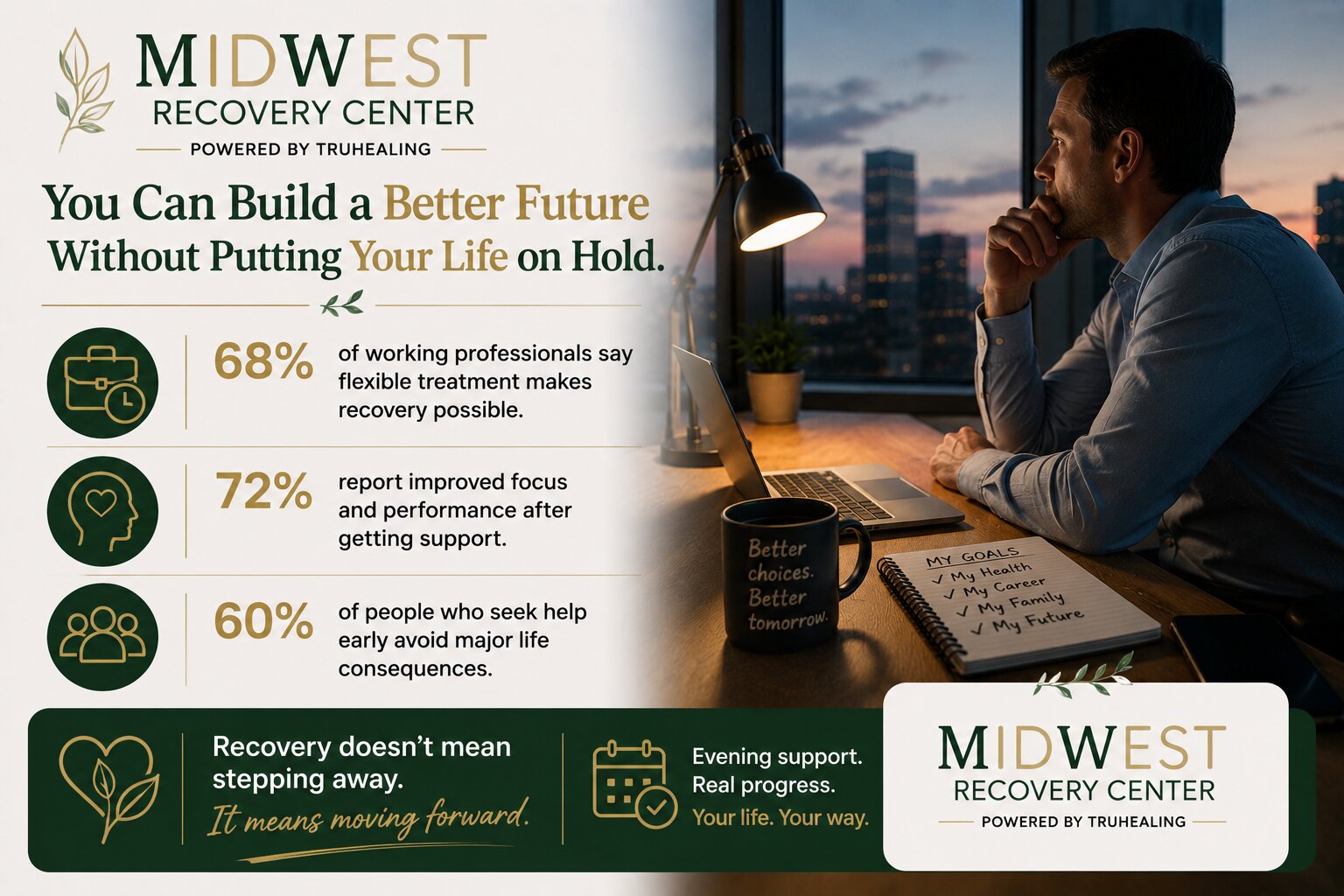
Then I learned that some people participate in multi-day weekly treatment during evening hours.
That discovery felt like someone had opened a door I didn’t know existed.
For the first time, recovery felt realistic.
Not because it was easy.
Because it felt possible.
And sometimes possibility is enough to get someone moving.
Alcohol Was Taking More Than I Realized
One thing I didn’t understand until I stopped drinking was how much space alcohol occupied in my life.
Not just the drinking itself.
The planning.
The recovery.
The worrying.
The hiding.
The negotiating.
The guilt.
The promises.
The mental calculations.
The constant effort of managing something I claimed wasn’t a problem.
I spent years measuring the wrong things.
I measured whether I kept my job.
I measured whether I paid my bills.
I measured whether anyone confronted me.
I wasn’t measuring peace.
I wasn’t measuring energy.
I wasn’t measuring emotional freedom.
Once alcohol stopped dominating my mental landscape, I realized how much of my attention it had been stealing.
What I Found Instead
I expected treatment to focus entirely on drinking.
Instead, I found conversations about stress.
Perfectionism.
Relationships.
Boundaries.
Anxiety.
Identity.
Burnout.
Many high-functioning people discover that alcohol isn’t the only thing they need to address.
It’s often connected to larger patterns.
Patterns that existed long before drinking became a concern.
Recovery gave me tools I didn’t know I needed.
Not just for sobriety.
For life.
The Question Beneath the Search
Most people searching for outpatient rehab Toledo Ohio information aren’t just looking for a program.
They’re looking for permission.
Permission to admit they’re struggling.
Permission to ask questions.
Permission to believe they don’t have to wait until everything falls apart.
If that’s you, consider this your permission.
You do not need to hit rock bottom.
You do not need to lose your job.
You do not need a dramatic story.
You only need enough honesty to acknowledge what you’re experiencing.
And enough courage to explore your options.
What If You’re Not Sure Yet?
That’s okay.
Many people aren’t.
Most people who eventually get help spend weeks or months thinking about it first.
The important thing is not forcing certainty.
The important thing is staying curious.
Ask questions.
Learn about your options.
Have conversations.
Explore possibilities.
Whether you’re looking for help in locations or exploring support available in Youngstown, remember that gathering information does not commit you to a decision.
It simply helps you make a better one.
Frequently Asked Questions
Can I keep working while getting treatment?
Many people seek support while continuing to work. Treatment recommendations depend on individual needs, but work and recovery are not always mutually exclusive.
Will my employer know if I seek help?
Confidentiality rules generally protect personal healthcare information. Treatment providers can discuss privacy concerns in more detail.
What if I don’t think my drinking is severe enough?
You do not need to wait for catastrophic consequences to explore support. Many people seek help long before reaching a crisis point.
Can evening treatment really be effective?
Many individuals benefit from treatment schedules that allow them to continue meeting professional and family responsibilities.
What if I am the primary provider for my family?
This is one of the most common concerns professionals express. Discussing your specific situation with a treatment provider can help identify realistic options.
Is it common for successful professionals to need treatment?
Yes. Substance use disorders affect people from every profession, income level, and educational background.
What if I feel embarrassed?
Embarrassment is extremely common. Many people feel shame before reaching out. Asking for help often becomes easier once the first conversation happens.
How do I know when it’s time?
If alcohol is taking up increasing mental space, affecting relationships, creating stress, or becoming difficult to control, it may be worth exploring support.
What if I’ve tried to quit on my own before?
Many people attempt to manage alcohol use independently before seeking professional support. Previous attempts do not determine future outcomes.
What happens if I call?
Often, the first step is simply a conversation about your situation, concerns, and available options. You can ask questions and gather information without making immediate commitments.
You Don’t Have to Choose Between Success and Recovery
For years, I believed asking for help would cost me everything I had built.
What I eventually discovered was the opposite.
Recovery helped me protect the things I cared about most.
My career. My relationships. My health. My future.
You don’t have to wait until everything falls apart to take your concerns seriously.
And you don’t have to choose between responsibility and recovery.
Call (833) 657-0858 or visit our Intensive Outpatient Program services to learn more about our Intensive Outpatient Program services Cincinnati, Ohio.