
How Recovery Can Begin Before Someone Believes in It

How Recovery Can Begin Before Someone Believes in It

If you’re reading this, there’s a good chance you’ve had the same conversation more times than you can count.

Maybe your son promises he’ll cut back.

Maybe he says he’s fine.

Maybe he insists that everyone is overreacting.

Then a few days later, you find another bottle.

Another excuse.

Another reason to worry.

For many parents, one of the most discouraging moments comes when they suggest a recovery meeting and hear an immediate “No.”

No interest.

No discussion.

No willingness to consider it.

At that point, many parents begin asking a painful question:

“If he won’t even go to a meeting, how could treatment possibly help?”

At Midwest Recovery Center, we’ve spoken with many families carrying this exact fear. Often, they assume that refusing meetings means their loved one has no interest in recovery.

Fortunately, that isn’t always true.

In fact, some of the people who eventually build strong, lasting recovery foundations once rejected nearly every suggestion their families offered.

If you’re researching options and wondering whether live-in treatment options can still help someone who refuses meetings, it’s important to understand what recovery often looks like in real life—not just in movies or success stories.

Why Parents Often Connect Meetings With Recovery

Most families encounter recovery through familiar images.

Support groups.

Recovery meetings.

People sharing their stories.

Someone celebrating sobriety milestones.

Because those images are so common, it’s understandable that parents begin associating meetings with recovery itself.

Over time, it can start to feel as though refusing one automatically means rejecting the other.

But recovery is much larger than any single approach.

Meetings help many people.

They provide community, accountability, encouragement, and shared experience.

For some individuals, they become an essential part of long-term recovery.

For others, they are one piece of a larger process.

And for some people, they are not the first step that opens the door.

The important thing to understand is that a person can resist meetings and still be struggling internally with their substance use.

They can reject a specific solution while still knowing something needs to change.

Resistance Often Looks Different Than Parents Expect

One mistake many families make is assuming resistance means their child doesn’t care.

In reality, resistance can come from many places.

Fear.

Shame.

Embarrassment.

Hopelessness.

Pride.

Confusion.

Imagine being a young adult who secretly suspects alcohol has become a problem.

Now imagine admitting that concern out loud.

For many people, that feels terrifying.

Accepting help can feel like accepting a new identity.

And many young adults are not ready for that conversation.

Instead, they push back.

They argue.

They avoid.

They dismiss.

From the outside, it looks like indifference.

Inside, it may feel very different.

The behavior isn’t healthy.

But understanding it can help families respond with greater clarity and less frustration.

Why Some People Reject Meetings Before They’ve Ever Attended One

Parents often tell us:

“He won’t even try one.”

That can feel incredibly discouraging.

But consider this:

Many people reject recovery meetings based entirely on assumptions.

They imagine being judged.

They imagine sitting in a room full of strangers.

They imagine being forced to speak.

They imagine being labeled.

They imagine losing control.

Most of those fears are based on imagination rather than experience.

The same thing happens with treatment.

People often fear what they have never actually experienced.

That fear can create resistance long before someone has enough information to make an informed decision.

What Treatment Can Offer That Meetings Alone Cannot

Recovery meetings provide valuable peer support.

Treatment often serves a different purpose.

For many individuals, alcohol use isn’t happening in isolation.

It may be connected to:

  • Anxiety
  • Depression
  • Trauma
  • Family conflict
  • Stress
  • Low self-worth
  • Difficulty regulating emotions

Sometimes drinking is the visible problem.

Sometimes it’s also the coping strategy covering other struggles underneath.

When mental health and substance use collide, recovery often requires more than simply stopping alcohol.

It requires understanding why alcohol became important in the first place.

That’s one reason some people who resist meetings may still benefit from a structured treatment environment where they can begin exploring those deeper issues.

Motivation Is Often Built, Not Found

This is one of the most important things families need to understand.

Many parents assume treatment only works for people who are highly motivated.

The reality is often much different.

Motivation changes.

Sometimes daily.

Sometimes hourly.

People arrive at treatment carrying all kinds of emotions.

Hope.

Fear.

Anger.

Skepticism.

Frustration.

Some are fully committed.

Others are deeply uncertain.

What matters is not whether someone arrives completely convinced.

What matters is whether they engage enough to begin learning, exploring, and participating.

Motivation often grows after people begin experiencing small successes.

Not before.

This surprises many families.

They expect belief to come first.

Often, belief follows progress.

What Parents Are Usually Looking For

When parents search online for help for alcoholic son concerns, they are rarely looking for a textbook explanation.

They’re looking for reassurance.

They want to know whether it’s too late.

They want to know whether recovery is still possible.

They want to know whether treatment can help someone who doesn’t seem fully committed.

The answer is that recovery is rarely as black-and-white as people imagine.

Many individuals who eventually thrive in recovery did not begin their journey feeling inspired.

They began feeling exhausted.

Confused.

Defensive.

Scared.

The starting point often matters far less than the direction someone eventually begins moving.
Can Recovery Start Before Someone Is Ready

Why Environment Can Change Everything

One challenge families face is that home environments often contain reminders of old habits.

Old routines.

Old stressors.

Old triggers.

Old patterns.

Imagine trying to learn a new language while everyone around you continues speaking the old one.

Change becomes much harder.

A structured environment creates space between the individual and some of those influences.

It provides time to focus.

Time to think.

Time to practice new skills.

Time to experience life without the constant pressure of maintaining old habits.

That distance can be incredibly valuable for people who have struggled to make changes on their own.

What If My Son Says Treatment Is Pointless?

We hear this concern frequently.

Parents often become discouraged when their son insists treatment won’t work.

But many people enter treatment believing exactly that.

They don’t arrive optimistic.

They don’t arrive excited.

They don’t arrive convinced.

They arrive because something isn’t working.

And over time, they begin discovering possibilities they couldn’t see before.

A person’s opinion about treatment before experiencing it is not always a reliable predictor of what happens afterward.

People change.

Perspectives change.

Recovery often begins with uncertainty.

What Parents Can Do Right Now

When someone you love is struggling, it’s natural to want a solution.

A script.

A perfect sentence.

A breakthrough moment.

Unfortunately, addiction rarely responds to perfect speeches.

What tends to help more is consistency.

Clear boundaries.

Calm communication.

Professional guidance.

Patience.

And perhaps most importantly, recognizing that you cannot force recovery.

You can encourage it.

Support it.

Create opportunities for it.

But ultimately, your role is not controlling the outcome.

Your role is helping create conditions where change becomes possible.

Hope Is Not the Same as Denial

Sometimes parents worry that being hopeful means ignoring reality.

It doesn’t.

Hope and honesty can exist together.

You can acknowledge that your son is struggling.

You can acknowledge that meetings are being refused.

You can acknowledge that things feel uncertain.

And you can still believe recovery remains possible.

The most effective hope is not blind optimism.

It’s informed hope.

Hope grounded in the reality that people recover every day.

Hope grounded in the reality that resistance can soften.

Hope grounded in the reality that today’s refusal does not automatically determine tomorrow’s choices.

Families exploring treatment options in locations or seeking additional support in Youngstown often discover that recovery is far more flexible than they originally imagined.

And sometimes, that’s exactly what families need to hear.

Frequently Asked Questions

Can treatment help someone who refuses AA meetings?

Yes. Many people enter treatment despite being resistant to meetings. Recovery can involve multiple approaches, and treatment often helps individuals explore what support works best for them.

Does refusing meetings mean my son is in denial?

Not necessarily. Some people resist meetings because of fear, stigma, misconceptions, or discomfort rather than complete denial of the problem.

What if my son says he doesn’t have a drinking problem?

This is common. Professional assessment can sometimes help individuals gain greater insight into how alcohol is affecting their lives.

Can someone recover without attending AA?

Recovery pathways vary. While many people benefit from meetings, different individuals connect with different forms of support and treatment.

Why does my son hide alcohol?

Hidden alcohol often reflects attempts to avoid conflict, shame, or consequences. It can also indicate that alcohol use has become difficult to control.

What should I say when he refuses help?

Focus on expressing concern rather than arguing. Calm, consistent conversations are often more productive than repeated confrontations.

Is treatment only for people who want it?

Many individuals begin treatment feeling uncertain. Motivation can develop throughout the recovery process rather than existing fully beforehand.

Can families be involved in treatment?

Family involvement is often an important part of recovery and rebuilding trust, depending on individual circumstances and treatment plans.

How do I know when professional help is needed?

If alcohol use is affecting health, relationships, safety, employment, education, or daily functioning, professional evaluation may be beneficial.

Is there still hope if this is our first attempt?

Absolutely. Many people achieve meaningful recovery after their first experience with treatment. Every recovery journey begins somewhere.

One Refusal Does Not Define the Future

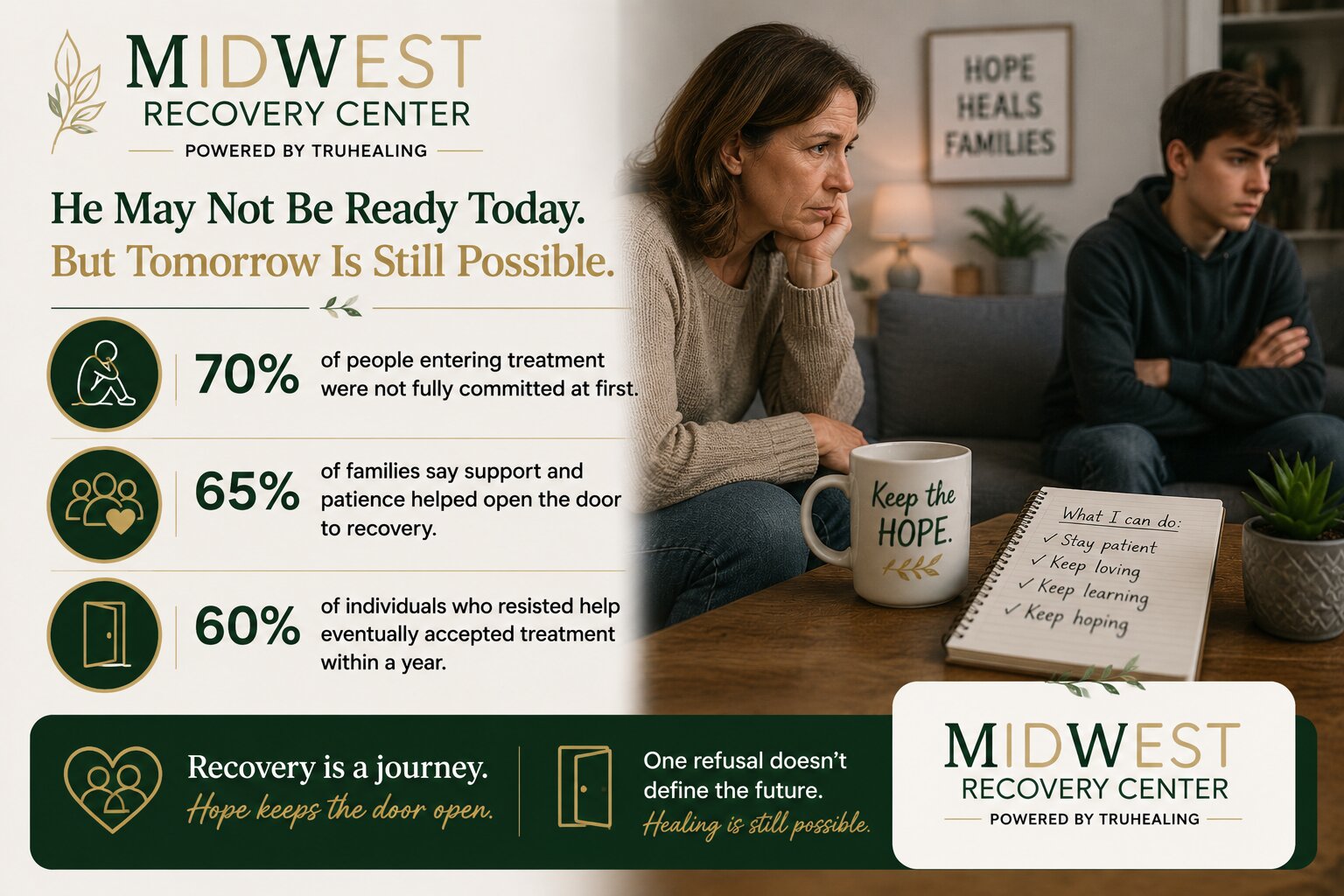
If your son refuses meetings today, it may feel like every door is closing.

But recovery rarely unfolds in a straight line.

People change.

Attitudes change.

Perspectives change.

Sometimes the person who refuses help today becomes the person who asks for it tomorrow.

And sometimes recovery begins long before someone realizes they’re ready.

Call (833) 657-0858 or visit our residential treatment program services to learn more about our residential treatment program services Cincinnati, Ohio.

*The stories shared in this blog are meant to illustrate personal experiences and offer hope. Unless otherwise stated, any first-person narratives are fictional or blended accounts of others’ personal experiences. Everyone’s journey is unique, and this post does not replace medical advice or guarantee outcomes. Please speak with a licensed provider for help.

Level Of Care

PHP (Partial Hospitalization Program)
Daytime treatment with structure, therapy, and support—return home each night.

IOP (Intensive Outpatient Program)
Flexible therapy a few days a week to balance life and recovery.

OP (Outpatient Program)
Ongoing therapy and support to maintain progress.

MAT (Medication-Assisted Treatment)
Evidence-based care using medication and counseling to reduce cravings.

Ready to Start?
Call (833) 657-0858: to learn which program fits your recovery goals.

Who are you seeking help for? *

We’re here to listen and help you find the right path forward. Please tell us who needs care so we can match you with the best program and support.

💬 Your responses are 100% confidential and never shared outside our admissions team.

Recovery Shouldn’t Have to Wait — Begin Treatment Today.

At Ohio Treatment Center in Toledo, Ohio, we make it simple to take that first step toward healing. Our streamlined admissions process can often lead to same-day placement in treatment for MAT, PHP, IOP and more..

Call today for a free, confidential consultation with our caring admissions team — we’ll walk you through every step with compassion and clarity.

Call (833) 657-0858
Why call us?

Check Your Insurance Coverage in Minutes

We’ll handle the insurance details — so you can focus on getting better.

At Ohio Treatment Center, we work with most major private insurance providers to make treatment affordable and accessible. Complete our quick, confidential form below, and we’ll let you know if your plan is in-network — without contacting your insurance company.

Commonly accepted providers include:
Blue Cross Blue Shield (BCBS) • Aetna • Cigna • UnitedHealthcare • Humana • Anthem • Tricare

What Happens Next

  • Fill out the short form below
  • Our team reviews your benefits
  • We’ll contact you with your coverage details

Getting help shouldn’t be stressful. Let’s find out what your insurance can cover today.

Level Of Care

Detox
Begin recovery safely with 24/7 medical support. Our detox program helps you manage withdrawal comfortably and prepares you for the next step.

Residential Treatment
Continue healing in a supportive, structured setting with daily therapy, wellness activities, and round-the-clock care.

Aftercare
Before you leave, we’ll help you create a plan for ongoing support and lasting recovery.

Ready to Start?
Call (833) 657-0858: to learn which program fits your recovery goals.

Who are you seeking help for? *

We’re here to listen and help you find the right path forward. Please tell us who needs care so we can match you with the best program and support.

💬 Your responses are 100% confidential and never shared outside our admissions team.

Recovery Shouldn’t Have to Wait — Begin Treatment Today.

At Midwest Detox Center in Maumee, Ohio, we make it simple to take that first step toward healing. Our streamlined admissions process can often lead to same-day placement in treatment for medically supervised detox and residential treatment programs.

Call today for a free, confidential consultation with our caring admissions team — we’ll walk you through every step with compassion and clarity.

Call (833) 657-0858
Why call us?

Check Your Insurance Coverage in Minutes

We’ll handle the insurance details — so you can focus on getting better.

At Midwest Detox, we work with most major private insurance providers to make treatment affordable and accessible. Complete our quick, confidential form below, and we’ll let you know if your plan is in-network — without contacting your insurance company.

Commonly accepted providers include:
Blue Cross Blue Shield (BCBS) • Aetna • Cigna • UnitedHealthcare • Humana • Anthem • Tricare

What Happens Next

  • Fill out the short form below
  • Our team reviews your benefits
  • We’ll contact you with your coverage details

Getting help shouldn’t be stressful. Let’s find out what your insurance can cover today.

Level Of Care

Medical Detox
24/7 medically supervised detox to help you safely withdraw from drugs or alcohol while managing symptoms and preventing complications.

Inpatient Treatment
A structured, residential setting that provides continuous medical care, counseling, and therapeutic support to build a foundation for long-term recovery.

Residential Program
Comfortable, home-like housing where you can focus fully on healing with daily therapy, peer support, and holistic recovery services.

Ready to Start?
Call (833) 657-0858: to learn which program fits your recovery goals.

Who are you seeking help for? *

We’re here to listen and help you find the right path forward. Please tell us who needs care so we can match you with the best program and support.

💬 Your responses are 100% confidential and never shared outside our admissions team.

Recovery Shouldn’t Have to Wait — Begin Detox Today

At Ohio Detox Center in Maumee, Ohio, we make it simple to take that first step toward healing. Our streamlined admissions process can often lead to same-day placement in detox or inpatient treatment for substance use and co-occurring mental health conditions.

Call today for a free, confidential consultation with our caring admissions team — we’ll walk you through every step with compassion and clarity.

Call (833) 657-0858
Why call us?

Check Your Insurance Coverage in Minutes

We’ll handle the insurance details — so you can focus on getting better.

We’ll take care of the details — so you can focus on getting better.
At Ohio Detox Center, we work with Ohio Medicaid and most major insurance providers to make treatment affordable and accessible.

Here’s how it works:

  1. Fill out the short form below
  2. Our team reviews your benefits
  3. We’ll contact you with your coverage details

Getting help shouldn’t be stressful. Let’s find out what your insurance can cover today.

Levels of Care

Detox
We understand that taking the first step can feel overwhelming. Our detox program offers a compassionate, medically supported environment where you can rest, heal, and begin recovery safely. You’ll never go through it alone — our team is with you every step of the way.

IOP (Intensive Outpatient Program)
A flexible treatment option that lets you maintain work, school, or family responsibilities while attending therapy several days a week. IOP focuses on relapse prevention, coping skills, and long-term recovery through group and individual sessions.

Residential
Residential care gives you the time and space to focus fully on healing. Surrounded by supportive staff and peers, you’ll work through underlying causes of addiction, rebuild healthy routines, and rediscover confidence in your recovery journey.

MAT (Medication-Assisted Treatment)
Combining FDA-approved medications with counseling and behavioral therapy, MAT helps reduce cravings and withdrawal symptoms related to opioid or alcohol use. Each treatment plan is closely monitored to ensure comfort, safety, and lasting recovery.

Ready to Start?
Call (833) 657-0858: to learn which program fits your recovery goals.

Who are you seeking help for? *

We’re here to listen and help you find the right path forward. Please tell us who needs care so we can match you with the best program and support.

Myself

A loved one or family member

💬 Your responses are 100% confidential and never shared outside our admissions team.

Check Your Insurance Coverage in Minutes

We’ll handle the insurance details — so you can focus on getting better.

At Midwest Centers at Youngstown, we work with most major private insurance providers to make treatment affordable and accessible. Complete our quick, confidential form below, and we’ll let you know if your plan is in-network — without contacting your insurance company.

Commonly accepted providers include:
Blue Cross Blue Shield (BCBS) • Aetna • Cigna • UnitedHealthcare • Humana • Anthem • Tricare

What Happens Next

  • Fill out the short form below
  • Our team reviews your benefits
  • We’ll contact you with your coverage details

Getting help shouldn’t be stressful. Let’s find out what your insurance can cover today.

Recovery Shouldn’t Have to Wait — Begin Treatment Today.

At Midwest Centers at Youngstown in Ohio, we make it simple to take that first step toward healing. Our streamlined admissions process can often lead to same-day placement in treatment for substance use or co-occurring mental health disorders.

Call today for a free, confidential consultation with our caring admissions team — we’ll walk you through every step with compassion and clarity.

Level Of Care

Partial Hospitalization Program (PHP)
Our PHP offers a highly structured, supportive environment where you can focus on recovery during the day and return home at night. It’s an ideal step between inpatient and outpatient care, providing daily therapy, accountability, and a strong recovery routine.

Intensive Outpatient Program (IOP)
Our IOP gives you the flexibility to continue work, school, or family life while receiving evidence-based treatment several days a week. You’ll participate in group and individual therapy focused on relapse prevention, coping skills, and long-term healing.

Outpatient Program (OP)
For those transitioning from a higher level of care or seeking ongoing support, our outpatient program offers continued therapy at a pace that fits your lifestyle. It’s a supportive bridge that helps you maintain recovery and stay connected to care.

Medication-Assisted Treatment (MAT)
MAT combines FDA-approved medications with therapy and counseling to reduce cravings and support long-term recovery from opioid or alcohol addiction. Our team monitors each plan closely to ensure safety, comfort, and effectiveness.

Ready to Start?
Call (833) 657-0858: to learn which program fits your recovery goals.

Who are you seeking help for? *

We’re here to listen and help you find the right path forward. Please tell us who needs care so we can match you with the best program and support.

Myself

A loved one or family member

💬 Your responses are 100% confidential and never shared outside our admissions team.

Recovery Shouldn’t Have to Wait — Begin Treatment Today.

At Midwest Recovery Center in Toledo, Ohio, we make it simple to take that first step toward healing. Our streamlined admissions process can often lead to same-day placement in treatment for substance use or co-occurring mental health disorders.

Call today for a free, confidential consultation with our caring admissions team — we’ll walk you through every step with compassion and clarity.

Check Your Insurance Coverage in Minutes

We’ll handle the insurance details — so you can focus on getting better.

At Midwest Recovery Center, we work with most major private insurance providers to make treatment affordable and accessible. Complete our quick, confidential form below, and we’ll let you know if your plan is in-network — without contacting your insurance company.

Commonly accepted providers include:
Blue Cross Blue Shield (BCBS) • Aetna • Cigna • UnitedHealthcare • Humana • Anthem • Tricare

What Happens Next

  • Fill out the short form below
  • Our team reviews your benefits
  • We’ll contact you with your coverage details

Getting help shouldn’t be stressful. Let’s find out what your insurance can cover today.