
When you love someone in active addiction, the relationship starts to feel like walking through a minefield barefoot. You try to predict their moods, protect them from the fallout, and keep the house (and your heart) from burning down again.
You might be holding everything together on the outside—but inside, you’re exhausted, confused, and wondering if you’re doing any of this right.
The good news? The cycle isn’t permanent. The bad news? It doesn’t break on its own.
That’s where CBT comes in.
Cognitive Behavioral Therapy (CBT) isn’t a magic fix. But it is one of the most effective tools we have—for helping people recover, and for helping relationships stabilize when addiction has shaken the foundation.
Let’s walk through how CBT works and why it might be the quiet key to healing—for them, and for you.
What Is CBT and Why Does It Work in Relationships?
CBT stands for Cognitive Behavioral Therapy. It’s a form of therapy that focuses on the connection between thoughts, feelings, and behaviors. In simple terms: what we think affects what we do—and what we do affects how we feel.
In relationships impacted by addiction, this matters more than most people realize.
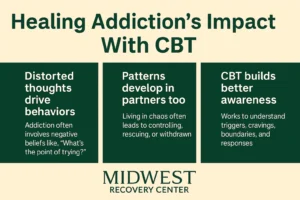
Because when someone is deep in their use—or even early in recovery—they’re often driven by distorted thoughts:
- “I already messed up, so what’s the point?”
- “If I tell the truth, they’ll leave me.”
- “They don’t really love me. They just want to control me.”
These thoughts lead to self-sabotage, avoidance, emotional explosions, and relapse. CBT helps identify those thoughts early—before they turn into destructive behaviors.
And here’s the part that matters for you, the partner: those same distorted thought patterns often show up in you, too.
Not because you’re flawed. But because you’ve been surviving in chaos.
CBT Isn’t About Blame—It’s About Awareness
If you’ve been in love with someone using substances, you’ve likely developed your own internal script:
- “If I say the wrong thing, they’ll spiral.”
- “It’s not worth starting a fight—they won’t change.”
- “If I don’t fix this, who will?”
These thoughts aren’t dramatic. They’re human. They’re protective. But over time, they shape how you show up in the relationship.
Maybe you’ve become overly controlling. Or painfully quiet. Or resentful. Or numb.
CBT helps you see those patterns for what they are: coping mechanisms that made sense at one time, but might be hurting more than they’re helping now.
And it gives both of you the space to try something different.
How CBT Helps the Person in Recovery
For your partner or spouse, CBT is often one of the first therapies offered in addiction treatment programs. That’s because it doesn’t just focus on the substance—it focuses on the why behind the use.
CBT helps them:
- Recognize triggering thoughts before they escalate
- Understand how emotions drive cravings
- Interrupt shame spirals that lead to relapse
- Respond differently to stress, conflict, or fear
It also gives them language. Instead of hiding or lashing out, they learn how to say:
- “I feel overwhelmed.”
- “I’m craving right now.”
- “I need help staying grounded.”
When communication changes, trust starts to regrow.
How CBT Helps You as the Partner
You may not be in formal therapy—but CBT principles can still transform your daily experience.
CBT helps partners learn how to:
- Separate their own feelings from their partner’s behavior
- Identify when fear or guilt is driving decisions
- Build boundaries that are clear, kind, and firm
- Stop over-functioning in response to addiction chaos
For example: Instead of saying, “You’re ruining everything,” you learn to say, “When you disappear, I feel scared and alone. I need communication if we’re going to rebuild trust.”
CBT gives you a new map—one where you’re not trying to control the storm, but navigating it with clarity.
Rewiring Relationship Patterns Takes Time—But CBT Gives You Tools
It’s common for couples to develop unhealthy patterns when addiction is involved:
- One person chases. The other withdraws.
- One person fixes. The other sabotages.
- One person explodes. The other shuts down.
CBT helps identify these loops. Not by assigning blame—but by asking: What belief is keeping this going? And what could we do instead?
It also creates space for moments that feel different:
- When someone pauses mid-argument and says, “Let’s take five.”
- When a mistake doesn’t lead to days of silence.
- When trust gets rebuilt not with grand gestures, but small consistent actions.
Those moments matter. And they stack up.
But What If It Feels Too Late?
If the relationship feels threadbare, CBT can still help.
You don’t have to know if you’re staying long-term. You don’t have to know what the future holds. CBT doesn’t require commitment—it invites curiosity.
It helps you look at your role in the system (without shame), notice what’s fueling your responses, and start choosing your reactions instead of being ruled by them.
Even if your partner isn’t engaging in therapy yet, learning CBT-based tools yourself can bring peace. Not because you’re responsible for the outcome—but because you deserve to feel stable inside the storm. If you’re in Maumee, Perrysburg, Cincinnati, Ohio, or Lambertville, Michigan, Midwest Recovery provides programs with that same trusted approach.
FAQ: CBT & Relationship Healing Amid Addiction
Can CBT fix our relationship?
CBT is not a magic fix—but it offers structure, insight, and communication tools that many couples say helped them rebuild trust. It’s often a starting point, not the whole journey.
What if my partner isn’t ready for therapy yet?
That’s okay. You can still learn CBT-based tools through support groups, self-help resources, or your own therapy. Sometimes, partners modeling healthy patterns creates the invitation for others to follow.
Is CBT just about thinking positive?
Not at all. CBT is about realism, not toxic positivity. It teaches people to challenge distorted thoughts and replace them with more accurate ones—not just “happy” ones.
Does Midwest Recovery offer CBT as part of addiction treatment?
Yes. Midwest Recovery Center in Toledo integrates CBT into our treatment approach. It’s used in both individual and group therapy settings.
How soon do people see results with CBT?
Many clients notice small changes in the first few weeks—better emotional regulation, more honest conversations, fewer explosive arguments. Long-term patterns take longer to shift, but CBT helps you stay on course.
A Final Thought for Partners Holding the Line
You’ve probably been through more than you’ve admitted out loud.
Maybe you’ve shown up again and again. Maybe you’ve doubted yourself more than once. Maybe you’ve thought, If something doesn’t change, I can’t keep doing this.
You’re not alone. And you’re not powerless.
CBT doesn’t offer instant transformation—but it does offer hope. Real, grounded, slow-building hope.
The kind that says: You can love someone and protect yourself.
You can support recovery without losing yourself in the process.
You can rewrite patterns—one thought, one boundary, one honest conversation at a time.
Want to explore how CBT could help both you and your partner find stability again?
Call (888) 657-0858 to learn more about our CBT services in Toledo, Ohio.