
You stopped drinking younger than most, and instead of relief you got… this: a strange mix of pride, confusion, and awkward loneliness. Your friends still party. Social media looks fluorescent and loud. Sometimes being sober feels like living on a different planet.
And now someone mentioned a residential treatment program, and you’re like:
Isn’t that for people who’ve hit rock bottom? For the folks who’ve lost everything? For old people?
If that feels familiar, you’re not alone.
You might be young and sober—but that doesn’t mean your pain is small. It just means people around you haven’t had to look you in the eye and ask, “Are you okay?”
This isn’t clickbait. This is what actually goes unsaid.
1. You’ll Wonder If You “Belong” – And The Answer Is Yes
Walking into residential treatment as a young adult feels like showing up to a reunion where everyone else got the invite earlier in life.
You might think:
I’m too young for this. I should be fine. I shouldn’t need this.
But what you feel—loneliness, anxiety, shame, confusion—is real. And sometimes being sober exposes pain that’s been buried under distraction for years.
You’re not alone in this room, even if you’re the youngest or the outlier. Healing isn’t about age—it’s about honesty.
Very quickly, you realize that the program isn’t a club you entered by failing. It’s a space where people are learning something few ever get taught: how to live well sober.
And if you’re in or near Youngstown, Ohio, you might be surprised how many young people in care are asking the same questions you are.
2. You Won’t Lose Your Identity—You’ll Find It
One of the biggest fears young people have about residential treatment is that they’ll lose themselves in a bubble of seriousness and sobriety.
Let’s be real—you don’t want to become boring. You don’t want to be the person who nods politely and never jokes again.
Here’s the weird truth: sobriety doesn’t take the fun out of life. It takes the chaos out. And what’s left is you, but clearer—sharper, more present, more alive than you expected.
You’ll find out things like:
- You laugh harder when you’re not hungover
- You remember what you read without rewinding
- You start to feel feelings you forgot existed
Treatment helps you reconnect with your own rhythm, not erase your personality.
3. The Non‑Sober World Will Still Exist—But It Won’t Control You
Before treatment, you might’ve felt your sobriety was fragile—as if one late night, one party invite, one awkward silence could make you fall apart.
In residential treatment, you learn something important: your worth isn’t tied to other people’s choices.
Parties still happen. Weekend drinks still happen. But now you see them through a different lens. You start to ask:
- Do I want that life?
- Or is that what I was told I should want?
- And if I choose a different path, does that make me weird or brave?
Many young people discover that their sober life is not a subtraction—it’s an upgrade. Not everyone will get that right away. And that’s okay.
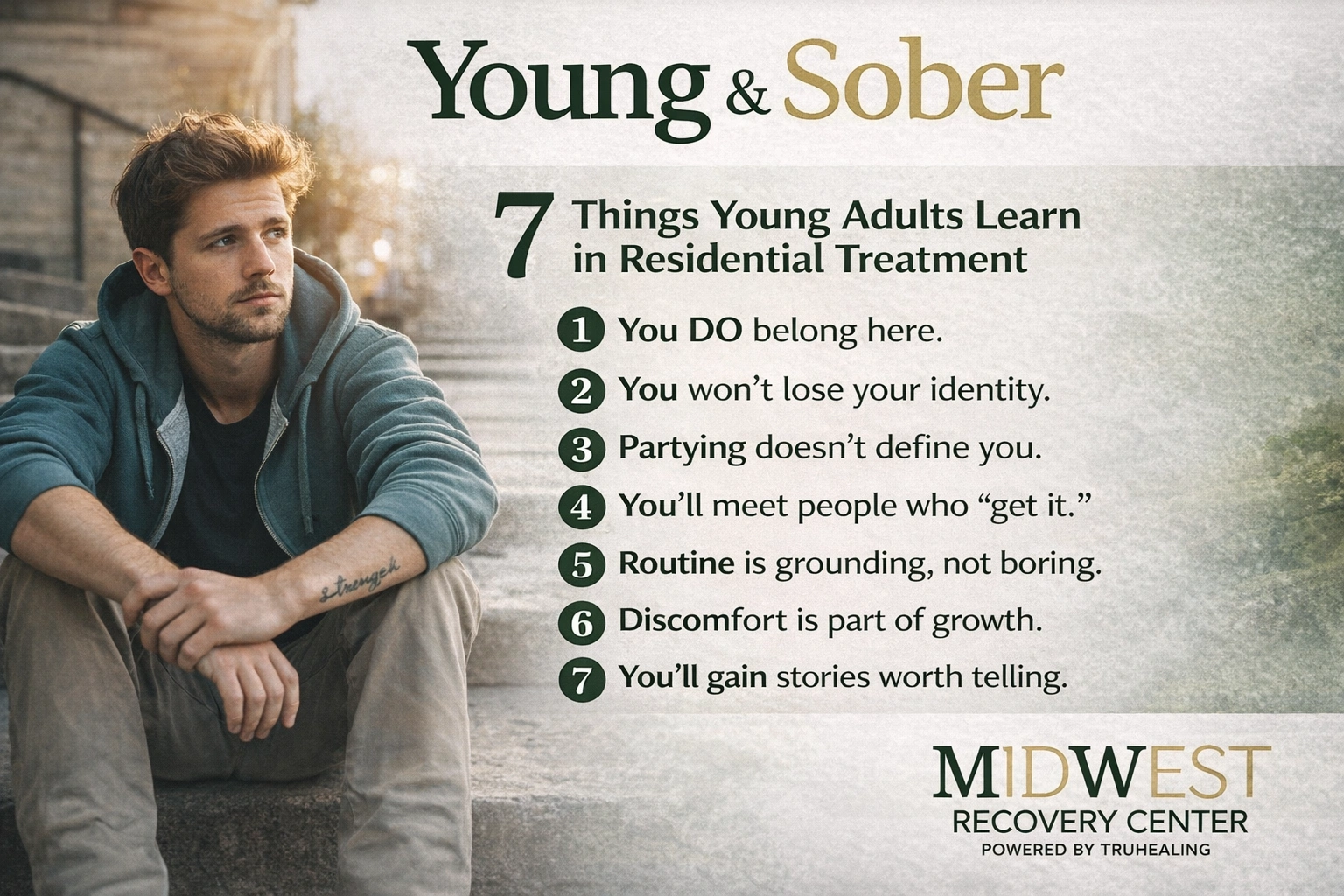
4. You’ll Meet People Who Actually See You
There’s a strange kind of loneliness in being young and sober: you’re surrounded by people, but no one knows what it feels like to carry your particular mix of experience and exhaustion.
In residential treatment, you meet others learning to be human again—people who’ve lived, lost, tried and failed, tried again.
There’s a roommate. A counselor. Someone in group who says something that hits you like a punch and a hug at the same time.
You might even hear something like:
“I thought I was the only one who felt this weird about life.”
And for the first time in a long while, you realize you’re not the only one who feels disoriented by recovery.
This kind of connection? It’s not cheap therapy talk. It’s real.
Some of the community you build may come from places you never expected—people you might not have talked to outside treatment. That’s part of the magic.
5. The Routine Helps More Than You Think
You may have read about structured schedules and thought: Great, another boring calendar.
But structure is healing.
Most days in residential treatment look like this:
- Morning check‑ins that help quiet the voice that says you’re alone
- Group therapy where you hear truths you didn’t know you needed
- Individual sessions where you unpack the story you never told anyone
- Rest time and meals that feel simple, but essential
You start to realize that your old life—fast, chaotic, numbing—wasn’t freedom. It was survival mode.
In treatment, you get to practice living without autopilot. You learn what fills your tank instead of drains it.
And as weird as it sounds, many young people find that routine doesn’t restrict them—it grounds them.
6. Discomfort Isn’t a Sign You’re Failing
Residential treatment will push you. Not harm you—just push you to see what’s under the fear.
You might feel:
- Awkward in group
- Annoyed by clichés
- Vulnerable when someone asks a simple question
- Frustrated that healing doesn’t look like a movie montage
That doesn’t mean you’re failing—far from it.
Growth almost always feels uncomfortable. It’s like stretching a muscle you never knew was tight: it hurts… briefly.
There’s a moment in treatment where discomfort shifts—where you realize:
This was hard because I’m capable of something different now.
And that’s a turning point worth the struggle.
7. You Will Leave With Stories You Didn’t Expect to Carry
No matter how reluctant you are at the start, residential treatment changes the narrative of your life.
You’ll leave with stories like:
- The first time you slept through the night sober
- The first time you said something real and someone listened
- A moment of laughter in group that wasn’t forced
- A day when cravings felt less loud than your hope
You’ll walk out having learned resilience—not as a buzzword, but as a muscle you built.
People ask why stories matter. Here’s why:
Your story is the container for your hope.
It’s what reminds you of where you came from and where you’re heading.
And before you know it, you’re not the weird sober person in a party world—you’re someone who’s awake to possibility.
Frequently Asked Questions (FAQs)
Who is residential treatment for?
Residential care is for people who want deep, daily support while learning to live sober with stability. If you feel overwhelmed, stuck, or like meetings and outpatient aren’t enough, this could be right for you.
Is residential treatment only for addiction?
No. It’s for addiction and co‑occurring mental health challenges like anxiety, depression, trauma, and burnout. It’s about holistic healing, not just stopping substance use.
Do I have to be “broken” to go?
No. You just need to be honest enough to know that your current way of coping isn’t sustainable.
Will I be older than everyone?
Maybe not. Many programs see a mix of ages. And even if you’re younger, your experience is valid and important.
What comes after residential care?
Aftercare is part of the plan. You may step down to outpatient therapy, support groups, or continued community support to keep momentum.
Can I bring my phone?
Policies vary, but most programs limit electronics early on to help you focus on connection and healing.
There Is No Shame in Choosing You
Yes, being young and sober can make you feel like the odd one out. Like you’re in a private club no one asked to join.
But here’s the real secret:
Recovery isn’t about fitting into someone else’s story. It’s about writing your own.
You don’t have to be perfect. You don’t have to have it all figured out. You just have to show up for yourself with honesty and curiosity.
Call (888) 657-0858 to learn more about our residential treatment program in Toledo, Ohio.