

When Something Feels Very Wrong: Finding Steady Help for Your Young Adult

When Something Feels Very Wrong Finding Steady Help for Your Young Adult

Something has shifted. You can feel it.

Maybe your young adult has stopped answering texts. Maybe they’re sleeping all day and pacing all night. Maybe their personality feels… unfamiliar. Or maybe substances have entered the picture and everything feels more volatile than it used to.

You’re not just worried. You’re scared.

At Midwest Recovery Center, we talk to parents in this exact place every week — loving, exhausted, unsure what to do next. When weekly therapy isn’t enough but inpatient care feels overwhelming, our structured daytime support program can provide a stabilizing middle ground.

You are not dramatic. You are responding to real change.

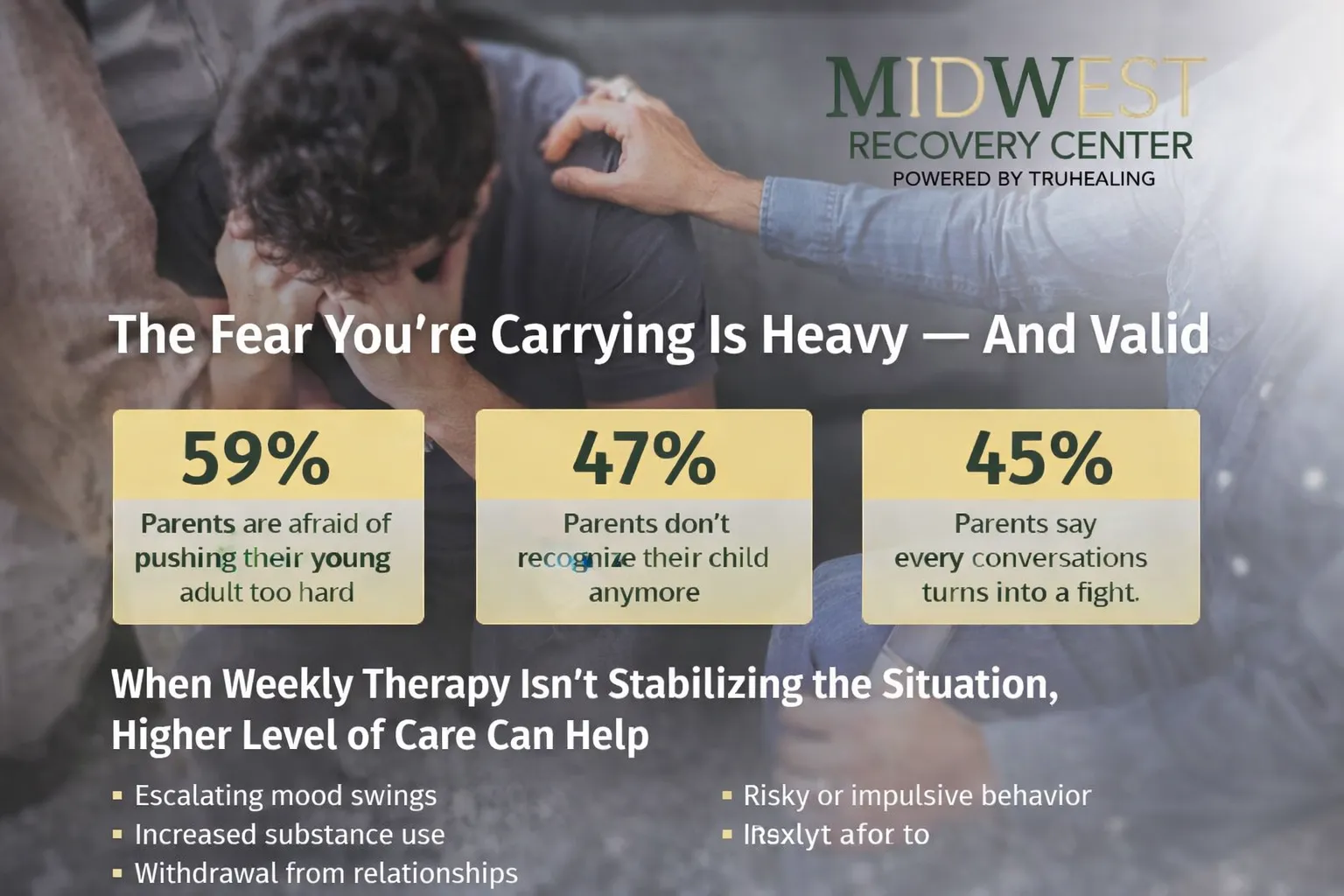
The Fear You’re Carrying Is Heavy — And Valid

There’s a specific kind of fear that comes with watching your child unravel as an adult.

You can’t ground them.
You can’t monitor every move.
You can’t force help.

You’re walking a tightrope between respecting their independence and intervening before something worse happens.

Parents often tell us:

  • “I don’t recognize them anymore.”
  • “Every conversation turns into a fight.”
  • “I’m afraid to push too hard.”
  • “I’m afraid not to.”

That tension is exhausting. It can feel like living on alert 24/7.

And underneath it all is grief — grief for the version of your child who felt steady, hopeful, predictable.

If this is where you are, take a breath. There are levels of care designed specifically for this in-between space.

When Weekly Therapy Isn’t Stabilizing the Situation

Therapy is powerful. But in times of crisis, one hour a week may not create enough containment.

You might notice:

  • Escalating mood swings
  • Increased substance use
  • Panic attacks or paranoia
  • Sudden hopelessness
  • Risky or impulsive behavior
  • Withdrawal from school, work, or relationships

Sometimes mental health challenges and substance use start feeding each other. Emotions intensify. Coping skills collapse. Structure disappears.

This is often when families begin exploring a partial hospitalization program — not as a punishment or last resort, but as a structured reset.

It provides multiple days per week of therapeutic support while your young adult continues living at home.

More support.
More accountability.
More stability.

Without the disruption of overnight care.
Structured Support Shift

What Structured Daytime Care Actually Feels Like

Many parents hear the name and imagine something extreme.

In reality, this level of care is designed to stabilize, not overwhelm.

Think of it like scaffolding around a building under repair. The goal isn’t to tear everything down. It’s to reinforce what’s already there so it doesn’t collapse.

In structured daytime treatment, your young adult typically participates in:

  • Individual therapy sessions
  • Group therapy with peers facing similar struggles
  • Psychiatric evaluation and medication support if needed
  • Skills training for emotional regulation
  • Support for co-occurring mental health and substance use challenges
  • Family involvement and communication guidance

There is rhythm to the week.
There is consistency.
There is monitoring when symptoms spike.

That structure alone can dramatically reduce chaos at home.

Parents often say the first noticeable shift is this: the emotional temperature in the house lowers.

“Are We Overreacting?” — The Question Almost Every Parent Asks

The doubt creeps in quickly.

Maybe this is just a phase.
Maybe they’ll grow out of it.
Maybe pushing for more care will damage your relationship.

Here’s what we’ve learned after guiding many families through this decision: crisis rarely resolves with less support.

Choosing a higher level of care does not mean your child is broken. It means their current coping capacity is overwhelmed.

Early intervention can prevent emergency room visits, legal trouble, academic collapse, or psychiatric hospitalization.

This isn’t about labeling. It’s about stabilizing.

And stabilization creates breathing room for everyone.

You Don’t Have to Have the Diagnosis Figured Out

Parents often feel pressured to name the problem before seeking help.

Is it depression?
Bipolar disorder?
Trauma?
Substance use disorder?
Psychosis?
Anxiety spiraling out of control?

You don’t have to solve the clinical puzzle.

Your role is not to diagnose. Your role is to notice.

Notice that your young adult isn’t okay.
Notice that something has escalated.
Notice that your gut says more support is needed.

Our team conducts thorough assessments to determine what’s happening and what level of care fits best. You don’t have to walk into this conversation with medical language — just honesty.

What Changes When the Right Level of Care Is in Place

Parents often expect dramatic, overnight transformation.

That’s not how real stabilization works.

Instead, changes show up quietly:

  • Sleep becomes more regulated
  • Emotional explosions decrease
  • Language replaces silence
  • Substance use reduces or becomes more transparent
  • Your child begins articulating feelings instead of acting them out

It’s not magic. It’s structure.

And structure creates safety.

Over time, safety allows healing to begin.

The Hidden Relief Parents Don’t Expect

One of the most surprising shifts parents report is their own relief.

When your young adult is in crisis, you become hypervigilant. You’re scanning their tone, their behavior, their text messages. You’re bracing for the next blow-up.

When structured daytime support begins, you are no longer the only one holding the weight.

There is a team watching.
There is accountability beyond your home.
There are professionals guiding next steps.

That shared responsibility often lowers parental anxiety in ways nothing else has.

You still care deeply. But you’re not carrying it alone.

If You’re Searching for Help Close to Home

Geography matters when you’re navigating crisis. Proximity can make consistency easier, especially if family involvement is part of care.

Families in Maumee, Ohio and Toledo, Ohio often reach out to us when they need structured support without sending their young adult far away.

Keeping care local can help preserve connection while adding stability.

If location is part of your concern, we can help you explore appropriate treatment options that fit both clinical needs and logistical realities.

What If They Don’t Want to Go?

This is one of the hardest parts.

Young adults in crisis may resist help. They may minimize what’s happening. They may fear stigma. They may simply be exhausted.

Approach matters.

Instead of:
“You have to do this.”

Try:
“I’m scared because I love you. I think you deserve more support right now.”

Lead with concern, not control.

Our admissions team can also guide families on how to start this conversation in a way that preserves relationship while emphasizing safety.

Frequently Asked Questions

How long does structured daytime care typically last?

Length of stay varies based on individual need. Some young adults attend for a few weeks; others benefit from a longer stabilization period. The goal is not to keep someone longer than necessary — it’s to ensure they step down safely and steadily.

Will my young adult still live at home?

Yes. This level of care allows your child to return home each evening. That balance can help them practice coping skills in real time while still receiving consistent therapeutic support.

Is this only for substance use issues?

No. This level of care supports individuals struggling with mental health conditions, substance use, or both. When symptoms intensify and weekly therapy isn’t enough, structured daytime treatment can provide added containment.

What if my child has already tried treatment before?

Previous treatment does not mean failure. Sometimes the level of care wasn’t the right fit. Sometimes life stressors shifted. Sometimes more structure is needed than before. Each situation is evaluated individually.

Will I be involved as a parent?

Family involvement is often encouraged. Crisis affects the whole household, and communication patterns matter. We help families rebuild trust and clarity — not through blame, but through skill-building.

How quickly can we start?

If safety is a concern, sooner is better. Our admissions team can assess urgency and guide next steps. In crisis situations, delays often increase risk. Early movement creates stabilization faster.

When You’re Lying Awake at Night

There’s a particular loneliness to 2 a.m. worry.

The house is quiet.
Your mind isn’t.

You replay conversations.
You question your past decisions.
You wonder if you missed warning signs.

You didn’t fail your child.

Crisis is not a parenting scorecard. It’s a moment that calls for more support.

If your young adult is overwhelmed, structured stabilization can act like borrowed strength until they find their own again.

You don’t need perfect clarity before reaching out. You don’t need the right terminology. You don’t even need to know exactly what you’re asking for.

You just need to start the conversation.

Call (888) 657-0858 to learn more about our Partial Hospitalization Program in Toledo, Ohio.
*The stories shared in this blog are meant to illustrate personal experiences and offer hope. Unless otherwise stated, any first-person narratives are fictional or blended accounts of others’ personal experiences. Everyone’s journey is unique, and this post does not replace medical advice or guarantee outcomes. Please speak with a licensed provider for help.

Level Of Care

PHP (Partial Hospitalization Program)
Daytime treatment with structure, therapy, and support—return home each night.

IOP (Intensive Outpatient Program)
Flexible therapy a few days a week to balance life and recovery.

OP (Outpatient Program)
Ongoing therapy and support to maintain progress.

MAT (Medication-Assisted Treatment)
Evidence-based care using medication and counseling to reduce cravings.

Ready to Start?
Call (833) 657-0858: to learn which program fits your recovery goals.

Who are you seeking help for? *

We’re here to listen and help you find the right path forward. Please tell us who needs care so we can match you with the best program and support.

💬 Your responses are 100% confidential and never shared outside our admissions team.

Recovery Shouldn’t Have to Wait — Begin Treatment Today.

At Ohio Treatment Center in Toledo, Ohio, we make it simple to take that first step toward healing. Our streamlined admissions process can often lead to same-day placement in treatment for MAT, PHP, IOP and more..

Call today for a free, confidential consultation with our caring admissions team — we’ll walk you through every step with compassion and clarity.

Call (833) 657-0858
Why call us?

Check Your Insurance Coverage in Minutes

We’ll handle the insurance details — so you can focus on getting better.

At Ohio Treatment Center, we work with most major private insurance providers to make treatment affordable and accessible. Complete our quick, confidential form below, and we’ll let you know if your plan is in-network — without contacting your insurance company.

Commonly accepted providers include:
Blue Cross Blue Shield (BCBS) • Aetna • Cigna • UnitedHealthcare • Humana • Anthem • Tricare

What Happens Next

  • Fill out the short form below
  • Our team reviews your benefits
  • We’ll contact you with your coverage details

Getting help shouldn’t be stressful. Let’s find out what your insurance can cover today.

Level Of Care

Detox
Begin recovery safely with 24/7 medical support. Our detox program helps you manage withdrawal comfortably and prepares you for the next step.

Residential Treatment
Continue healing in a supportive, structured setting with daily therapy, wellness activities, and round-the-clock care.

Aftercare
Before you leave, we’ll help you create a plan for ongoing support and lasting recovery.

Ready to Start?
Call (833) 657-0858: to learn which program fits your recovery goals.

Who are you seeking help for? *

We’re here to listen and help you find the right path forward. Please tell us who needs care so we can match you with the best program and support.

💬 Your responses are 100% confidential and never shared outside our admissions team.

Recovery Shouldn’t Have to Wait — Begin Treatment Today.

At Midwest Detox Center in Maumee, Ohio, we make it simple to take that first step toward healing. Our streamlined admissions process can often lead to same-day placement in treatment for medically supervised detox and residential treatment programs.

Call today for a free, confidential consultation with our caring admissions team — we’ll walk you through every step with compassion and clarity.

Call (833) 657-0858
Why call us?

Check Your Insurance Coverage in Minutes

We’ll handle the insurance details — so you can focus on getting better.

At Midwest Detox, we work with most major private insurance providers to make treatment affordable and accessible. Complete our quick, confidential form below, and we’ll let you know if your plan is in-network — without contacting your insurance company.

Commonly accepted providers include:
Blue Cross Blue Shield (BCBS) • Aetna • Cigna • UnitedHealthcare • Humana • Anthem • Tricare

What Happens Next

  • Fill out the short form below
  • Our team reviews your benefits
  • We’ll contact you with your coverage details

Getting help shouldn’t be stressful. Let’s find out what your insurance can cover today.

Level Of Care

Medical Detox
24/7 medically supervised detox to help you safely withdraw from drugs or alcohol while managing symptoms and preventing complications.

Inpatient Treatment
A structured, residential setting that provides continuous medical care, counseling, and therapeutic support to build a foundation for long-term recovery.

Residential Program
Comfortable, home-like housing where you can focus fully on healing with daily therapy, peer support, and holistic recovery services.

Ready to Start?
Call (833) 657-0858: to learn which program fits your recovery goals.

Who are you seeking help for? *

We’re here to listen and help you find the right path forward. Please tell us who needs care so we can match you with the best program and support.

💬 Your responses are 100% confidential and never shared outside our admissions team.

Recovery Shouldn’t Have to Wait — Begin Detox Today

At Ohio Detox Center in Maumee, Ohio, we make it simple to take that first step toward healing. Our streamlined admissions process can often lead to same-day placement in detox or inpatient treatment for substance use and co-occurring mental health conditions.

Call today for a free, confidential consultation with our caring admissions team — we’ll walk you through every step with compassion and clarity.

Call (833) 657-0858
Why call us?

Check Your Insurance Coverage in Minutes

We’ll handle the insurance details — so you can focus on getting better.

We’ll take care of the details — so you can focus on getting better.
At Ohio Detox Center, we work with Ohio Medicaid and most major insurance providers to make treatment affordable and accessible.

Here’s how it works:

  1. Fill out the short form below
  2. Our team reviews your benefits
  3. We’ll contact you with your coverage details

Getting help shouldn’t be stressful. Let’s find out what your insurance can cover today.

Levels of Care

Detox
We understand that taking the first step can feel overwhelming. Our detox program offers a compassionate, medically supported environment where you can rest, heal, and begin recovery safely. You’ll never go through it alone — our team is with you every step of the way.

IOP (Intensive Outpatient Program)
A flexible treatment option that lets you maintain work, school, or family responsibilities while attending therapy several days a week. IOP focuses on relapse prevention, coping skills, and long-term recovery through group and individual sessions.

Residential
Residential care gives you the time and space to focus fully on healing. Surrounded by supportive staff and peers, you’ll work through underlying causes of addiction, rebuild healthy routines, and rediscover confidence in your recovery journey.

MAT (Medication-Assisted Treatment)
Combining FDA-approved medications with counseling and behavioral therapy, MAT helps reduce cravings and withdrawal symptoms related to opioid or alcohol use. Each treatment plan is closely monitored to ensure comfort, safety, and lasting recovery.

Ready to Start?
Call (833) 657-0858: to learn which program fits your recovery goals.

Who are you seeking help for? *

We’re here to listen and help you find the right path forward. Please tell us who needs care so we can match you with the best program and support.

Myself

A loved one or family member

💬 Your responses are 100% confidential and never shared outside our admissions team.

Check Your Insurance Coverage in Minutes

We’ll handle the insurance details — so you can focus on getting better.

At Midwest Centers at Youngstown, we work with most major private insurance providers to make treatment affordable and accessible. Complete our quick, confidential form below, and we’ll let you know if your plan is in-network — without contacting your insurance company.

Commonly accepted providers include:
Blue Cross Blue Shield (BCBS) • Aetna • Cigna • UnitedHealthcare • Humana • Anthem • Tricare

What Happens Next

  • Fill out the short form below
  • Our team reviews your benefits
  • We’ll contact you with your coverage details

Getting help shouldn’t be stressful. Let’s find out what your insurance can cover today.

Recovery Shouldn’t Have to Wait — Begin Treatment Today.

At Midwest Centers at Youngstown in Ohio, we make it simple to take that first step toward healing. Our streamlined admissions process can often lead to same-day placement in treatment for substance use or co-occurring mental health disorders.

Call today for a free, confidential consultation with our caring admissions team — we’ll walk you through every step with compassion and clarity.

Level Of Care

Partial Hospitalization Program (PHP)
Our PHP offers a highly structured, supportive environment where you can focus on recovery during the day and return home at night. It’s an ideal step between inpatient and outpatient care, providing daily therapy, accountability, and a strong recovery routine.

Intensive Outpatient Program (IOP)
Our IOP gives you the flexibility to continue work, school, or family life while receiving evidence-based treatment several days a week. You’ll participate in group and individual therapy focused on relapse prevention, coping skills, and long-term healing.

Outpatient Program (OP)
For those transitioning from a higher level of care or seeking ongoing support, our outpatient program offers continued therapy at a pace that fits your lifestyle. It’s a supportive bridge that helps you maintain recovery and stay connected to care.

Medication-Assisted Treatment (MAT)
MAT combines FDA-approved medications with therapy and counseling to reduce cravings and support long-term recovery from opioid or alcohol addiction. Our team monitors each plan closely to ensure safety, comfort, and effectiveness.

Ready to Start?
Call (833) 657-0858: to learn which program fits your recovery goals.

Who are you seeking help for? *

We’re here to listen and help you find the right path forward. Please tell us who needs care so we can match you with the best program and support.

Myself

A loved one or family member

💬 Your responses are 100% confidential and never shared outside our admissions team.

Recovery Shouldn’t Have to Wait — Begin Treatment Today.

At Midwest Recovery Center in Toledo, Ohio, we make it simple to take that first step toward healing. Our streamlined admissions process can often lead to same-day placement in treatment for substance use or co-occurring mental health disorders.

Call today for a free, confidential consultation with our caring admissions team — we’ll walk you through every step with compassion and clarity.

Check Your Insurance Coverage in Minutes

We’ll handle the insurance details — so you can focus on getting better.

At Midwest Recovery Center, we work with most major private insurance providers to make treatment affordable and accessible. Complete our quick, confidential form below, and we’ll let you know if your plan is in-network — without contacting your insurance company.

Commonly accepted providers include:
Blue Cross Blue Shield (BCBS) • Aetna • Cigna • UnitedHealthcare • Humana • Anthem • Tricare

What Happens Next

  • Fill out the short form below
  • Our team reviews your benefits
  • We’ll contact you with your coverage details

Getting help shouldn’t be stressful. Let’s find out what your insurance can cover today.