
When your child went to treatment the first time, you dared to hope. Maybe they came home clean, clear-eyed, more like the version of them you remember. You watched for signs, counted sober days, learned new terms like “boundaries” and “triggers.” And then — slowly or suddenly — you noticed it again. Slurred words. Missed work. Defensiveness. That gut-level knowing.
They’re using again.
If you’re reading this with a mix of heartbreak and numbness, this is for you. You haven’t failed. And neither has your child. What you’re facing now doesn’t mean the end — it means they may need a different kind of support. One that’s structured but flexible. Clinical but still connected to home. A partial hospitalization program (PHP) can be exactly that.
What Is a Partial Hospitalization Program?
A partial hospitalization program, often called PHP, is a form of intensive outpatient care designed for people who need more than once-a-week therapy but don’t require 24/7 residential treatment. Clients attend treatment during the day — usually five days a week, several hours per day — and return home each evening.
Unlike traditional outpatient therapy, PHP provides:
- Daily group and individual therapy
- Psychiatric support and medication management
- Life skills and relapse prevention training
- Access to trauma-informed care and dual-diagnosis treatment
- Consistent structure and accountability
If full rehab feels too intense or unworkable, and outpatient hasn’t been enough, PHP offers a critical middle ground — especially for young adults who want help, but don’t want to leave everything behind to get it.
When Treatment Didn’t “Work” — Why PHP Matters After Relapse
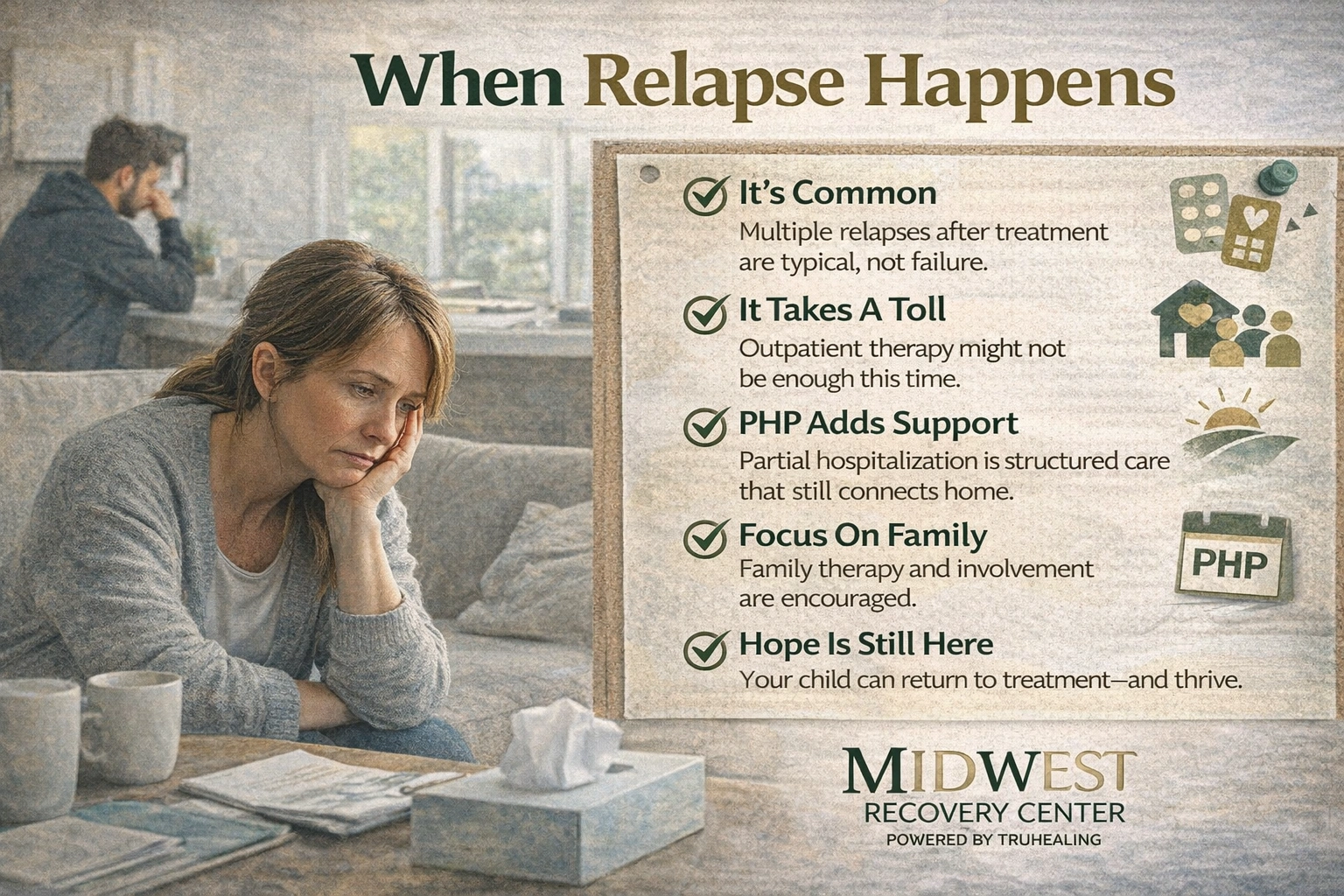
Relapse can look like defiance from the outside. But often, it’s just exhaustion. Or unresolved trauma. Or the simple truth that one round of treatment wasn’t enough.
If your child completed inpatient care and still ended up back in the same patterns, you might wonder: Was it all for nothing? Not at all.
Relapse isn’t a moral failure. It’s data. It tells us: they need more time, more practice, or a different approach.
PHP is designed for this moment. It supports your child’s recovery journey without sending them “back to square one.” At Midwest Recovery Center, many families from communities like Toledo, OH have turned to PHP as a practical, hope-restoring option when the first attempt at sobriety didn’t hold.
Signs Your Young Adult May Need PHP
You don’t need a diagnosis to trust your instincts. If you’re seeing some of these patterns, PHP might be the next right step:
1. Multiple relapses after outpatient care
They may need a more immersive structure — one that keeps them grounded in recovery five days a week.
2. Emotional swings or untreated mental health issues
Depression, anxiety, trauma — these are not “side problems.” They often drive substance use. PHP treats both.
3. High risk, but not in crisis
If they’re not safe alone, but don’t meet the criteria for inpatient hospitalization, PHP offers close monitoring.
4. Strong desire for independence
Many young adults in Maumee, OH and similar communities want support without giving up their autonomy. PHP allows them to live at home or in sober housing while receiving care.
5. Family burnout
If you’re walking on eggshells, constantly managing crises, or feel like nothing is enough — PHP brings in a clinical team to help hold the weight.
How PHP Helps Heal Without Shame
One of the hardest parts of relapse is the shame spiral — for both your child and you. PHP disrupts that spiral with action, not judgment.
It provides:
- Structure they can rely on
- Therapy that meets them where they are
- Medication support if needed
- Family involvement to help everyone heal
At Midwest Recovery Center, families in Austintown, OH have shared how PHP helped their loved ones rebuild motivation after a return to use. One parent said, “It gave us something solid to believe in again — a plan, a schedule, a team.”
What to Expect: A Day in PHP
A typical day in a PHP might look like this:
- Morning check-in and medication (if prescribed)
- Group therapy: working through triggers, boundaries, and coping tools
- Individual therapy: trauma work, relapse processing, personal goals
- Skill-building workshops: emotional regulation, job prep, sober socializing
- Family therapy sessions (weekly or bi-weekly)
- Case management: housing, legal, education planning
By the end of the day, your child is not only receiving support — they’re practicing sobriety in real time, with clinical scaffolding around them.
What Makes PHP Different (and Sometimes Better) Than Other Options
PHP isn’t “rehab lite.” It’s a specific level of care designed for people who need more — but don’t need to be admitted to a hospital or live in a facility.
PHP vs. Outpatient Therapy
Outpatient may mean one therapy session a week. PHP means five days of immersive, structured support. It’s the difference between dipping your toe in the water and learning to swim.
PHP vs. Inpatient Rehab
Residential care removes the person from their environment. PHP teaches them how to stay sober in their environment — with support woven in.
For families navigating work, school, or childcare commitments, PHP also offers flexibility. In places like Toledo, OH, where parents often juggle long hours or shift work, PHP can be a lifeline that fits real life.
Real Parent Perspective: “PHP Saved Our Sanity”
“After his second relapse, we were out of ideas. He didn’t want to ‘go away’ again, and we were terrified of what would happen if we did nothing. PHP gave us both space and connection. He had structure. We had peace of mind. And for the first time, we weren’t trying to fix it alone.”
– Parent, Midwest Recovery Center
FAQs About PHP for Parents
How long does PHP last?
Programs vary, but most last between 2–6 weeks. Progress is reviewed weekly and length is based on individual need.
Does insurance cover PHP?
Yes — most private plans and Medicaid options provide coverage. Midwest Recovery’s intake team can verify benefits quickly.
Is my child too young for PHP?
PHP can be a great fit for young adults. In fact, it often works better than outpatient or residential for those in their late teens and twenties.
What if my child refuses to go?
You’re not alone. Many parents in Maumee, OH and surrounding areas have faced resistance. Our team can guide you through options for intervention or family meetings.
Can I be involved?
Yes. Family participation is encouraged and often key to success. You’ll have access to family therapy, education, and support.
If You’re Tired, You’re Not Alone
You’ve probably asked yourself, “How many times do I have to go through this?” You’re allowed to feel tired. Angry. Helpless. But you don’t have to feel alone.
Recovery isn’t one giant leap. It’s a series of decisions. PHP might not be the first step, but it could be the right next step.
At Midwest Recovery Center, we help parents and families across Ohio — including those in Austintown, Toledo, and Maumee — reconnect with hope. We understand relapse, and we know that it’s not the end of someone’s potential. It’s a turning point.
Call (888) 657‑0858 to learn more about how our partial hospitalization program in Toledo, Ohio can help your child stabilize, grow, and try again — with support that doesn’t give up.