
When you’re newly sober, silence gets loud.
You may have imagined that once you stopped using, you’d feel better—lighter, clearer, maybe even proud. And maybe some days, you do.
But for many in early recovery, the most overwhelming feeling isn’t shame or cravings.
It’s loneliness.
If you’ve just entered sobriety and feel quietly disconnected—from people, from yourself, from everything you used to rely on—you’re not broken. You’re just in a space your nervous system doesn’t recognize yet.
This FAQ was created with that in mind—to gently answer the questions you might not know how to ask, or feel too raw to bring up. And to show how a residential treatment program can be more than a safe place to stay—it can be a place to belong again.
What is a residential treatment program—and why does it matter in early recovery?
A residential treatment program is a live-in treatment option that provides structured care, clinical support, and community—all in one place.
It matters in early recovery because this is when most people are at their most fragile. Not just physically, but emotionally. You’re stepping away from a coping tool that likely shaped every part of your life. Now, everything feels exposed.
Residential treatment gives you:
- Time away from triggers and pressure
- Consistent daily support and accountability
- A quiet, structured space to start understanding what sobriety really means
- Connection to others who are learning to live without numbing, just like you
You don’t need to know what comes next. You just need a place that knows how to help you find it.
I feel so disconnected—how does residential treatment help with that?
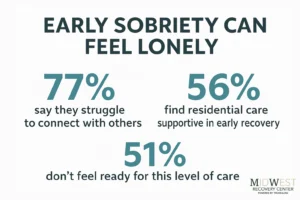
Most people in early sobriety experience some version of emotional distance—like watching the world happen from behind glass. You might be surrounded by people and still feel completely alone.
That’s not a flaw. It’s part of healing.
And residential treatment was built with that in mind.
Through peer support, group therapy, and shared daily rhythms, you start to feel the slow return of connection. Not forced socializing. Not group hugs. Just moments of being seen, heard, and understood—without having to explain everything.
At Midwest Recovery Center, we create environments that feel safe enough for real connection to unfold naturally, even for people who feel emotionally shut down when they arrive.
Do I have to talk in groups right away?
No.
In group therapy, sharing is encouraged—but never forced.
Many people sit quietly in the beginning. That’s okay. Your presence matters. Listening counts. Over time, as trust builds and your nervous system settles, words come.
You can speak at your pace. Your story belongs to you. And there’s no timeline for when it “should” feel easier to tell.
What if I don’t feel ready for this level of care?
Readiness doesn’t always feel like motivation. Sometimes, it feels like exhaustion.
Like knowing deep down, I can’t keep doing this alone.
Residential treatment isn’t about being ready in the motivational sense. It’s about being willing to be supported, even if you’re scared or unsure.
If you’re feeling lonely, flat, disconnected, or afraid you’ll go back to using—residential care might be exactly the space where readiness can finally take shape.
What does a typical day look like in residential treatment?
Structure is one of the quiet gifts of residential treatment. It helps regulate your body, mind, and emotions—without you needing to hold it all together.
A typical day at Midwest Recovery might include:
- Morning routines: wake-up, breakfast, grounding activity
- Daily group therapy focused on topics like identity, coping skills, or relationships
- Individual therapy sessions tailored to your needs
- Peer connection time: meals, walks, check-ins
- Educational workshops: relapse prevention, emotional regulation, family dynamics
- Evening routines: journaling, reflection, light activity, rest
Nothing is about “fixing” you. Everything is about supporting your return to yourself.
What happens when I feel like giving up—even inside treatment?
Everyone hits a wall at some point. A moment where you think: This isn’t working. I want to leave.
That’s normal. It’s part of the process. And it’s something we prepare for—not punish.
At Midwest Recovery, we hold space for those moments. We don’t lecture. We stay present. We check in. And we remind you: the hard part often comes right before the breakthrough.
You’re allowed to feel stuck. But you don’t have to stay there alone.
Will anyone there actually understand what I’ve been through?
Yes.
Because you’re not the only one.
It might feel like your story is too specific, your pain too complex. But inside every group, you’ll find people who’ve carried similar weight—even if the details look different.
You’ll meet others who:
- Drank or used to quiet their anxiety
- Hid their habits from loved ones for years
- Felt like they lost their identity when they got sober
- Are grieving more than they expected—relationships, control, numbness itself
And over time, the thing that made you feel different?
Becomes the thing that makes you feel connected.
I’m from Oregon or Perrysburg, Ohio—can I stay close to home?
Yes.
If you’re looking for a residential treatment program in Oregon, Ohio, or nearby areas like Perrysburg or Maumee, Midwest Recovery Center offers local access to comprehensive care.
Staying close to home can help reduce the overwhelm of travel and separation—especially for those in early recovery who need familiar grounding while still stepping into a new kind of support.
We’re right here in Toledo, offering proximity, privacy, and presence.
Will I feel better right away?
Not always. And that’s okay.
The early stages of healing often feel worse before they feel better.
Why? Because when you remove the substance, you start to feel everything else.
That rawness is a sign that your nervous system is thawing—not breaking. You’re finally safe enough to feel what was buried.
Residential treatment gives you a place to move through that—not escape it.
What happens when I leave residential treatment?
Leaving doesn’t mean being cut off.
You’ll leave with:
- A custom aftercare plan: outpatient, therapy, housing
- A support network: peers, clinicians, referrals
- Coping tools and routines you’ve practiced in a safe space
- Optional connection to Midwest Recovery’s alumni community
You don’t go from 24/7 support to zero. You scale down gently—with the same attention and care.
What if I relapse after leaving?
We don’t hope for relapse. But we never shame it either.
Recovery is not a straight line. And if you fall, you’re still welcome.
Midwest Recovery holds the door open—whether you need a tune-up, a re-entry, or just someone to talk to. We’d rather see you come back than disappear into silence.
I don’t feel strong enough to do this. Can I still start?
Yes.
Strength isn’t the requirement. It’s the result.
You don’t have to come in believing you can do it.
You just have to come in.
The belief will grow. The support will meet you. And the version of you who’s hurting right now?
They’re the reason we built this place in the first place.
You Don’t Have to Stay Lonely to Stay Sober
Loneliness can feel like a slow undoing. But connection—real connection—can begin with one small step.
If you’re newly sober and wondering if you belong in residential treatment, the answer is simple:
Yes. You do.
Call (888) 657-0858 or visit Midwest Recovery Center’s Residential Treatment Program page to take the next gentle step.
This space is here for you. So you don’t have to keep trying to do this alone.