
You’ve been saying “I’m fine” for so long that it’s automatic now.
It rolls off your tongue in texts. In meetings. At the doctor’s office. You might even say it to yourself, just to quiet the ache in your chest or distract from the hollow in your stomach. You say it because you don’t know what else to say—and because explaining what you’re really feeling would take more energy than you have left.
But here’s what you already know: you’re not fine.
You’re exhausted, overstimulated, emotionally threadbare. The kind of tired that no nap or day off can fix. The kind of lonely that happens even in a full house. The kind of pain that sneaks in even when nothing looks “wrong.”
At Midwest Recovery Center, our residential treatment program was created for this moment—when keeping it together stops working, and something deeper is finally allowed to come through.
Burnout Doesn’t Just Live in the Mind—It Lives in the Body
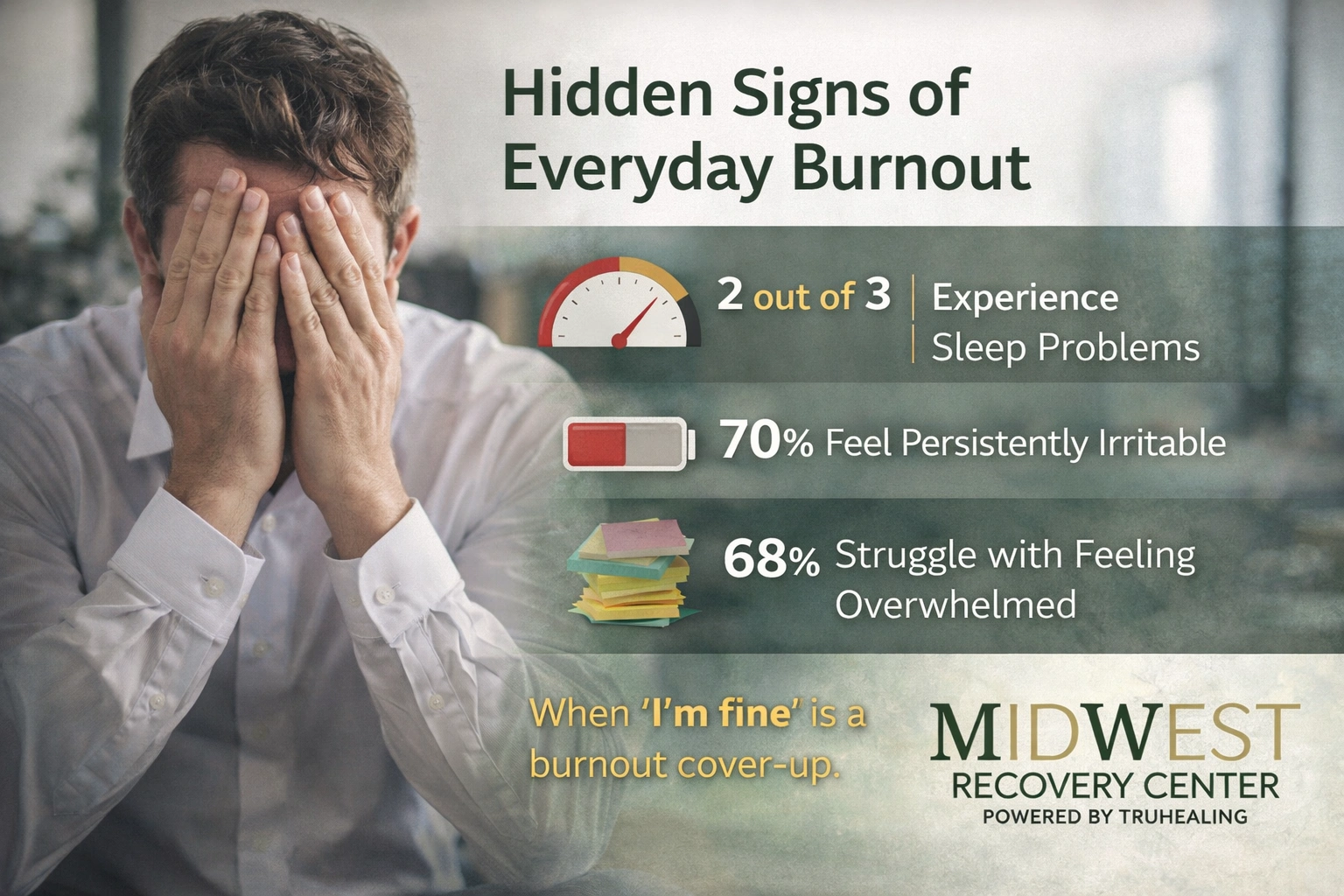
The signs don’t always shout. Sometimes they whisper. A little more sleep but still waking up exhausted. A quick snap at someone you love—and the guilt that chokes you afterward. Losing interest in things you used to enjoy. Losing track of time. Or crying while doing the dishes, with no real reason except… it’s too much.
Burnout isn’t always dramatic. But it is destructive.
When your body is screaming for rest and your mind won’t turn off, residential treatment creates the pause that most people can’t find in their everyday life.
It’s not about removing you from your problems—it’s about giving you the space and support to finally face them with help.
The First Few Days: Slowing the Spin
There’s no performance when you arrive. No need to explain everything perfectly. No one judging how long it took you to get here.
The first few days are about stabilization and support. You meet your care team. You’re assessed gently—not clinically interrogated. You’re given time to rest. Your body starts to believe what your heart hasn’t yet: it’s safe now.
Whether you’re coming from a therapist referral, an overwhelmed breakdown, or just the realization that you can’t keep pretending anymore, we start where you are.
Not where you “should” be.
Day-to-Day Care That Works for Emotionally Tired People
Each day in residential treatment is structured, but soft. You’re not on the clock. You’re not forced to overshare. You’re invited into healing—not shoved into it.
Your schedule might include:
- Morning grounding sessions that calm the nervous system before the mind starts spinning
- Group therapy that meets you with honesty and humanity—not platitudes
- Individual therapy where you can unpack the deeper roots of what’s been wearing you down
- Mindfulness or movement to reconnect you with your body in safe, simple ways
- Rest time that’s encouraged, not guilted away
You are allowed to rest here. Not as a reward. But because you’re human.
For the People Who Keep Holding It All Together
Many of our clients are “functioning.” They’re parents. Professionals. Helpers. People who others rely on. People who have learned to smile through pain because they don’t want to make anyone uncomfortable.
We see you.
And we see the toll that takes: the numbness. The rage that bubbles underneath. The isolation that no one notices because you never stop showing up.
Residential treatment lets you stop holding it together—for once. It lets you hand the reins to someone else for a little while, so you can breathe.
For those navigating this quiet unraveling in Austintown, Ohio, this level of care might be closer than you think. And more available than you ever thought to ask for.
You’re Not “Broken.” You’re Depleted.
There’s a big difference between being broken and being depleted. One implies you’re faulty. The other simply means you’ve been giving more than you had to give—and there was no one there to refill your tank.
In residential care, you start to fill back up. Slowly. Quietly. Sometimes uncomfortably. But it happens.
You’ll have days where you finally sleep through the night. Moments where your laughter surprises you. Hours where the pressure lifts just enough to let peace slip in.
Healing doesn’t always look dramatic. Sometimes it looks like making it to dinner without anxiety. Like journaling honestly for the first time in years. Like noticing you didn’t check your phone compulsively today.
You Don’t Have to Know “Why” You’re This Tired
Some people come into treatment with a clear trauma history. Others don’t. Some had chaotic childhoods, abusive relationships, or substance dependencies. Others just… burned out. Slowly. Quietly.
You don’t need a diagnosis to deserve help. You don’t need to have hit rock bottom to be worthy of support.
If you’re emotionally tired to the point of breaking, that’s enough.
And if you’re someone trying to manage all this beneath the surface in Maumee, Ohio, it’s okay to say, “This isn’t sustainable anymore.” You don’t have to disappear to get better. You just have to let someone meet you in the truth.
FAQ: What People Want to Know—But Don’t Always Ask
How long is a residential stay?
It varies, but most clients stay between 30 to 45 days, depending on needs, progress, and aftercare planning. We work with you to tailor a stay that’s sustainable—not one-size-fits-all.
Can I bring my phone or laptop?
In most cases, phones and devices are limited, especially in the early days. This helps you disconnect from outside stress and focus on healing. You’ll be informed ahead of time and supported through the adjustment.
What’s the difference between residential and inpatient care?
Residential care is more homelike and less medically acute than inpatient hospitalization. It offers full-time therapeutic support without the clinical feel of a hospital setting.
Do I have to talk about everything right away?
Not at all. You’re encouraged to move at your own pace. Nothing is forced. Many clients take several days (or weeks) to feel safe opening up—and that’s normal.
Will my family be involved?
Only if you want them to be. Family therapy is available for those who need it, but your recovery is your space. Boundaries are respected. Relationships can be rebuilt in time.
What happens after discharge?
Your care team will help you develop a personalized plan for aftercare. This may include intensive outpatient care, traditional therapy, support groups, or sober housing—whatever helps sustain your healing.
You’re Allowed to Fall Apart—So You Can Come Back Together
The world doesn’t stop just because you do. That’s the hard part. But maybe, just maybe, you’re allowed to step back anyway. To let yourself fall apart in a place where someone can help you gather the pieces again.
This is what residential treatment does.
It doesn’t save you. It sees you. And in that seeing, you finally stop having to prove your pain. You’re believed. And from there—real recovery can begin.
Call (888) 657-0858 to learn more about our Residential Treatment Program in Toledo, Ohio.