
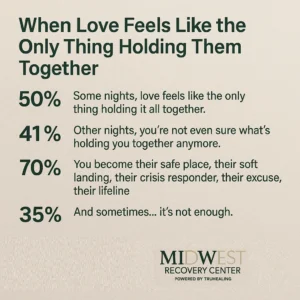
Some nights, love feels like the only thing holding it all together.
Other nights, you’re not even sure what’s holding you together anymore.
When you love someone who’s struggling with substance use—or stuck in a cycle of emotional crisis—you carry a weight most people can’t see. You become their safe place, their soft landing, their crisis responder, their excuse, their lifeline.
And sometimes… it’s not enough.
That’s not because you’re failing them. It’s because love, as deep and fierce as yours, was never meant to replace professional help.
Midwest Recovery Center’s Partial Hospitalization Program in Toledo, Ohio might be the next right step—not just for your partner, but for you too.
What Is a Partial Hospitalization Program (PHP)?
Think of PHP as structured support without the overnight stay.
It’s a middle path between full hospitalization and standard outpatient therapy. Your partner spends several hours a day—usually five to six—in treatment: therapy, support groups, medication management (if needed), and recovery skill-building. Then they return home at night.
It’s intense enough to create real momentum, but flexible enough to fit into real life.
PHP is especially useful when someone is still functioning “well enough” to not need inpatient—but not well enough for once-a-week therapy to cut it. And let’s be real: a lot of people stuck in active use fall right in that middle space.
When Love Feels Like the Only Thing Holding Them Together
If you’re the one managing the chaos…
If you’re Googling treatment options at 2 a.m. while pretending everything’s fine by breakfast…
If you’re constantly explaining away behaviors you wish didn’t need explaining…
You’ve already been doing everything.
And maybe that’s the hardest part—knowing that your love isn’t the problem, but it’s not the solution either.
PHP brings in backup. It hands the baton to a team who can step in, so you can finally exhale. Not because you’re walking away—but because you can’t keep doing this alone forever.
What PHP Offers That You Can’t (And Shouldn’t Have To)
This one’s going to sting a little, but it’s important: you are not their therapist. You are not their sponsor. You are not their doctor.
And trying to be all three? It’s a recipe for resentment, burnout, and grief.
Here’s what a Partial Hospitalization Program offers your partner that you simply cannot (and were never supposed to):
- Daily emotional regulation work: Instead of stuffing it down or exploding at home, they process pain in real time with professionals.
- Trauma-informed group support: They learn they’re not the only one struggling, and that truth? It softens shame.
- Skill-based coping tools: Recovery isn’t just abstaining—it’s learning how to stay sober through real-life triggers.
- Medication and psychiatric support: If depression, anxiety, or other mental health struggles are tangled in the addiction, PHP helps address both at once.
You are allowed to stop being their entire safety net. PHP becomes the container, so you don’t have to be.
Signs It Might Be Time for PHP
You don’t need a rock-bottom moment to consider this.
In fact, many couples reach for help not because things exploded—but because the slow burn is getting unbearable.
Some signs a Partial Hospitalization Program might be the next step:
- They’ve tried outpatient therapy but can’t stay consistent
- There’s been a recent relapse or close call
- They’re using daily or regularly but still trying to maintain “normal” life
- Emotional outbursts, depression, or substance use are impacting your relationship safety
- You’re seeing a cycle: apology → good day → slow slide → chaos → apology again
If you live near Perrysburg, Ohio or Maumee, Ohio, Midwest Recovery Center’s PHP services are close enough to support your partner—and your sanity.
How to Talk About PHP Without Starting a War
You might be thinking: “If I bring this up, it’ll be a fight.”
That’s understandable. But silence can also become its own kind of war—just slower and lonelier.
Here’s one way to frame it that keeps things soft but clear:
“I love you. And I know you’re doing your best. But I don’t think either of us can keep doing this alone. I found something called a Partial Hospitalization Program. It’s not a hospital, but it’s real help. I want you to consider it—not because I’m giving up on you, but because I believe you deserve more than survival.”
Speak from care. Offer an option—not an ultimatum. And then let the idea breathe.
Planting the seed matters more than winning the conversation.
You Deserve Relief Too
Let’s not pretend this is all about them.
You’re here reading this blog for a reason. You’re tired. Tired of worrying. Tired of crying over someone you love but can’t save. Tired of lying for them, covering for them, hoping this time the promise sticks.
PHP helps you, too.
Because when your partner is in care five hours a day, you get five hours back. Not just to rest, but to feel. To ask yourself what you need. To maybe start talking to someone, too.
Your healing is just as valid.
What Recovery Looks Like With PHP
PHP isn’t magic—but it’s momentum.
Here’s what we often see in couples after a few weeks in PHP:
- The partner in treatment feels calmer, clearer, and more self-aware
- Boundaries become less “fights” and more “agreements”
- Communication starts to rebuild—slowly, but more honestly
- The non-using partner (you) gets to stop bracing for impact every day
The best part? Your relationship gets room to breathe. Not to be perfect. But to be more than crisis management.
You’re Not Giving Up. You’re Choosing Hope.
Let’s rewrite the story.
Suggesting PHP doesn’t mean you’re abandoning them. It means you’re advocating for a kind of help that goes beyond what love alone can carry.
And that’s the bravest kind of love there is.
FAQs About PHP for Partners and Spouses
What exactly happens during PHP?
Your partner will attend structured programming several hours a day—usually Monday through Friday. This includes individual therapy, group therapy, education on recovery and coping skills, and psychiatric care if needed. They return home in the evenings.
Can I be involved in their treatment?
Yes. Many PHPs include family therapy or check-ins. You’ll also have opportunities to set boundaries and gain support around your own role. This is part of what makes PHP so stabilizing—it supports both of you.
What if my partner doesn’t think they need it?
That’s common. PHP can feel like a big leap—especially if your partner isn’t ready to admit how bad things have gotten. You can still plant the seed, express your limits, and offer it as a choice rather than a demand.
How long does a PHP last?
Most programs last 2–6 weeks, depending on your partner’s needs and progress. Some people transition into an intensive outpatient program (IOP) after PHP for continued support.
Is it just for addiction?
No. PHP is often used for mental health struggles like depression, anxiety, trauma, or emotional dysregulation. If your partner is using to cope with emotional pain, PHP can address both issues at once.
What if we live outside Toledo?
Midwest Recovery Center serves surrounding communities as well. If you’re looking for a Partial Hospitalization Program in Oregon, Ohio or other nearby towns, call us. We’ll help you find the best fit—whether it’s with us or a trusted partner.
Call (888) 657-0858 or visit Midwest Recovery Center’s Partial Hospitalization Program page to find out how PHP can support your partner—and give you both a real path forward.
Because “I love you” shouldn’t be the only thing holding it all together.