
You’re watching it happen. Slowly, or maybe all at once. Your son or daughter—now technically “an adult”—is using again. And it’s not just a phase. You can see the toll. You can feel the distance growing. But when you bring it up, they shut down, get angry, or swear they have it under control.
You’re not overreacting. You’re not failing. You’re a parent who still loves their child—and is desperate for some kind of next step.
This guide is for you. The one lying awake at night, Googling “how bad does it have to get before I can do something?” You’re not alone. At Midwest Recovery Center, we speak to parents in this exact moment every day.
Here are some of the questions you might not feel safe saying out loud—but that deserve honest, helpful answers.
What is a medical detox program, and when is it needed?
A medical detox program is a safe, supervised environment where a person can withdraw from drugs or alcohol under 24/7 medical care. It’s not “rehab.” It’s the first step to get the substance out of their system without putting their body at risk.
If your child is drinking or using regularly and shows signs of physical withdrawal when they stop—shaking, vomiting, sweating, mood swings, insomnia—a medical detox program may be the safest way forward, even if they’re not ready to admit there’s a problem.
It’s not a punishment. It’s a way to protect their body so they can even begin to think clearly again.
What if my child refuses to go?
This is one of the hardest realities for parents to face. You see the danger, but they won’t acknowledge it—or worse, they lie to protect their use.
While you can’t force internal readiness, there are steps you can take. You can speak with a clinician, explore intervention support, and prepare for a window when they may be more open—after a consequence, a close call, or simply a moment of honesty.
Midwest Recovery Center offers guidance on how to approach these conversations with empathy and strategy. You don’t have to figure it out alone.
Can I admit my child to detox if they’re over 18?
Legally, adults must consent to treatment—yes, even your 20-year-old who still depends on you in every other way.
But there are exceptions. If your child is at immediate risk of harming themselves or others, or is medically unstable due to substance use, an emergency evaluation may be appropriate. Some states also allow for involuntary holds in life-threatening situations.
Even without legal authority, many parents play a powerful role in creating momentum. A quiet offer of help. A ride to an intake. A willingness to say, “I’ll go with you.”
And if you’re located near Youngstown, Ohio, there may be local pathways and support in help in locations that make access easier when that window opens.
What if they don’t think it’s “that bad”?
Most don’t.
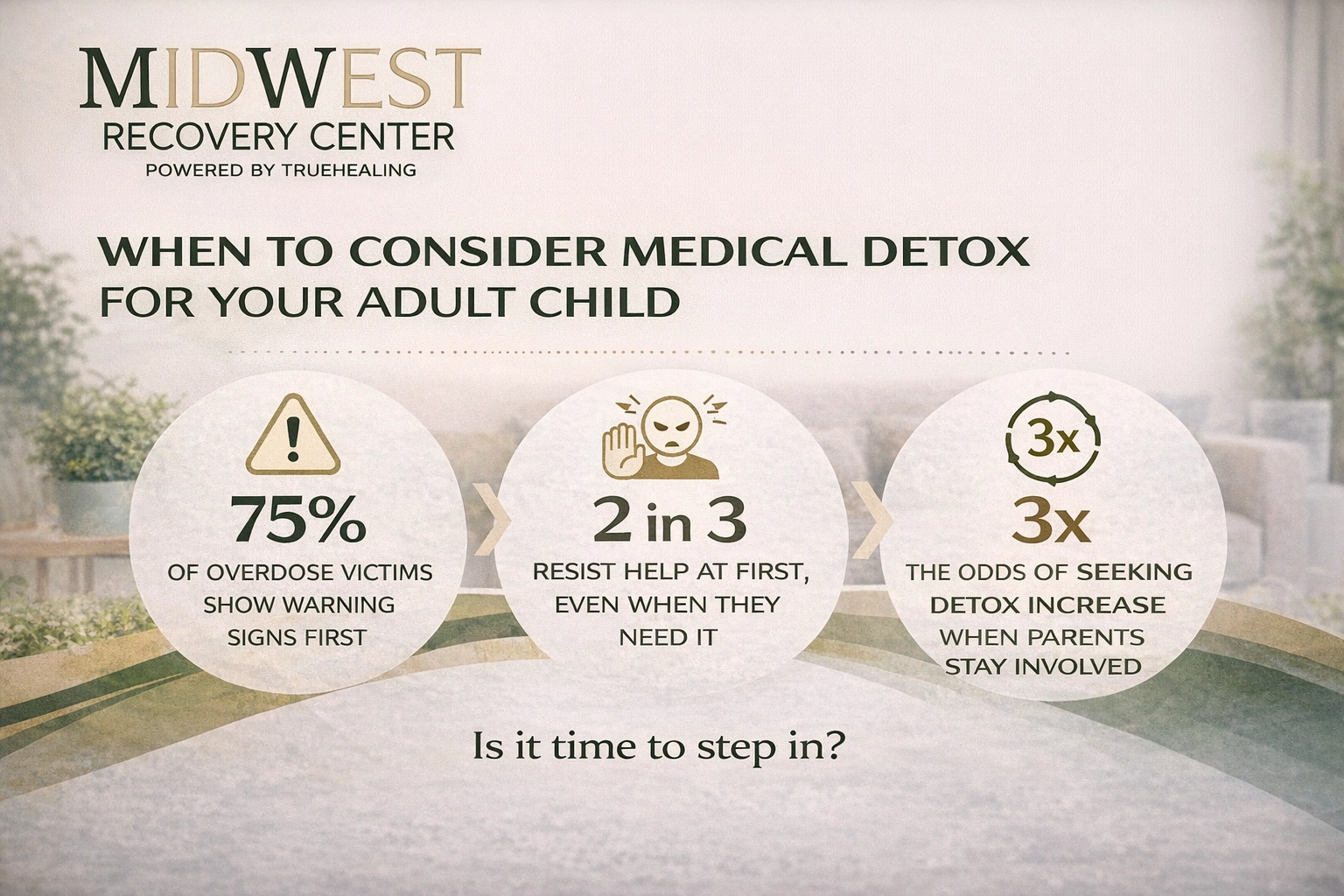
Many young adults downplay their use because they’re scared of what the truth might mean. Or they’re comparing themselves to someone worse. Or they believe they’re managing it—because their world hasn’t completely fallen apart.
But you don’t have to wait for destruction to begin healing.
We often tell parents: if you can see the problem, there is a problem. Even if they won’t name it yet.
What happens in detox, and will they be treated with compassion?
A quality medical detox program isn’t cold or clinical—it’s human. It’s a place where your adult child will be monitored closely for withdrawal symptoms, supported with medications as needed, and given space to stabilize—physically and emotionally.
They won’t be judged. They won’t be shamed. And they won’t be left alone in their fear.
At Midwest Recovery, we meet clients with calm, not confrontation. Many parents are surprised at how quickly the nervous system settles once substances are out of the picture—and how differently their child begins to talk, think, and connect after just a few days.
What if my child walks out?
It’s possible. And painful. But not the end.
Detox is a voluntary process unless mandated by law. Some people leave before it’s complete. But each experience plants a seed—even if they don’t finish it. Some return weeks later. Some call months after. Very few forget it.
What matters is that the door stays open—and that they know someone believed in them enough to offer help, even when they weren’t ready.
What can I do while I wait for them to be ready?
Take care of yourself. Learn about substance use. Set boundaries that protect your well-being, too.
Talk to a therapist. Join a support group for parents. Let your child know that while you can’t force their healing, you’re always ready to support it.
And explore your options ahead of time. Call detox centers. Ask questions. Find out what the intake process looks like. The more you know, the calmer you’ll be when that sliver of opportunity appears.
Parents in Toledo, Ohio often tell us the biggest relief came from simply talking to someone who understood—before the crisis hit.
How do I know if my child is ready?
You may not get a big “I’m ready” moment. You might get something smaller.
“I’m tired.”
“I don’t want to feel like this anymore.”
“I don’t know what to do.”
That’s your opening.
And sometimes, the offer itself opens the door. “Would you be willing to go just for a few days? You don’t have to figure it all out right now.”
The right ask, at the right time, with the right support—can shift everything.
If you’re here reading this, it means you haven’t given up. And neither have we.
Call (888) 657-0858 to learn more about our medical detox program services in Ohio.
You are not a bad parent. You are a hopeful one. Let us stand with you in that hope.