
When You’ve Pulled Away From Treatment — And Don’t Know How to Come Back

When You’ve Pulled Away From Treatment — And Don’t Know How to Come Back

Sometimes people don’t make a dramatic decision to leave treatment.

They just miss one group. Then another. Then it feels awkward to return.

If that’s where you are, I want you to hear this from a clinician who has worked with many people in your exact position: stepping away doesn’t erase your progress. It doesn’t disqualify you from support. And it doesn’t mean you failed.

If you’ve drifted from care—especially from an intensive outpatient program—and anxiety and substance use are starting to resurface, there are often quiet signs that it’s time to reconnect.

This isn’t about guilt. It’s about awareness.

Let’s walk through it together.

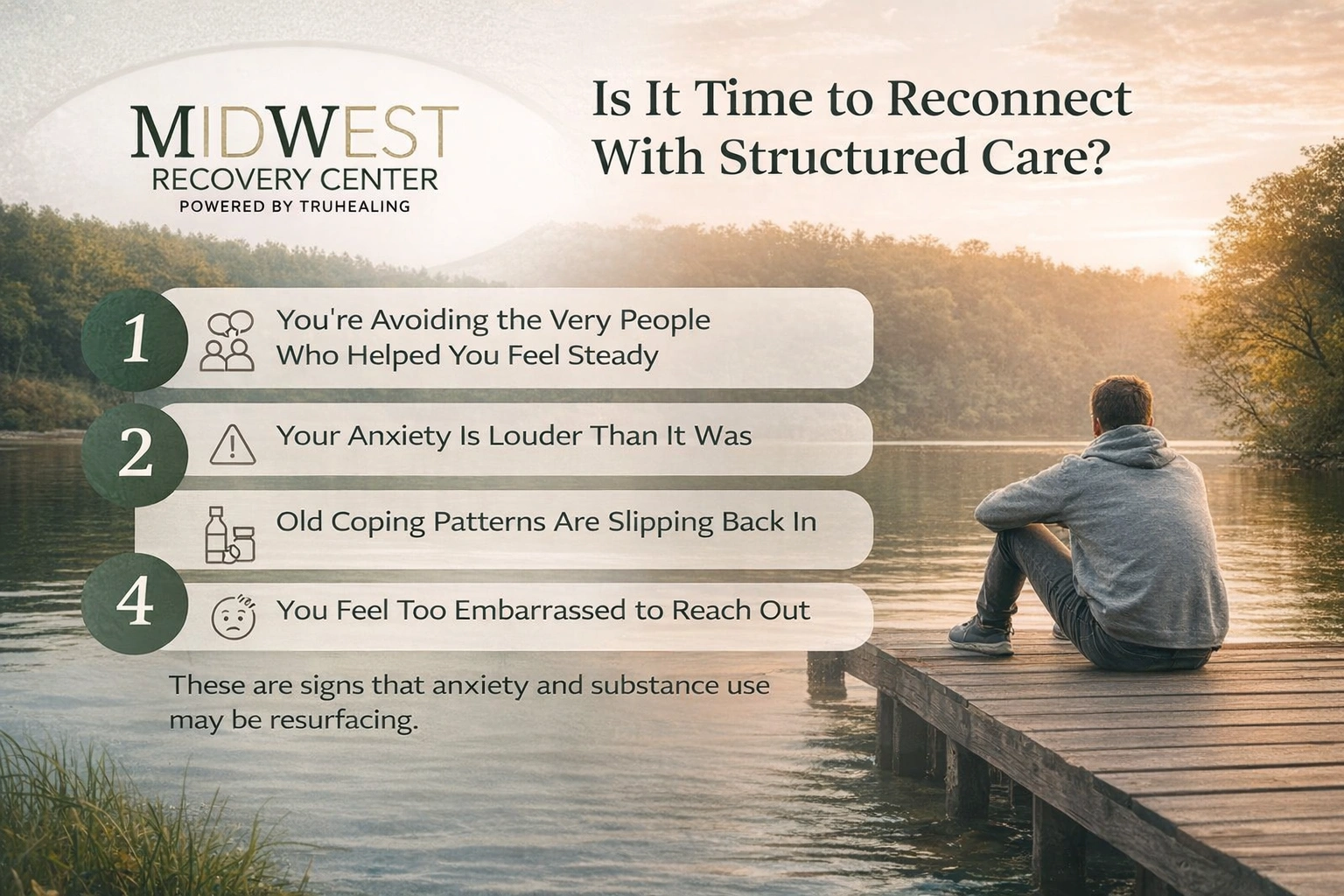
1. You’re Avoiding the Very People Who Helped You Feel Steady

Avoidance is one of anxiety’s favorite tools.

It starts small. You silence notifications. You tell yourself you’ll call your counselor next week. You skip a group because you’re tired—and then the gap grows.

When anxiety rises, isolation often follows. And isolation is fertile ground for both anxious spirals and substance use.

I’ve watched people convince themselves that disappearing is easier than explaining. Easier than saying, “I’m not okay.” Easier than admitting they used again. Easier than facing perceived judgment.

But here’s what’s important: avoidance usually means something inside you feels overwhelmed—not resistant to help.

If you’ve pulled back from safe connections, that’s not a character flaw. It’s a signal.

Structured, multi-day weekly care exists partly because healing is hard to do alone. If your world is shrinking again, that’s worth noticing.

2. Your Anxiety Is Louder Than It Was

When people first enter treatment, anxiety is often front and center. Over time, with consistency and support, it usually softens. Not disappears—but steadies.

If you’ve stepped away and notice:

  • Racing thoughts returning
  • Constant self-criticism
  • Trouble sleeping
  • Physical tension that won’t let up
  • A sense of dread without a clear reason

Those are not random setbacks. They’re signs your nervous system may need more structure again.

Anxiety has a way of rewriting the story. It says:

  • “They’re judging you.”
  • “You already messed up.”
  • “You’re too far behind to go back.”

As a clinician, I can tell you: those thoughts are symptoms, not truths.

When mental health and substance use collide, anxiety often becomes the driver. Substances may temporarily quiet it, but they rarely resolve it. In fact, they tend to amplify it over time.

If anxiety feels like it’s running the show again, it’s not weakness. It’s information.
midwest_recovery_reconnect

3. Old Coping Patterns Are Slipping Back In

This is often the most painful sign to admit.

Maybe you told yourself you’d “just take a short break.” But during that break, something familiar crept back in.

  • Drinking to fall asleep.
  • Using to take the edge off social anxiety.
  • Increasing frequency without meaning to.
  • Telling yourself it’s manageable—even when it feels heavier.

Substances are often used as emotional regulators. Especially for anxiety.

But here’s the difficult truth: when substances become the primary coping tool again, anxiety almost always worsens underneath.

You may notice:

  • Hangxiety (heightened anxiety after drinking or using)
  • Mood swings
  • Increased irritability
  • Shame cycles that fuel more use

This doesn’t mean you’ve undone everything you learned. Skills don’t disappear. They get buried under stress.

Returning to structured care doesn’t mean starting from scratch. It means reactivating what you already know—with more support around it.

4. You Feel Too Embarrassed to Reach Out

This is one of the most common barriers I see.

People don’t stay away because they don’t care. They stay away because they feel ashamed.

They imagine staff saying, “Why did you leave?”
They imagine being judged.
They imagine being seen as unreliable.

Let me say something clearly: treatment teams expect interruptions. Life happens. Symptoms flare. People relapse. People get scared.

The door is not closed because you stepped outside.

Embarrassment is often a sign that you still value what you had. It means the experience mattered to you.

And here’s something I’ve learned: the longer you wait to reconnect, the heavier the shame becomes. But the moment you send the email or make the call, that weight usually starts to lift.

Shame thrives in silence. It weakens in conversation.

5. You Keep Telling Yourself “I Should Be Able to Handle This”

High-functioning individuals especially struggle here.

You might still be going to work. Still paying bills. Still showing up for family. So you tell yourself you don’t “really” need that level of care.

But needing support isn’t about collapsing. It’s about prevention.

If you notice you’re white-knuckling your days—holding it together externally while internally feeling exhausted—that’s meaningful.

Structured outpatient care isn’t punishment. It’s scaffolding. It holds things steady while you rebuild balance.

You don’t have to hit a dramatic bottom to deserve help.

6. A Small Part of You Is Still Reading This

This may be the most important sign of all.

If you’re here, something inside you hasn’t given up.

It may be skeptical. It may be frustrated. It may be tired of trying.

But it’s still listening.

In my experience, that quiet voice is often the part that knows you felt better with consistent support. It remembers moments of clarity. It remembers what steadiness felt like.

That voice doesn’t need to shout. It just needs space.

And sometimes, returning to a setting like an intensive outpatient program provides that space again—without requiring you to uproot your entire life.

Why Anxiety and Substance Use Often Travel Together

It’s important to understand this dynamic without turning it into a lecture.

Anxiety increases discomfort.
Substances reduce discomfort—temporarily.
The relief reinforces the behavior.
The after-effects increase anxiety.

And the cycle tightens.

Breaking that cycle alone is incredibly difficult. Breaking it with structured accountability, peer support, and clinical guidance is far more sustainable.

That’s why returning to care isn’t about “trying harder.” It’s about changing the conditions around you.

What Coming Back Actually Looks Like

Many people imagine that returning means:

  • Starting from day one
  • Being publicly called out
  • Repeating everything exactly the same way

In reality, re-entry is often collaborative.

It can look like:

  • Reassessing your current stressors
  • Adjusting frequency or scheduling
  • Rebuilding a treatment plan that reflects where you are now
  • Addressing what made you step away in the first place

Treatment is not a one-and-done event. It’s iterative.

You are not the same person you were when you started. And that matters.

You’re Not the Only One Who Has Left and Come Back

Many people step away at least once.

Sometimes it’s fear. Sometimes logistics. Sometimes relapse. Sometimes life chaos.

What separates long-term stability from ongoing struggle isn’t perfection. It’s the willingness to return when things wobble.

And returning often requires more courage than starting.

If you’re in the Youngstown area and looking for steady, compassionate treatment in your community, you can explore available support in Youngstown, Ohio. Knowing care is local and accessible can make re-entry feel more manageable.

You don’t have to explain everything perfectly before reaching out. You just have to take one step.

Frequently Asked Questions

What if I relapsed while I was away?

Relapse is common in recovery. It does not disqualify you from treatment. In fact, it’s often a reason to strengthen support. Most programs are prepared to help you process what happened and build more sustainable coping strategies.

Will I have to start completely over?

Not necessarily. Your treatment team will likely reassess where you are now, but previous progress still matters. Skills you learned are still yours. The goal is to build on them—not erase them.

I feel ashamed. Is that normal?

Very normal. Shame is one of the strongest emotional barriers to re-engaging with care. But shame is also often a sign that you care about your recovery. It’s something that can be worked through—not something that should keep you away.

What if my anxiety is worse than before?

Anxiety can spike when support structures fall away or when substance use resumes. That doesn’t mean you’re broken. It means your nervous system may need consistent, guided regulation again.

How do I actually reach out after ghosting?

You don’t need a perfect script. A simple message works:

“I’d like to talk about returning. I’ve been struggling.”

That’s enough to start.

What if I’m not sure I need that level of care again?

It’s okay to explore options. A conversation doesn’t commit you to anything. It gives you information. Sometimes clarity comes through dialogue, not isolation.

You’re Allowed to Come Back

There’s a misconception that treatment only works if you do it perfectly the first time.

That’s not how healing works.

Healing is often uneven. It includes pauses. Doubt. Fear. Re-entry.

If anxiety is creeping back in, if substances are quietly taking up more space again, if isolation is growing—those aren’t verdicts. They’re signals.

Signals that you may need steadiness again. Structure again. Support again.

Call (888) 657-0858 or visit our intensive outpatient program services to learn more.

You won’t be met with lectures.
You won’t be asked to defend your absence.

You’ll be met with people who understand that sometimes the bravest step isn’t starting.

It’s coming back.
*The stories shared in this blog are meant to illustrate personal experiences and offer hope. Unless otherwise stated, any first-person narratives are fictional or blended accounts of others’ personal experiences. Everyone’s journey is unique, and this post does not replace medical advice or guarantee outcomes. Please speak with a licensed provider for help.

Level Of Care

PHP (Partial Hospitalization Program)
Daytime treatment with structure, therapy, and support—return home each night.

IOP (Intensive Outpatient Program)
Flexible therapy a few days a week to balance life and recovery.

OP (Outpatient Program)
Ongoing therapy and support to maintain progress.

MAT (Medication-Assisted Treatment)
Evidence-based care using medication and counseling to reduce cravings.

Ready to Start?
Call (833) 657-0858: to learn which program fits your recovery goals.

Who are you seeking help for? *

We’re here to listen and help you find the right path forward. Please tell us who needs care so we can match you with the best program and support.

💬 Your responses are 100% confidential and never shared outside our admissions team.

Recovery Shouldn’t Have to Wait — Begin Treatment Today.

At Ohio Treatment Center in Toledo, Ohio, we make it simple to take that first step toward healing. Our streamlined admissions process can often lead to same-day placement in treatment for MAT, PHP, IOP and more..

Call today for a free, confidential consultation with our caring admissions team — we’ll walk you through every step with compassion and clarity.

Call (833) 657-0858
Why call us?

Check Your Insurance Coverage in Minutes

We’ll handle the insurance details — so you can focus on getting better.

At Ohio Treatment Center, we work with most major private insurance providers to make treatment affordable and accessible. Complete our quick, confidential form below, and we’ll let you know if your plan is in-network — without contacting your insurance company.

Commonly accepted providers include:
Blue Cross Blue Shield (BCBS) • Aetna • Cigna • UnitedHealthcare • Humana • Anthem • Tricare

What Happens Next

  • Fill out the short form below
  • Our team reviews your benefits
  • We’ll contact you with your coverage details

Getting help shouldn’t be stressful. Let’s find out what your insurance can cover today.

Level Of Care

Detox
Begin recovery safely with 24/7 medical support. Our detox program helps you manage withdrawal comfortably and prepares you for the next step.

Residential Treatment
Continue healing in a supportive, structured setting with daily therapy, wellness activities, and round-the-clock care.

Aftercare
Before you leave, we’ll help you create a plan for ongoing support and lasting recovery.

Ready to Start?
Call (833) 657-0858: to learn which program fits your recovery goals.

Who are you seeking help for? *

We’re here to listen and help you find the right path forward. Please tell us who needs care so we can match you with the best program and support.

💬 Your responses are 100% confidential and never shared outside our admissions team.

Recovery Shouldn’t Have to Wait — Begin Treatment Today.

At Midwest Detox Center in Maumee, Ohio, we make it simple to take that first step toward healing. Our streamlined admissions process can often lead to same-day placement in treatment for medically supervised detox and residential treatment programs.

Call today for a free, confidential consultation with our caring admissions team — we’ll walk you through every step with compassion and clarity.

Call (833) 657-0858
Why call us?

Check Your Insurance Coverage in Minutes

We’ll handle the insurance details — so you can focus on getting better.

At Midwest Detox, we work with most major private insurance providers to make treatment affordable and accessible. Complete our quick, confidential form below, and we’ll let you know if your plan is in-network — without contacting your insurance company.

Commonly accepted providers include:
Blue Cross Blue Shield (BCBS) • Aetna • Cigna • UnitedHealthcare • Humana • Anthem • Tricare

What Happens Next

  • Fill out the short form below
  • Our team reviews your benefits
  • We’ll contact you with your coverage details

Getting help shouldn’t be stressful. Let’s find out what your insurance can cover today.

Level Of Care

Medical Detox
24/7 medically supervised detox to help you safely withdraw from drugs or alcohol while managing symptoms and preventing complications.

Inpatient Treatment
A structured, residential setting that provides continuous medical care, counseling, and therapeutic support to build a foundation for long-term recovery.

Residential Program
Comfortable, home-like housing where you can focus fully on healing with daily therapy, peer support, and holistic recovery services.

Ready to Start?
Call (833) 657-0858: to learn which program fits your recovery goals.

Who are you seeking help for? *

We’re here to listen and help you find the right path forward. Please tell us who needs care so we can match you with the best program and support.

💬 Your responses are 100% confidential and never shared outside our admissions team.

Recovery Shouldn’t Have to Wait — Begin Detox Today

At Ohio Detox Center in Maumee, Ohio, we make it simple to take that first step toward healing. Our streamlined admissions process can often lead to same-day placement in detox or inpatient treatment for substance use and co-occurring mental health conditions.

Call today for a free, confidential consultation with our caring admissions team — we’ll walk you through every step with compassion and clarity.

Call (833) 657-0858
Why call us?

Check Your Insurance Coverage in Minutes

We’ll handle the insurance details — so you can focus on getting better.

We’ll take care of the details — so you can focus on getting better.
At Ohio Detox Center, we work with Ohio Medicaid and most major insurance providers to make treatment affordable and accessible.

Here’s how it works:

  1. Fill out the short form below
  2. Our team reviews your benefits
  3. We’ll contact you with your coverage details

Getting help shouldn’t be stressful. Let’s find out what your insurance can cover today.

Levels of Care

Detox
We understand that taking the first step can feel overwhelming. Our detox program offers a compassionate, medically supported environment where you can rest, heal, and begin recovery safely. You’ll never go through it alone — our team is with you every step of the way.

IOP (Intensive Outpatient Program)
A flexible treatment option that lets you maintain work, school, or family responsibilities while attending therapy several days a week. IOP focuses on relapse prevention, coping skills, and long-term recovery through group and individual sessions.

Residential
Residential care gives you the time and space to focus fully on healing. Surrounded by supportive staff and peers, you’ll work through underlying causes of addiction, rebuild healthy routines, and rediscover confidence in your recovery journey.

MAT (Medication-Assisted Treatment)
Combining FDA-approved medications with counseling and behavioral therapy, MAT helps reduce cravings and withdrawal symptoms related to opioid or alcohol use. Each treatment plan is closely monitored to ensure comfort, safety, and lasting recovery.

Ready to Start?
Call (833) 657-0858: to learn which program fits your recovery goals.

Who are you seeking help for? *

We’re here to listen and help you find the right path forward. Please tell us who needs care so we can match you with the best program and support.

Myself

A loved one or family member

💬 Your responses are 100% confidential and never shared outside our admissions team.

Check Your Insurance Coverage in Minutes

We’ll handle the insurance details — so you can focus on getting better.

At Midwest Centers at Youngstown, we work with most major private insurance providers to make treatment affordable and accessible. Complete our quick, confidential form below, and we’ll let you know if your plan is in-network — without contacting your insurance company.

Commonly accepted providers include:
Blue Cross Blue Shield (BCBS) • Aetna • Cigna • UnitedHealthcare • Humana • Anthem • Tricare

What Happens Next

  • Fill out the short form below
  • Our team reviews your benefits
  • We’ll contact you with your coverage details

Getting help shouldn’t be stressful. Let’s find out what your insurance can cover today.

Recovery Shouldn’t Have to Wait — Begin Treatment Today.

At Midwest Centers at Youngstown in Ohio, we make it simple to take that first step toward healing. Our streamlined admissions process can often lead to same-day placement in treatment for substance use or co-occurring mental health disorders.

Call today for a free, confidential consultation with our caring admissions team — we’ll walk you through every step with compassion and clarity.

Level Of Care

Partial Hospitalization Program (PHP)
Our PHP offers a highly structured, supportive environment where you can focus on recovery during the day and return home at night. It’s an ideal step between inpatient and outpatient care, providing daily therapy, accountability, and a strong recovery routine.

Intensive Outpatient Program (IOP)
Our IOP gives you the flexibility to continue work, school, or family life while receiving evidence-based treatment several days a week. You’ll participate in group and individual therapy focused on relapse prevention, coping skills, and long-term healing.

Outpatient Program (OP)
For those transitioning from a higher level of care or seeking ongoing support, our outpatient program offers continued therapy at a pace that fits your lifestyle. It’s a supportive bridge that helps you maintain recovery and stay connected to care.

Medication-Assisted Treatment (MAT)
MAT combines FDA-approved medications with therapy and counseling to reduce cravings and support long-term recovery from opioid or alcohol addiction. Our team monitors each plan closely to ensure safety, comfort, and effectiveness.

Ready to Start?
Call (833) 657-0858: to learn which program fits your recovery goals.

Who are you seeking help for? *

We’re here to listen and help you find the right path forward. Please tell us who needs care so we can match you with the best program and support.

Myself

A loved one or family member

💬 Your responses are 100% confidential and never shared outside our admissions team.

Recovery Shouldn’t Have to Wait — Begin Treatment Today.

At Midwest Recovery Center in Toledo, Ohio, we make it simple to take that first step toward healing. Our streamlined admissions process can often lead to same-day placement in treatment for substance use or co-occurring mental health disorders.

Call today for a free, confidential consultation with our caring admissions team — we’ll walk you through every step with compassion and clarity.

Check Your Insurance Coverage in Minutes

We’ll handle the insurance details — so you can focus on getting better.

At Midwest Recovery Center, we work with most major private insurance providers to make treatment affordable and accessible. Complete our quick, confidential form below, and we’ll let you know if your plan is in-network — without contacting your insurance company.

Commonly accepted providers include:
Blue Cross Blue Shield (BCBS) • Aetna • Cigna • UnitedHealthcare • Humana • Anthem • Tricare

What Happens Next

  • Fill out the short form below
  • Our team reviews your benefits
  • We’ll contact you with your coverage details

Getting help shouldn’t be stressful. Let’s find out what your insurance can cover today.