

You’re doing it all. Keeping the family fed, showing up to work on time, juggling appointments, solving problems, paying bills. People around you think you’ve got it together—and in some ways, you do. But beneath the efficiency, something’s unraveling. You’re tired in a way sleep can’t fix. You feel like you’re living life a few inches to the left of yourself. And maybe you’ve quietly wondered: is this what burnout feels like? Or is it something deeper?
At Midwest Recovery Center, our partial hospitalization program is designed for people exactly like you—those who look “fine” on the outside but feel disconnected, numb, or dangerously close to breaking. Here, you don’t need to collapse to deserve care. You just have to stop pretending it doesn’t hurt.
Behind the Mask: When Functioning Well Isn’t the Whole Story
High-functioning clients are often the last to seek help. They’ve built identities around capability, around not needing much, around being the one others depend on. But emotional pain doesn’t skip you just because you’ve mastered coping.
Maybe you drink more than you’d like to admit—but only at night, and only once the house is quiet. Maybe anxiety simmers under your skin like background static, only breaking into panic when you’re alone. Maybe you haven’t truly felt joy, clarity, or rest in years.
And yet, from the outside, you seem successful. You manage. You show up.
You might even tell yourself:
- “I’m just tired, not depressed.”
- “It’s not that bad. I’ve seen worse.”
- “If I can just get through this week…”
This is what success masking struggle looks like. And this is exactly why partial hospitalization exists.
What Happens in a Partial Hospitalization Program (PHP)?
Partial hospitalization isn’t a pause button—it’s a recalibration. It’s a clinically supported, structured day program that offers depth, safety, and space to heal without stepping completely out of your life.
At Midwest Recovery Center, PHP typically includes five days a week of programming, often five to six hours a day. Clients go home at night, but spend their days immersed in therapy, connection, and skill-building work.
A typical day might look like:
Morning Check-Ins & Emotional Grounding:
Many high-functioning people don’t realize how little time they spend in their bodies. We start with practices to anchor you in the present—often the first pause you’ve had in years.
Group Therapy Sessions:
Not the cliché, not the cliché. These are targeted, therapist-led conversations where you’ll hear echoes of your own story in others—and start to speak yours without fear.
Individual Therapy:
You’ll have dedicated time with a clinician who gets how high-functioning shows up in hiding. Together, you’ll explore patterns, triggers, past wounds, and how those connect to your current symptoms.
Workshops and Skills Training:
Topics range from boundaries and burnout to emotional regulation and healthy coping. You’ll build tools that you can use outside the walls of treatment—because this isn’t theoretical. It’s real life.
Personal Integration Time:
Time for journaling, processing, applying. You’re not just absorbing; you’re embodying.
And unlike weekly therapy, which might take months to reach certain depths, PHP compresses and accelerates growth by giving you time, frequency, and support to go deeper—faster.
Why High-Functioning People Wait So Long to Get Help
One reason high-functioning individuals delay treatment is the belief that their “normal” disqualifies them. You’re not missing work. You’re not out of control. You’re still performing. So how could anything be seriously wrong?
But functioning doesn’t equal thriving. And high performance doesn’t protect against pain.
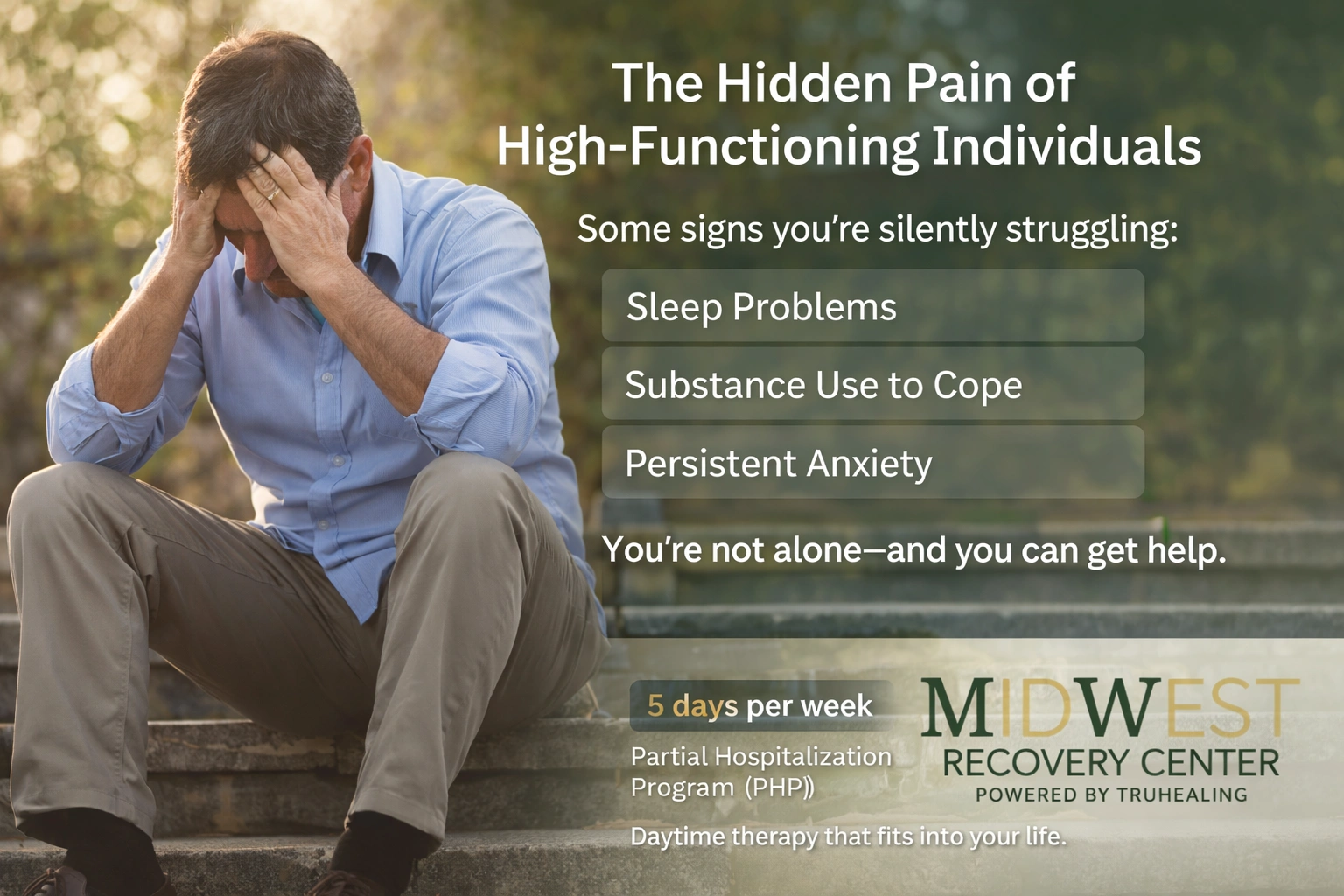
You may be quietly experiencing:
- Sleep disruption or chronic fatigue
- Substance use patterns that feel “needed”
- Anxiety masked as perfectionism
- Depression that shows up as numbness, not sadness
- Isolation despite a full calendar
In some cases, clients arrive in PHP after a subtle tipping point: a panic attack at work, a DUI no one saw coming, a sudden crash in motivation or mood. But for many, it’s just a slow realization that something needs to change—and that something is them.
PHP Is Not a Step Back—It’s a Way Forward
There’s a stigma around higher levels of care. But here’s the truth: PHP isn’t for people who’ve failed. It’s for people who are ready to stop faking “fine.”
You’ll meet others who’ve been carrying too much for too long. People who aren’t in crisis but are in pain. People like you—who’ve learned to function through trauma, stress, or addiction, but are ready to stop surviving and start healing.
You might be surprised how many are professionals, parents, leaders, students, caretakers. They’re not broken. They’re just tired of carrying everything alone.
And they’re discovering something new: that vulnerability can coexist with strength, and that asking for help isn’t weakness—it’s wisdom.
Care That Meets You Where You Are
You don’t need to uproot your entire life to begin treatment. PHP allows you to:
- Sleep in your own bed
- Stay connected to family or caregiving roles
- Keep essential responsibilities while prioritizing your mental health
- Experience deep, therapeutic care in a contained and supportive environment
And while treatment is serious work, many clients say they find moments of peace, laughter, and connection that had been missing for years. There’s something healing about being in a space where everyone’s working on themselves—with intention, honesty, and support.
For those in Maumee, OH, PHP may be more accessible than you think. Whether you’re driving from a quiet neighborhood or commuting from a busy downtown office, a few weeks of structured care can recalibrate your entire trajectory.
How Do I Know If I’m a Good Fit?
If any of the following apply, partial hospitalization might be worth exploring:
- You feel “off” but can’t explain why
- You’re using substances to cope, even subtly
- Therapy feels helpful but not enough
- You’re burning out but can’t slow down
- You’ve reached a place where pretending doesn’t work anymore
And if you’re located near Austintown, OH, there’s real, local support available. You don’t have to leave your life to begin healing—you just need a place that gets what you’re going through.
Frequently Asked Questions (FAQs)
Is partial hospitalization the same as inpatient treatment?
No. PHP is a day program. You go home at night. Inpatient requires 24/7 stay. PHP offers high-level care with more flexibility.
How long does PHP last?
It varies. Most clients attend for 2–4 weeks, depending on needs and goals. Some may continue longer or step down into an intensive outpatient program.
What if I don’t feel “sick enough”?
That’s common. Many high-functioning clients feel unsure if they’re “allowed” to need help. But if you’re suffering, even quietly—it’s enough.
Can I work while in PHP?
Many clients adjust their schedules or take short leaves. PHP is intensive, but some continue part-time work. It’s about balance, not elimination.
What kinds of issues does PHP address?
We work with anxiety, depression, trauma, stress, burnout, substance use, and dual diagnosis. The common thread is emotional suffering that’s impacting daily life—even if it’s not obvious to others.
Will I have to talk in groups?
Yes—but at your pace. Group therapy can be powerful, but you won’t be pushed beyond your comfort. Many people find unexpected relief in finally being real with others.
What If You Didn’t Have to Do It Alone?
You’ve spent years figuring it out on your own. Making it work. Pushing through. Keeping up appearances. But here’s the truth:
Healing doesn’t happen in isolation.
And peace isn’t found in perfection.
There’s another way—one that honors your strength and your struggle. A way to stop just functioning and start feeling fully alive again.
Call (888) 657-0858 to learn more about our partial hospitalization program in Toledo, Ohio.