

If you had looked at my life from the outside, you probably would’ve said I was doing fine.
I had responsibilities. I kept showing up. I answered texts. I paid bills on time. I hit deadlines. I laughed at the right moments. I still looked “functional.”
That word kept me stuck for a long time.
Functional.
Because as long as I could still manage my life outwardly, I convinced myself my drinking or drug use wasn’t serious enough to deserve help. I told myself I was just stressed. Burned out. Overworked. Needing a way to unwind.
But eventually, I had to admit something uncomfortable:
I wasn’t using substances to have fun anymore.
I was using them to tolerate my own life.
That realization hit quietly, not dramatically.
And if you’re reading this while searching for structured recovery support, there’s a good chance some part of you already understands that feeling too.
High-Functioning Addiction Is Easier to Rationalize
One of the hardest parts about being “high-functioning” is how easy it becomes to explain away unhealthy patterns.
I always had evidence ready:
- “I still go to work.”
- “I’m still successful.”
- “Nobody thinks I have a problem.”
- “I’m not as bad as other people.”
- “I can stop if I really want to.”
And technically, some of those things were true.
But addiction doesn’t become harmless just because someone hides it well.
A lot of high-functioning people become experts at survival mode. We learn how to compartmentalize. Push through exhaustion. Perform stability. Minimize emotional pain. Stay productive no matter what’s happening internally.
The problem is that eventually the emotional cost catches up to you.
Even if nobody else notices right away.
I Thought Getting Help Meant Losing My Entire Life
This was probably the biggest reason I delayed treatment.
I thought asking for help meant disappearing from my life completely. Leaving work. Explaining everything publicly. Walking away from responsibilities. Becoming “the person with the addiction.”
And honestly, my ego hated that idea.
A lot of high-functioning people secretly believe productivity protects them from needing support. We think:
“If I’m still functioning, maybe I don’t really qualify for treatment.”
So instead, we bargain with ourselves endlessly.
Cutting back. Making rules. Promising moderation. Swearing this weekend will be different. Trying to control something that quietly stopped feeling controllable a long time ago.
I spent months researching outpatient vs inpatient rehab because I was trying to figure out whether there was a way to get help without completely blowing up my life.
What I didn’t realize at the time was this:
My life already felt emotionally unmanageable internally. I was just hiding it well.
The Exhaustion Was Becoming Harder to Ignore
High-functioning addiction rarely looks dramatic at first.
It looks tired.
I became emotionally flat. Irritated constantly. Restless in ways I couldn’t explain. My brain never fully relaxed unless substances were involved somehow. Even good moments started feeling muted.
I wasn’t enjoying life anymore. I was managing it.
There’s a difference.
One night, I remember sitting in my parked car after work staring at my apartment building because I genuinely did not want to go inside sober. Not because anything terrible was happening there. I just didn’t know how to exist quietly with my own thoughts anymore.
That moment scared me.
Because deep down, I realized I wasn’t using recreationally anymore. I was using for emotional relief.
And once you recognize that, it becomes harder to pretend nothing’s wrong.
Nobody Around Me Really Knew How Bad It Felt
This part can feel incredibly isolating.
When you’re high-functioning, people often praise the exact behaviors helping you hide your struggle:
- “You always keep it together.”
- “You’re so reliable.”
- “I don’t know how you do it all.”
- “You seem totally fine.”
Meanwhile, internally, you may feel emotionally exhausted all the time.
A lot of people with high-functioning addiction become disconnected from themselves gradually. You stop asking whether you’re happy. You stop noticing how anxious you are. You normalize stress levels that would overwhelm most people.
And because nothing is visibly collapsing yet, nobody interrupts the cycle.
Including you.
I Kept Waiting for a “Good Enough” Reason to Get Help
I thought treatment was reserved for people whose lives had completely imploded.
Since mine hadn’t, I convinced myself I still had time.
But honestly? Waiting for total collapse is a dangerous recovery strategy.
One therapist said something during treatment that completely changed how I viewed my situation:
“You don’t have to wait until your suffering becomes catastrophic before you take it seriously.”
That sentence stayed with me because I realized how long I had been minimizing my pain simply because I was still functioning externally.
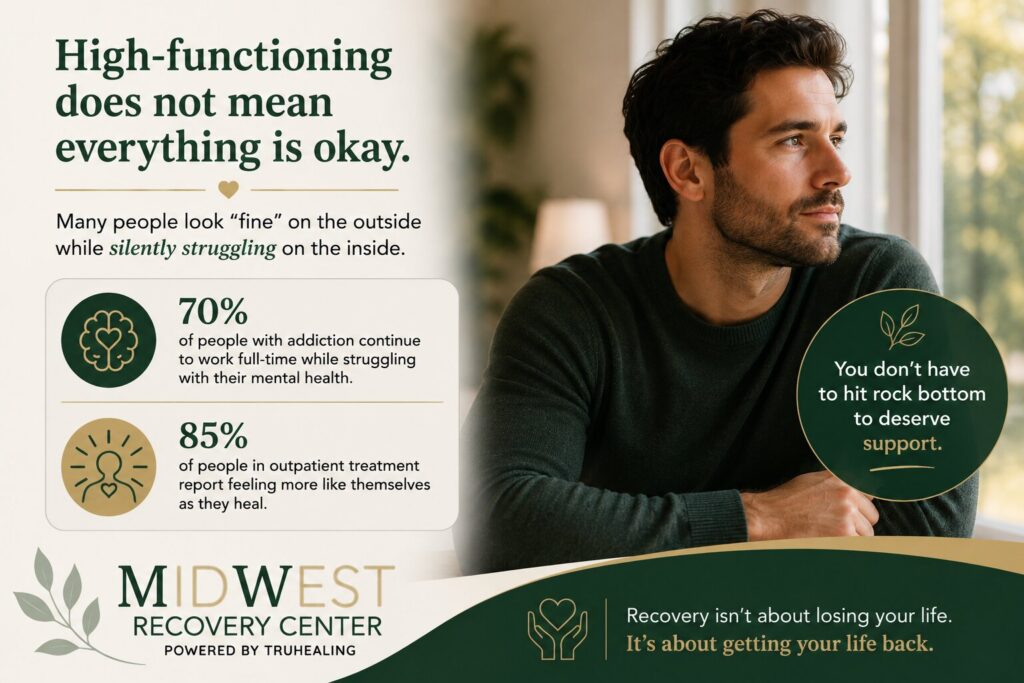
A person can look successful and still be deeply unwell.
Those things are not mutually exclusive.
Entering Treatment Felt Less Dramatic Than I Expected
I expected treatment to feel intense, overwhelming, or humiliating.
Instead, it mostly felt honest.
And honestly? I needed that more than I realized.
For the first time in a long time, I stopped spending all my energy trying to look okay. I stopped managing appearances constantly. I stopped pretending I wasn’t exhausted.
The structure helped in ways I didn’t expect too.
Not because someone was controlling me — but because my nervous system had been running on adrenaline, anxiety, and emotional avoidance for so long that consistency actually felt calming.
Simple things started mattering again:
- Sleeping through the night
- Eating regularly
- Feeling emotionally present in conversations
- Having routines that didn’t revolve around escaping
- Being honest without immediately feeling shame
Those changes sound small until you’ve lived without them for years.
I Had to Stop Romanticizing Independence
This part was uncomfortable.
A lot of high-functioning people quietly attach self-worth to handling everything alone. We treat needing support like failure. We think if we were disciplined enough, smart enough, or successful enough, we should be able to fix ourselves privately.
But isolation feeds addiction incredibly well.
And the more emotionally self-sufficient I tried to become, the less honest I became too.
That’s one reason treatment mattered for me.
Not because someone “saved” me. But because other people interrupted the lies I had normalized:
- “I’m fine.”
- “It’s not that serious.”
- “I can handle it myself.”
- “I just need to get more disciplined.”
Sometimes high-functioning people are drowning quietly because they’ve become too skilled at appearing capable.
Some of the People in Treatment Looked Exactly Like Me
This surprised me more than anything.
I expected treatment to feel foreign. Instead, I met people who were ambitious, intelligent, successful, funny, capable — and deeply emotionally exhausted underneath it all.
People who maintained careers while privately unraveling. People who looked stable publicly while silently depending on substances to cope with stress, anxiety, burnout, loneliness, or emotional overload.
That mattered.
Because high-functioning addiction can make you feel uniquely isolated. You start believing nobody else understands what it’s like to look successful while feeling internally chaotic all the time.
But plenty of people understand.
Most are just hiding it too.
Recovery Didn’t Ruin My Life—It Returned Parts of It
This was the thing I feared most before treatment:
“What if getting help destroys everything I built?”
What actually happened was much quieter than that.
I started feeling present again.
Not instantly happy. Not magically healed overnight. But emotionally present in my own life again.
Food tasted better. Conversations felt more real. My body stopped feeling constantly overwhelmed. I wasn’t structuring every evening around escaping myself emotionally anymore.
And slowly, I realized something painful:
I had normalized suffering for so long that peace initially felt unfamiliar.
That’s what high-functioning addiction often does. It convinces people constant stress, numbness, anxiety, exhaustion, or emotional disconnection are simply adulthood.
They’re not.
Recovery Was Less About “Fixing” Me and More About Letting Me Breathe
I think this is important to say.
Treatment didn’t turn me into a completely different person. It helped me reconnect with parts of myself I had buried underneath stress, substances, pressure, and emotional survival mode.
The goal wasn’t perfection.
It was learning how to exist without constantly needing to numb my own mind to get through the day.
And honestly? That changed everything.
You Don’t Need to Completely Fall Apart Before You Ask for Help
A lot of high-functioning people wait too long because they think needing help means they’ve failed somehow.
But you are allowed to recognize that something feels unsustainable before your entire life collapses.
You are allowed to admit:
- You’re exhausted
- You’re emotionally overwhelmed
- You’re tired of surviving this way
- You don’t want substances controlling your nervous system anymore
- You want support before things get worse
That doesn’t make you weak.
It makes you honest.
For people exploring care in locations or searching for treatment support near Toledo, Ohio, I think this matters most:
You do not need permission from other people to take your pain seriously.
FAQ: High-Functioning Addiction and Intensive Outpatient Support
Can someone have an addiction and still seem successful?
Yes. Many people struggling with addiction maintain jobs, relationships, responsibilities, and outward stability while privately struggling emotionally and physically.
What is high-functioning addiction?
High-functioning addiction refers to someone who appears productive or stable externally while still experiencing harmful substance use patterns internally.
Why do high-functioning people avoid treatment?
Many fear judgment, loss of independence, career disruption, or admitting they need help. Some also minimize their struggles because their life hasn’t visibly collapsed.
What made outpatient care appealing?
For many people, outpatient care offers structured support while still allowing them to maintain certain work, family, or daily responsibilities.
Is it normal to feel emotionally exhausted while still functioning?
Very normal. High-functioning addiction often involves chronic stress, burnout, emotional numbness, anxiety, and internal exhaustion that others may not see.
Do I need to hit rock bottom before getting help?
No. You do not need catastrophic consequences before your struggles become valid enough to deserve support.
Will treatment completely disrupt my life?
Treatment plans vary. Many people seek structured support options that help them stay connected to work, family, or other responsibilities while receiving care.
What if nobody else thinks my problem is serious?
Other people’s perceptions do not determine whether your relationship with substances is harming your mental health, emotional well-being, or quality of life.
You Are Allowed to Stop Surviving Like This
If you’re functioning outwardly while quietly unraveling inside, you are not alone.
A lot of people wait years before admitting they’re exhausted because they think needing support somehow cancels out their success.
It doesn’t.
You are allowed to want peace instead of constant emotional management.
You are allowed to stop numbing your way through life.
And you are allowed to ask for help before everything completely falls apart.
If you’re considering treatment support in Ohio, Midwest Recovery Center offers compassionate care designed to help people rebuild stability while staying connected to the parts of life that still matter to them.
Call (888) 657-0858 or visit our intensive outpatient program services in Toledo, Ohio to learn more about our intensive outpatient program services in Toledo, Ohio.