

Maybe you meant to miss just one session.
Then one week turned into two. Then your phone felt heavier every time you thought about calling. Then silence felt easier than explaining.
If you stepped away from our intensive outpatient program, we want to say something clearly and without hesitation:
You are allowed back.
Not reluctantly. Not conditionally. Not with a lecture waiting.
Just back.
This guide will walk you through how to return after dropping out — gently, honestly, and with your dignity intact.
Step 1: Let Go of the “I Blew It” Story
Before you reconnect, there’s usually a narrative running in the background.
“I messed this up.”
“They probably think I wasn’t serious.”
“I should’ve done better.”
We understand that voice. Many clients carry it quietly.
But here’s the truth: stepping away from treatment doesn’t erase the progress you made. The coping tools you learned are still yours. The insight you gained didn’t disappear.
Recovery isn’t a straight line. It bends. It stalls. It restarts.
Leaving doesn’t mean you failed. It means something overwhelmed you.
That’s human.
And humans are welcome here.
Step 2: Keep the Outreach Simple
You do not need a perfect explanation.
You do not need a long apology.
You do not need to justify every detail of what happened while you were gone.
A simple message works:
“I’d like to talk about coming back.”
That’s enough.
Most people delay reaching out because they think they need to explain everything first. But reconnection starts with contact — not with a polished story.
Pressing send is often the hardest part. After that, the tension usually begins to ease.
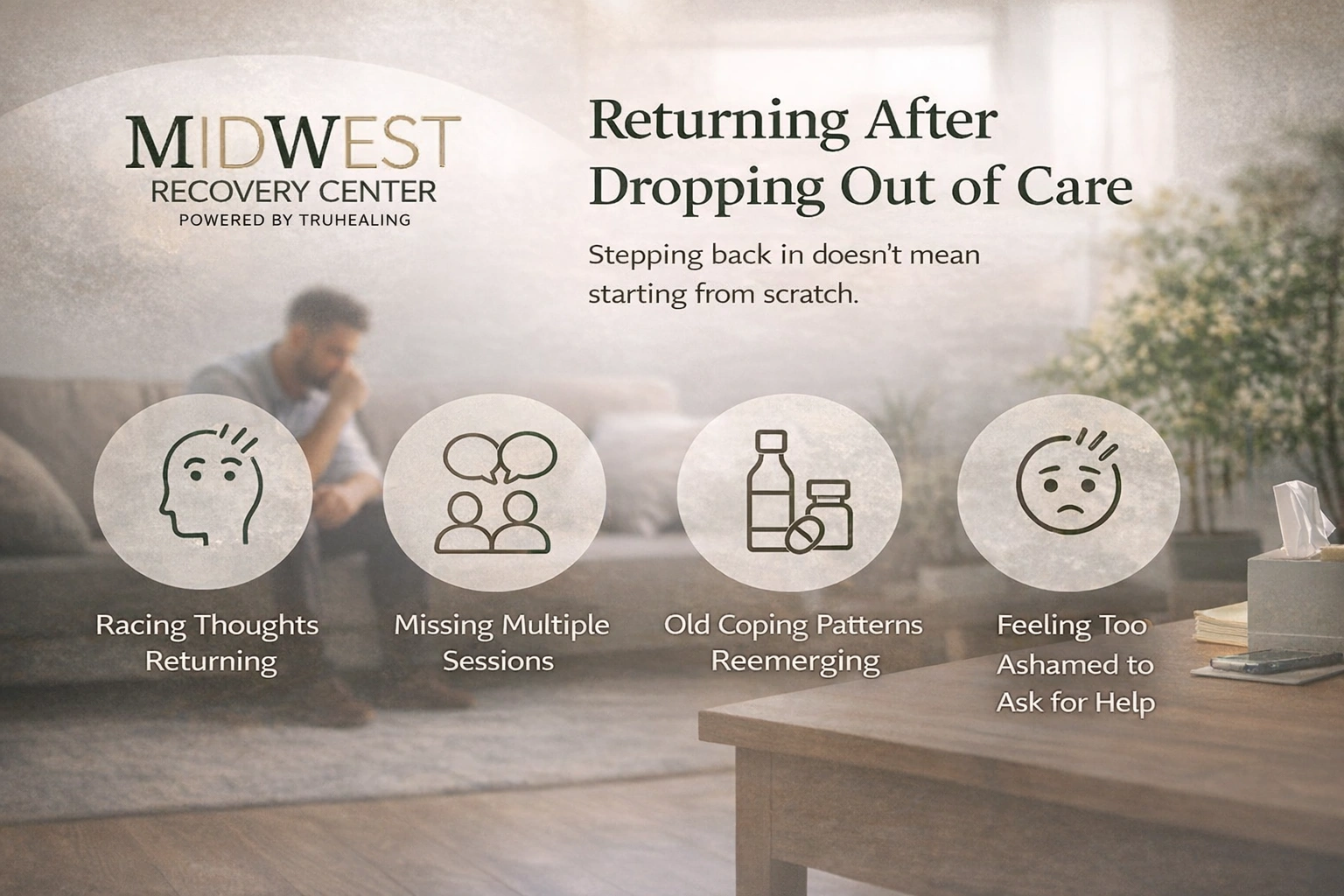
Step 3: Expect a Conversation, Not a Scolding
One of the biggest fears we hear is this:
“They’re going to ask why I left.”
We may ask what happened — but not to assign blame. We ask so we can understand what support needs adjusting.
When someone returns, we focus on:
- What felt overwhelming
- What changed in your life
- Whether anxiety increased
- Whether substance use returned
- What would make treatment more sustainable now
That’s not interrogation. That’s collaboration.
When mental health and substance use collide, disengagement is often a symptom — not defiance.
We don’t punish symptoms. We respond to them.
Step 4: Be Honest About What Happened
If you relapsed, tell us.
If anxiety spiked and you couldn’t walk into group, tell us.
If life became chaotic — work, family, transportation, stress — tell us.
You’re not the first person to say those things.
In fact, many clients who return say that the break helped them understand their triggers more clearly. Sometimes stepping away reveals the pressure points that need strengthening.
We can’t adjust the plan if we don’t know what made it crack.
Honesty speeds up stabilization.
Step 5: Allow This to Be a Restart — Not a Reset to Zero
Coming back does not mean erasing your previous work.
You are not “starting over from scratch.”
You are returning with more awareness than before.
You know how groups run.
You know which skills resonated.
You know where you struggled.
That knowledge matters.
Multi-day weekly treatment works best when it evolves with you. Re-entry is often smoother because you’re not walking in blind.
It’s less about beginning again and more about continuing differently.
Step 6: Understand That You’re Not the Only One
Many people step away from care at some point.
Some leave because they feel better and think they can manage alone.
Some leave because anxiety becomes louder.
Some leave because substance use returns.
Some leave because life logistics get complicated.
And many of them come back.
We’ve watched people return stronger because they now understand their patterns more clearly. The second attempt often carries deeper honesty.
One former client shared, “I thought they’d be disappointed. Instead, they were relieved I came back.”
That relief is real.
If you’re looking at treatment options close to home, compassionate support is available in communities like Maumee, Ohio and Austintown, Ohio. You don’t have to travel far or uproot your life to reconnect with care.
Knowing help is nearby can lower the emotional barrier to walking back in.
Step 7: Focus on One Step — Not the Entire Future
Anxiety loves big, overwhelming questions.
“What if I leave again?”
“What if I can’t stick with it?”
“What if nothing changes?”
Those are future-based fears.
Right now, the only decision in front of you is whether to reconnect.
You don’t need to solve the next six months. You don’t need guarantees.
You need one small act of courage.
Recovery is rarely rebuilt in dramatic leaps. It’s rebuilt in returns.
Sometimes the bravest thing you’ll do isn’t starting treatment.
It’s coming back to it.
Why People Leave in the First Place
Let’s normalize something important.
People don’t usually leave because they don’t care.
They leave because something felt:
Too heavy.
Too vulnerable.
Too exposing.
Too time-consuming.
Too emotionally raw.
Group discussions can bring things to the surface. Accountability can feel intense. Sitting with anxiety without numbing it can feel unbearable at first.
If you stepped away because it felt overwhelming, that doesn’t mean the support was wrong for you. It may mean we need to adjust the pace, the approach, or the structure.
That’s solvable.
What Often Changes When Clients Return
We’ve seen powerful shifts when people come back.
They’re more honest about cravings.
They speak up sooner when anxiety spikes.
They ask for adjustments instead of disappearing.
The shame that once kept them silent becomes something they can name out loud.
And once shame is spoken, it loses volume.
Clients who return often describe feeling lighter — not because everything is fixed, but because they’re no longer carrying it alone.
The Quiet Truth About Recovery
Recovery is not about perfection.
It’s about persistence.
It’s about returning when you wobble. It’s about choosing support even after you feel embarrassed. It’s about refusing to let one pause define your entire path.
If you’re reading this, that means a part of you still cares deeply about your stability.
That part deserves reinforcement — not criticism.
Frequently Asked Questions
What if I relapsed while I was away?
Relapse is common and does not disqualify you from returning. In many cases, it highlights where support needs strengthening. We address it clinically and compassionately — not punitively.
Will everyone know I dropped out?
No. Re-entry is handled professionally and respectfully. Your return is not announced or highlighted. We focus on moving forward.
Do I have to repeat everything?
Not necessarily. Your treatment plan will be reassessed, but previous progress still counts. We build from where you are now, not from zero.
What if I’m embarrassed to face staff or peers?
Embarrassment is common. Most clients find that the anticipation is worse than the actual return. Once you’re back in the room, the relief usually outweighs the discomfort.
What if anxiety is what made me leave?
That’s important information — and something we can address directly. If anxiety became overwhelming, your re-entry plan can focus more intentionally on regulation, pacing, and coping strategies.
Is it normal to leave and come back more than once?
For some people, yes. Recovery can include multiple attempts. What matters is that you keep choosing to return instead of giving up entirely.
You Are Still Welcome Here
You don’t have to craft the perfect comeback story.
You don’t have to defend your absence.
You don’t have to prove you’re ready forever.
You just have to take one step back toward support.
Call (888) 657-0858 to learn more about our intensive outpatient program in Toledo, Ohio.
No lectures.
No punishment.
No closed doors.
Just a team ready to meet you where you are — and walk forward from there.