

It usually doesn’t start with something obvious.
It’s small things at first. A shift in mood. A conversation that feels different. A distance you can’t quite explain but can definitely feel.
And then one day, it hits you:
Something is really wrong.
Not in a dramatic, movie-scene kind of way.
In a quiet, heavy way that sits in your chest and doesn’t leave.
If you’re here, you’re probably already in that moment.
And before anything else—we want you to know this:
You are not overreacting. And you are not alone.
At Midwest Recovery Center, we talk to parents in this exact place every day. You don’t need all the answers yet. You can start by exploring stabilizing care options and simply understanding what support can look like.
The Fear That Builds Before There’s a Plan
There’s a kind of fear that doesn’t come with instructions.
It’s layered. Confusing. Constant.
You might be thinking:
- “How did things get here?”
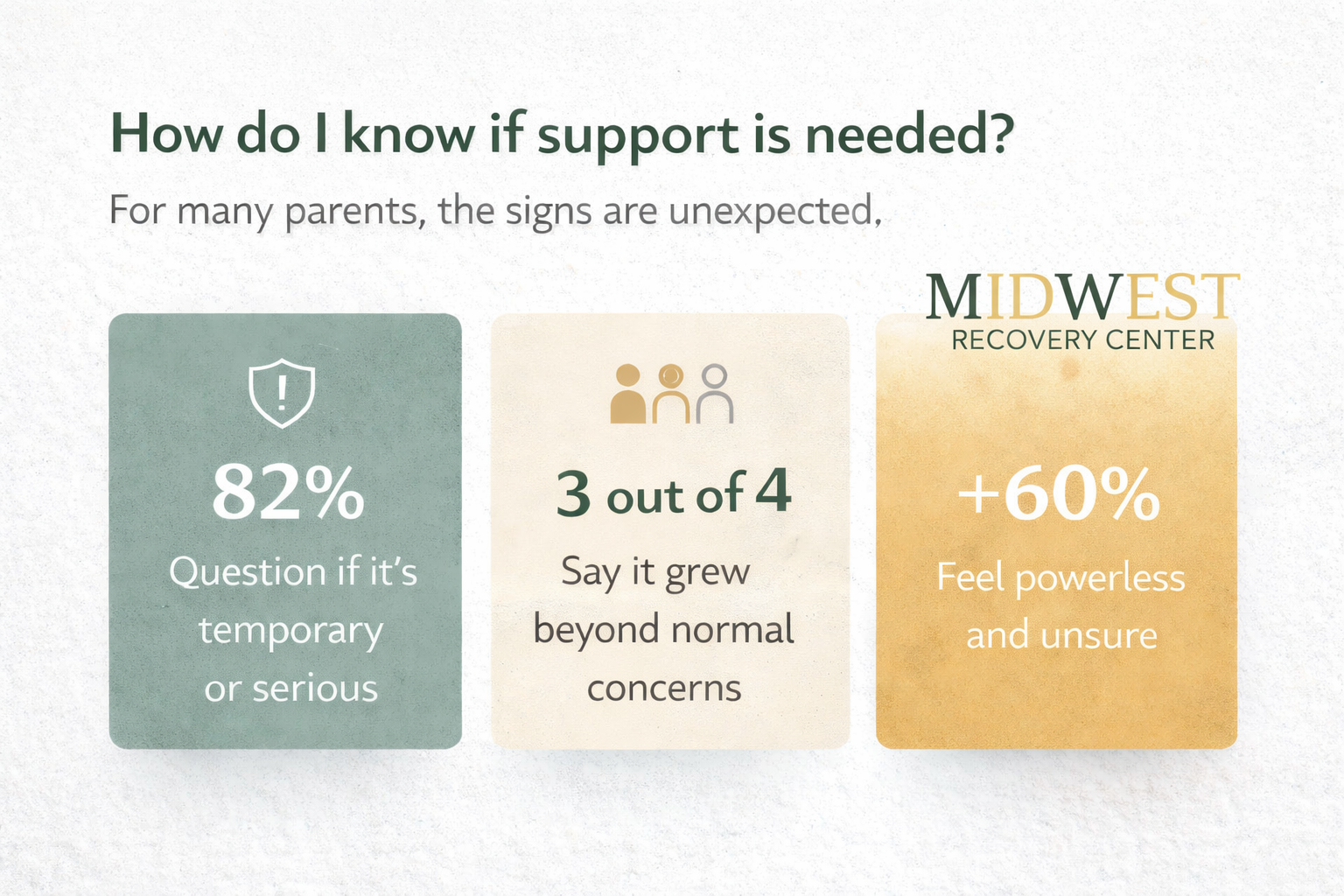
- “Is this temporary… or something serious?”
- “What if I wait too long to act?”
And at the same time:
- “What if I do the wrong thing?”
That tension—between urgency and uncertainty—is one of the hardest parts of being a parent in this situation.
Because you’re trying to protect your child…
without knowing exactly what they need.
Why This Doesn’t Respond to “Trying Harder”
You may have already tried everything that feels natural as a parent.
Talking. Setting boundaries. Offering support. Pulling back. Leaning in.
And still, something isn’t shifting.
That’s not because you’re doing it wrong.
It’s because what you’re dealing with doesn’t always respond to effort alone.
When a young adult is caught in a pattern that affects how their brain and body function, it can override logic, promises, and even consequences.
Which is why you might see this cycle:
- They say they’ll change
- They mean it in that moment
- And then… something pulls them right back
It’s frustrating. And heartbreaking.
But it’s also a sign that something deeper needs support—not just more pressure.
What Stabilization Really Means (And Why It Comes First)
When parents hear about treatment, they often imagine transformation.
They hope for a moment where everything clicks—where their child suddenly becomes motivated, engaged, and “back to normal.”
But in reality, the first goal isn’t transformation.
It’s stabilization.
And stabilization looks different than most people expect.
It can look like:
- Less emotional volatility
- Fewer crisis moments
- More predictable behavior
- Small, consistent steps instead of big swings
It’s not flashy.
But it’s powerful.
Because when things stabilize, your child has a chance to think more clearly, respond more intentionally, and reconnect with parts of themselves that have been buried under chaos.
The Complicated Feelings Around Medication Support
Let’s talk about the part that often brings the most hesitation.
Medication.
Even hearing the word can bring up a lot:
- Fear of dependency
- Fear of personality changes
- Fear of doing something irreversible
And those fears make sense.
You’re not just making a decision—you’re making a decision for someone you love deeply.
But here’s what we often see:
When the right kind of support is introduced, it doesn’t erase who your child is.
It reduces the intensity of what’s overwhelming them.
Think of it less like changing them—and more like lowering the volume on something that’s been too loud for too long.
The Moment Parents Start to Breathe Again
There’s a shift that happens.
It’s not immediate.
And it’s not perfect.
But it’s noticeable.
Parents often describe it like this:
- “They seem more present.”
- “Things feel a little calmer.”
- “We’re not in constant crisis anymore.”
That’s stabilization.
And for many families, it’s the first time in a long time that things feel… manageable.
For families seeking support in Maumee, Ohio, having access to structured care nearby can make that shift feel more reachable—especially when everything has felt out of control.
When Urgency Meets Uncertainty
Crisis creates pressure.
It makes everything feel like it needs to be solved immediately.
But at the same time, you might feel like you don’t have enough clarity to make a confident decision.
That can lead to paralysis.
You might find yourself:
- Researching endlessly
- Second-guessing every option
- Waiting for a “clear sign” that tells you what to do
But clarity doesn’t always come first.
Sometimes, support creates clarity—not the other way around.
You Haven’t Failed—You’re Facing Something Complex
This is the part many parents carry silently:
The belief that they should have been able to fix this.
That if they had said the right thing, done something differently, noticed it sooner… things wouldn’t be like this.
But what you’re facing isn’t simple.
It’s not a matter of better parenting or more effort.
It’s something that often requires layered support—support that goes beyond what any one person can provide, no matter how much they care.
And the fact that you’re here, still searching, still trying?
That says everything about your commitment.
What Changes When the Right Support Is in Place
When support begins to work, the changes aren’t always dramatic.
They’re steady.
The constant ups and downs begin to level out.
The tension in the home softens.
Communication becomes possible again—even in small ways.
And slowly, something returns that may have felt lost:
Connection.
For those exploring options near Austintown, Ohio, having access to compassionate, structured care can help create that shift—not overnight, but in a way that actually lasts.
You Don’t Need a Perfect Plan—Just a First Step
Right now, it might feel like everything depends on making the right decision.
But you don’t have to map out the entire path today.
You don’t need certainty about every detail.
You just need one step toward stability.
One conversation.
One question.
One moment of choosing support over uncertainty.
That’s enough to begin.
Frequently Asked Questions
How can I tell if this is serious enough for professional help?
If things feel unstable, unpredictable, or emotionally overwhelming—it’s worth exploring support.
You don’t need a diagnosis to recognize that something isn’t working.
Is it normal to feel conflicted about medication?
Yes.
Most parents feel some level of hesitation. It’s a big decision, and it’s okay to take time to understand what it means and how it might help.
What if my child doesn’t want help?
This is very common.
Support doesn’t always begin with full willingness. Sometimes it starts with small steps, gentle conversations, or creating an environment where help feels less threatening.
Will this change who my child is?
The goal isn’t to change their personality.
It’s to reduce the chaos and instability that are getting in the way of them being themselves.
How long does it take to see improvement?
Every situation is different.
But many families notice small shifts early—more stability, less volatility—even before larger changes begin to take shape.
What should I do if I feel overwhelmed?
Start small.
You don’t have to solve everything today. Focus on one step—whether that’s learning more, asking a question, or reaching out for guidance.
You don’t have to carry this alone.
Call (888) 657-0858 to learn more about our Medication-Assisted Treatment in Toledo, Ohio.