
You walked out. Maybe quietly. Maybe loudly. But you left. And inside your head, a voice keeps pounding:
“You failed. You quit. You’re worthless.”
Here’s the truth: quitting a intensive outpatient program (IOP) doesn’t make you weak. It makes you human.
You thought you could handle it. You thought you were fine. You thought you didn’t need help — until you realised you did.
And now you’re asking: How do I move past this? How do I forgive myself?
If you’re reading this, you still want something better for yourself. That’s hope showing up. Let’s walk it through.
1. Admit the Exit — Without Judgment
Stop pretending it didn’t happen. It did. You left. Maybe you missed a few sessions. Maybe you stopped answering calls. Maybe you changed your number or ghosted.
Whatever the method, the exit is real.
But you walked out not because you’re a bad person. Because survival doesn’t always feel secure. Because you were scared. Because the program felt scary. Because the pain you were trying to avoid felt louder.
So say it: I left IOP.
And then say it again: That part of my story matters — but it is not the whole story.
Naming the exit without self‑punishment clears space for the next step.
2. Recognize What You Were Running From (Not Just What You Left)
Most people who drop out of IOP aren’t running from the idea of getting help—they’re running from feeling exposed, vulnerable, judged, or even found out.
- Maybe your schedule was too much.
- Maybe the group hit truths you weren’t ready to face.
- Maybe you felt like an impostor in treatment, still functioning at work, still doing “fine.”
- Maybe you believed that if you asked for help you’d lose everything you’d built (job, respect, spouse).
Whatever it was, you weren’t running because you don’t need help—you were running because you did need it and didn’t yet believe you could keep your life and ask for help at the same time.
When you recognise that, you stop rolling in shame and start walking in preparation.
3. Redefine What “Starting Over” Really Means
You left IOP. So you must start over, right?
Wrong.
You’re not starting over; you’re re‑starting. The foundation you laid still exists. Every session you attended, every truth you told, every time you survived when you thought you couldn’t—all of that counts.
If you’re in or around Maumee, Ohio and thinking “I should’ve made it work,” instead hear this: you did make it work in part. You just stopped. Now you begin again.
You don’t erase the work. You reclaim it.
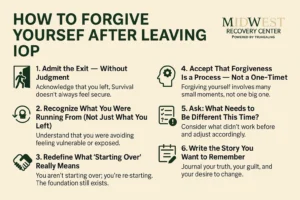
4. Accept That Forgiveness Is a Process—not a One‑Time Event
Forgiving yourself isn’t one dramatic moment where you suddenly feel whole again. It’s dozens of small moments:
- A morning where you don’t drink because you remember you left halfway through IOP.
- A group where you show up and say I’m back.
- A conversation where you don’t explain. You simply say I’m sorry I left.
- A moment where you hold your head up and choose recovery again.
Experts say self‑forgiveness involves acceptance, compassion, responsibility, and renewal.
Don’t wait for “the moment.” Have the moments.
5. Ask: What Needs to Be Different This Time?
The second time around is your chance to recalibrate.
You left once. Why? Because something wasn’t working.
So ask yourself:
- Was the schedule unmanageable?
- Did I hide because I still feared judgement?
- Did I think I had to do it perfectly or not at all?
- Did I feel alone in the room when my peers seemed “better”?
Now design the restart around what you learned:
- Choose a program like the one offered by Midwest Recovery Center in Toledo that understands drop‑outs.
- Set smaller, realistic goals instead of “never miss a session.”
- Build a support person or sponsor who’s been where you are.
- Make transparency your tool—not perfection.
6. Write the Story You Want to Remember
One of the best methods for self‑forgiveness is writing your truth.
- Write the version of events you’ve been telling yourself.
- Then write an alternate version: You arrived. You stopped. You’re returning. You’ll finish.
- Journal the shame, guilt, fear. Then journal the truth beneath them: you wanted healing. You believed in change.
When words are in your control, the story no longer controls you.
7. Return to IOP with a Different Expectation
If you’re in or around Perrysburg, Ohio and you decide to come back, ask for:
- A schedule that fits your real life, not your ideal life.
- Clear communication about what dropout means—not failure.
- A check‑in about how you’ll avoid the same exit pattern.
- A culture of “we’re glad you’re here” instead of “you had to earn this.”
Because dropping out once doesn’t mean you’re disqualified. It means you’re qualified for what you’ve already lived.
FAQs About Returning to an Intensive Outpatient Program After Quitting
Do I have to tell them why I left treatment?
No. You can choose how much to share. What matters is your next move. The program at Midwest Recovery won’t demand a full confession; they’ll support your recommitment.
Will I be judged or look like a “failure” in group?
Not if you choose a program built for people returning. You might realise you’re sitting next to someone who left and came back too. The shame in the room? It’s familiar. And it dissolves when you’re honest.
How can I stop using dropout as the reason I keep postponing help?
See the dropout not as a reason to hide but as a reason to come back. You already tried. That means you know part of the answer. You already have courage.
What if I’m afraid the same thing will happen again?
Then plan for it. Set up a “crisis code” with your sponsor or IOP group. Have one person you call when you feel the pull. Ask about a return clause in your program. Use the dropout as data for what needs to shift.
Does quitting mean I wasted my time?
Not at all. Every moment of awareness, discomfort, asking the question—that was progress. The person you were before quitting and the person you are now? Both needed the same thing: change.
The Invitation
You don’t have to look broken to be ready.
You don’t have to fall apart, hit the bottom, or lose everything to deserve healing.
You just have to say: “I’m back.”
A program like Midwest Recovery’s intensive outpatient program in Toledo is designed exactly for people who tried, paused, questioned, and are now ready again. No shame. No re‑penalties. Just a seat saved for you.
Let’s do this together. One real step. One honest moment. One story rewritten.
Call (888) 657‑0858 or visit our intensive outpatient program in Toledo to learn more and take your next step—on your terms, in your time, with support you deserve.