

You’re doing everything right.
At least, that’s what it looks like.
You’re working. Showing up. Handling responsibilities. Keeping things moving in a way that most people would call impressive.
And yet, there’s a moment—usually when things get quiet—where the truth slips in:
“I don’t know how long I can keep this up.”
That thought doesn’t make you weak. It makes you honest.
At Midwest Recovery Center, we work with people who have built lives that look stable—but feel exhausting to maintain. If that’s where you are, it may be worth exploring options like live-in recovery support—not because everything has fallen apart, but because it hasn’t… yet.
The Hidden Cost of Holding It All Together
High-functioning people rarely get interrupted.
Because from the outside, nothing looks urgent.
You’re not missing work.
You’re not creating obvious problems.
You’re not asking for help.
So no one steps in.
But internally, the cost builds.
It shows up as:
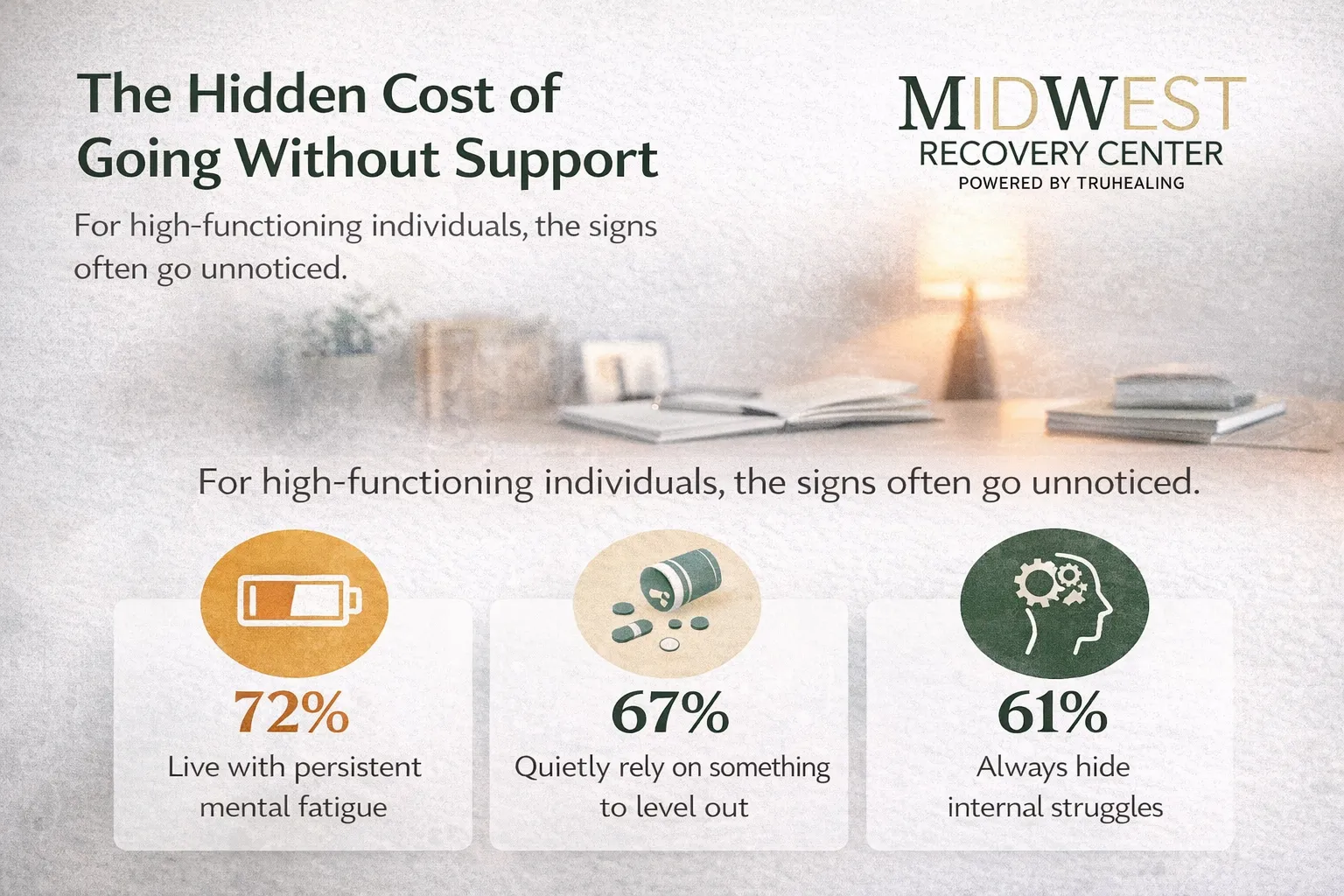
- Mental fatigue that never fully resets
- A quiet dependence on something to “level you out”
- The constant effort of managing how you feel so no one notices
It’s like running a machine at full capacity with no downtime.
Eventually, something starts to overheat.
You’re Not Falling Apart—You’re Slowly Burning Out
Most people expect a crisis to be loud.
But for high-functioning individuals, it’s usually quiet.
You don’t collapse.
You don’t explode.
You wear down.
You might notice:
- Less enjoyment in things that used to matter
- More reliance on routines that help you cope
- A growing sense that you’re just getting through the day
It’s subtle enough to ignore.
But persistent enough that you can’t fully escape it.
The Dangerous Comfort of “Still Functioning”
Here’s the trap:
Because you’re still functioning, it feels like you’re still in control.
You tell yourself:
- “It’s not that bad.”
- “I can manage this.”
- “Other people have it worse.”
And technically, you’re not wrong.
But functioning isn’t the same as thriving.
And over time, that gap between how things look and how they feel starts to widen.
Why Discipline Isn’t Solving This
If discipline were the answer, you’d already be fine.
You have discipline.
That’s how you’ve maintained everything this long.
But this isn’t about trying harder.
It’s about the fact that you’ve been carrying more than your system can sustainably handle.
At some point, it stops being about effort—and starts being about support.
What Happens When You Finally Step Out of the Loop
This is the part most people don’t expect.
When high-functioning individuals step into a more immersive level of care, the first feeling isn’t loss.
It’s relief.
Relief from:
- Having to manage everything alone
- Keeping up appearances
- Constantly negotiating with yourself
There’s a moment where your shoulders drop without you realizing it.
Because for the first time, you don’t have to hold everything together.
The Fear of Stepping Away From What You Built
This is usually the biggest barrier.
“I can’t step away from my life.”
“People rely on me.”
“What happens to everything I’ve worked for?”
These are valid concerns.
But here’s what we often say in clinical settings:
If your current pace isn’t sustainable, stepping away isn’t losing your life—it’s protecting it.
Because the alternative isn’t staying exactly where you are.
It’s slowly losing ground while trying to maintain the same image.
The Moment It Becomes Clear
For most people, there’s a turning point.
Not dramatic. Not public.
Just a quiet realization:
“This isn’t working anymore.”
It might come after a long night.
A stressful week.
A moment where you feel completely disconnected from everything around you.
And instead of brushing it off, you pause.
That pause matters.
Because it’s often the first honest moment you’ve had with yourself in a long time.
You Don’t Have to Wait for a Collapse
A lot of high-functioning individuals wait until something forces them to act.
A consequence. A scare. A breaking point.
But you don’t have to wait for that.
You can choose to step in earlier.
When you still have stability.
When you still have awareness.
When you still have the ability to make a proactive decision.
For individuals exploring care in Toledo, Ohio, making that choice before things escalate often leads to a completely different experience—one rooted in prevention, not crisis.
What Real Stability Actually Feels Like
Most people think stability means “holding it together.”
But real stability feels different.
It feels like:
- Not having to constantly monitor yourself
- Not needing something to get through the day
- Not feeling like everything depends on your ability to keep pushing
It’s quieter than what you’re used to.
And at first, that quiet can feel unfamiliar.
But over time, it starts to feel like something you didn’t realize you were missing.
The Truth About Control
High-functioning individuals often pride themselves on control.
But control can be deceptive.
Because managing something isn’t the same as being free from it.
Real control isn’t about holding everything in place.
It’s about not needing to.
And that’s where deeper support changes the equation.
You’re Not “Too Successful” to Need Help
This belief keeps a lot of people stuck:
“If I really needed help, my life wouldn’t look like this.”
But success doesn’t cancel out struggle.
In fact, it often hides it.
You can be accomplished, respected, reliable—and still be dealing with something that’s quietly taking more from you than you’re willing to admit.
And acknowledging that isn’t failure.
It’s clarity.
What Happens When You Choose Something Different
When you choose to step into support, the shift isn’t immediate transformation.
It’s space.
Space to:
- Think clearly
- Feel without managing it
- Understand what’s actually been going on beneath the surface
And from that space, change becomes possible in a way it never was before.
For those looking for help in Maumee, Ohio, having access to a structured, supportive environment can create that space in a way that’s both safe and sustainable.
You Don’t Have to Prove Anything Anymore
A lot of high-functioning individuals are used to proving themselves.
Proving they’re capable.
Proving they’re in control.
Proving they don’t need help.
But at some point, that proving becomes exhausting.
You don’t need to prove anything to deserve support.
You don’t need to justify how hard this feels.
You just need to be honest about where you are.
And that honesty is where everything starts to shift.
Frequently Asked Questions
If I’m still functioning, do I really need this level of support?
Functioning doesn’t always reflect what’s happening internally.
If maintaining your current life feels exhausting, overwhelming, or unsustainable, that’s worth paying attention to.
Will stepping away from my responsibilities set me back?
It can feel that way at first.
But in many cases, stepping away temporarily prevents much larger disruptions down the line. It’s a way of protecting what you’ve built.
What if I don’t feel “bad enough” to need help?
There’s no threshold you have to meet.
If something feels off, that’s enough reason to explore support. Waiting for things to get worse isn’t a requirement.
How quickly do people notice a difference?
Many people notice a shift early—not in everything, but in how they feel day to day. Less pressure. Less internal conflict. More clarity.
Will this change who I am?
No.
The goal is to remove what’s interfering with your ability to feel like yourself—not to replace who you are.
What if I’m not ready to fully commit?
You don’t have to decide everything today.
Sometimes the first step is simply learning more, asking questions, or allowing yourself to consider something different.
You don’t have to keep carrying this alone.
Call (888) 657-0858 to learn more about our Residential Treatment Program in Toledo, Ohio.