
There’s a kind of heartbreak that lives in repetition.
You’ve driven them to therapy.
Paid for outpatient.
Set boundaries, watched them break.
Brought them home, only to lose them again to the same patterns.
If you’re a parent of a young adult struggling with substance use, and you’re thinking we’ve tried everything, you’re not weak for being tired.
And you’re not out of options.
Sometimes, what’s needed isn’t more effort. It’s a complete shift in environment. A pause button. A space where the healing doesn’t depend on you holding everything together.
That’s where a residential treatment program can change everything—not just for your child, but for you too.
When Outpatient Isn’t Enough
Outpatient programs have their place. They offer flexibility. They allow a person to stay connected to school, work, or family. And for some, that’s exactly what’s needed.
But for others—especially young adults who are cycling through relapse, denial, or emotional volatility—outpatient just doesn’t go far enough.
Maybe your child:
- Keeps saying “I’ll stop” but doesn’t
- Gets triggered the moment they leave therapy
- Has tried detox but never stabilized
- Has become withdrawn, angry, or unreachable at home
- Seems stuck in a loop—and so do you
A residential treatment program offers a clean break from the chaos.
It removes the option to spiral. It replaces familiar triggers with safety, structure, and support.
In places like Maumee, Perrysburg, and Oregon, Ohio, Midwest Recovery Center provides this full-time environment right here in the region.
What Residential Treatment Actually Looks Like
When parents hear “residential,” they sometimes imagine a hospital wing or locked-down facility. But that’s not what Midwest Recovery offers.
Our residential program in Toledo, Ohio is a supportive, structured, and clinically driven home-like setting where healing can begin safely.
Here’s what’s included:
- 24/7 supervision and support
- Daily therapy—both individual and group
- Peer connection with others at a similar stage
- Medical and psychiatric care, if needed
- Life skills and emotional regulation tools
- Family involvement and support
- A daily rhythm that rebuilds structure and trust
Think of it as stepping out of the noise and into focus.
No more walking on eggshells. No more wondering if today will be “the day.”
Just a calm place where your child can finally hear themselves—and learn how to live without the substance.
Why This Isn’t Giving Up—It’s Letting Go the Right Way
Letting your child enter a residential treatment program can feel like surrender.
And in a way, it is.
It’s surrendering the illusion that you can fix this by loving harder.
It’s surrendering the control you’ve been holding so tightly, at the cost of your own peace.
But it’s not giving up on your child.
It’s giving them the dignity of their own process—one supported by trained professionals who understand addiction and mental health deeply.
You’re not abandoning them. You’re releasing them into care that you alone can’t provide.
And you’re allowed to breathe again, too.
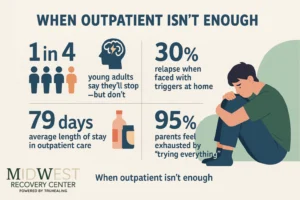
The Emotional Cost of “Trying Everything”
As a parent, you’ve probably run through every option:
- Boundaries
- Consequences
- Gentle conversations
- Tough love
- Monitoring
- Trusting
- Starting over
You’ve been the anchor, the detective, the nurse, the therapist.
But none of that is your job forever. You weren’t meant to hold all of this alone.
Residential treatment steps in when love needs backup.
It gives your child space to separate from the patterns, pressures, and proximity that may be part of the problem.
And it gives you space to heal, too.
What If They Say No?
It’s the most common question we hear from parents:
“But what if they won’t go?”
First, that hesitation is normal. Substance use often distorts judgment and minimizes risk. Your child might truly believe they’re fine—or fear being without their usual coping tool.
That’s why Midwest Recovery supports families before treatment even begins. We offer:
- Motivational interviewing to help your child explore their ambivalence
- Intervention support with trained professionals
- Guided pre-admission conversations that reduce resistance and fear
You don’t have to convince them on your own. And they don’t have to feel ambushed.
This isn’t about dragging someone in. It’s about inviting them into a safe place to reset.
What Happens After Residential?
One of the biggest myths about residential treatment is that it’s the “final step.”
But really, it’s just a clean beginning.
After residential care, clients often transition into:
- Intensive outpatient (IOP)
- Sober living environments
- Therapy and family support
- Alumni check-ins and aftercare planning
The goal is always sustainable recovery—not just abstinence.
We help build bridges back to school, work, family, and personal responsibility—with the tools to make that transition successful.
Why This Program Works for Families Like Yours
At Midwest Recovery, we work with parents who’ve felt completely out of hope—and we don’t offer empty promises.
What we offer is a full, professional team focused on progress, not perfection.
We understand young adults who are emotionally guarded, defensive, or deeply overwhelmed. We know how to connect, de-escalate, and encourage growth that sticks.
And we walk with you, not just your child.
Family involvement isn’t an afterthought—it’s part of the plan.
FAQs for Parents Exploring Residential Treatment
What age group is this program for?
We primarily serve young adults (18+) and adults who are ready for structured care. If your child is under 18, call us—we’ll help refer you to the right level of support.
How long is the stay?
Lengths vary, but most stays range from 30 to 90 days. Some may need longer stabilization, while others transition sooner based on progress and readiness.
Is it covered by insurance?
Many insurance plans cover residential treatment. Our admissions team can help verify coverage and walk you through your options.
Can I stay in contact during treatment?
Yes. Family communication is structured, not cut off. We schedule family sessions, check-ins, and keep you informed throughout the process.
What if my child has mental health concerns too?
We are dual-diagnosis capable, meaning we treat co-occurring mental health and substance use disorders together. Your child’s full wellbeing is our focus.
It’s Not Too Late for a New Beginning
If you’re exhausted, scared, and wondering if anything will work—this might be the moment that changes everything.
You don’t have to keep carrying this alone. And your child doesn’t have to keep spiraling without support.
Call (888) 657-0858 or visit Midwest Recovery Center’s Residential Treatment Program page to take the next step.
Even when you feel like you’ve tried everything, there’s still something left: A place built for healing. A path designed for hope. A team ready to walk with you—start to restart.