
Somewhere between the 90-day chip and today, things got blurry.
You were doing the work. Meetings. Check-ins. Maybe therapy. Maybe not. Either way, you were showing up. And then, slowly or suddenly, it got harder. A bad day turned into a bad week. That one drink you told yourself wouldn’t lead anywhere became three. Or five. Or every night again.
Now maybe you’re sitting with the shame of relapse—wondering if you undid everything you worked so hard for. Maybe you’re afraid to tell anyone. Maybe you haven’t even told yourself yet.
Here’s what we want you to know: you are not starting over. You’re picking up from where you are. And a residential treatment program can be the place where you catch your breath and come back to center.
At Midwest Recovery Center, we support people who’ve relapsed after recovery—not with lectures or disappointment, but with steady, real help. You haven’t failed. You’re still in the fight.
Relapse Is Painful—But It’s Not the End
Relapse carries a particular kind of grief. It’s not just the physical toll or the disappointment of others—it’s the way you feel disconnected from yourself.
You might be thinking:
- “I should have known better.”
- “I worked so hard. What was the point?”
- “No one’s going to take me seriously now.”
These thoughts are heavy, but they’re not the truth.
Relapse doesn’t erase your recovery. It reveals where you still need support. And stepping back into treatment—especially residential care—isn’t defeat. It’s bravery. It’s saying, “I want to try again, but I need help doing it.”
The Structure of a Residential Program Can Rebuild What’s Shaky
When you’re in the middle of active use—or even just slipping into old habits—life can feel unmanageable fast. Days blur together. Meals get skipped. Sleep disappears. Shame builds.
A residential treatment program offers something simple but powerful: structure that isn’t overwhelming.
This includes:
- Predictable daily routines
- Nourishing meals
- Group therapy and individual support
- Scheduled rest and reflection time
These rhythms help regulate your nervous system so you can actually focus on healing—not just surviving the next craving.
Whether you’re looking for a residential treatment program in Oregon, Ohio or nearby Maumee, our team offers deeply human support close to home.
You Don’t Have to Perform Here
One of the hardest parts of relapse is feeling like you need to “prove” you’re serious this time. Maybe you’ve already been in treatment once. Maybe people are watching closely. Maybe you’re watching yourself, too—harshly.
In our residential program, there’s nothing to prove. Just space to be honest.
You can show up tired, skeptical, heartbroken, or numb. We’ve seen it all. And we know that some of the strongest recoveries start with someone saying, “I don’t know if I can do this again.”
You don’t need to feel hopeful yet. We’ll hold the hope for you until it returns.
Real Healing Happens When You’re Ready to Be Seen Again
Relapse can make you want to disappear. It’s easier not to answer the phone, to avoid your old sober friends, to pull away from anything that reminds you of how far you’ve fallen.
But the truth is: isolation is the soil where relapse grows. Residential care pulls you out of that soil and back into connection.
You’ll be surrounded by people who get it—not just clinicians, but peers in recovery who’ve also stumbled and stood back up. Group sessions aren’t about sharing for applause—they’re about honesty, discomfort, and being seen in your struggle.
You deserve to be seen. Even now. Especially now.
You Bring Wisdom With You This Time
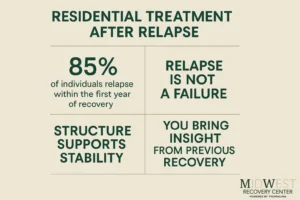
Coming back to treatment doesn’t mean you’re back at square one. In fact, you’re coming in with more knowledge than the first time.
You know what helps you regulate. You know what warning signs you missed. You know what environments or relationships made staying sober harder. You might even know what you need to say that you were too afraid to say before.
That’s not failure. That’s wisdom earned the hard way.
In our program, we help you build on what you’ve learned, not ignore it. Your relapse becomes part of your recovery—not the opposite of it.
Our Residential Treatment Program Supports the Whole You
At Midwest Recovery Center, our Toledo-based residential treatment program isn’t just about detox or abstinence. It’s about returning to stability in every sense of the word—emotional, physical, relational, and spiritual (if that’s meaningful for you).
We offer:
- 24/7 medical and emotional support
- Trauma-informed therapy
- Holistic care options like mindfulness, movement, and creative expression
- Discharge planning that starts early—because re-entry matters too
We also support alumni from nearby cities, so whether you’re looking for residential treatment in Perrysburg, Ohio or returning from out of state, you’ll be held with care and intention.
You Can Still Finish the Story You Started
Relapse can feel like a plot twist that ruins everything. But every powerful recovery story includes moments of doubt, delay, or detour. You’re still the author of this one.
You may not feel strong today. That’s okay. You may be tired of trying. That’s okay, too.
What matters is that part of you is still here—reading, wondering, hoping. And that part deserves care.
FAQ: Residential Treatment for Returning Alumni
Will I be judged for relapsing?
Absolutely not. Many of our staff members and peers in the program understand relapse firsthand. You’ll be treated with respect, not suspicion.
Do I have to stay for 30 days?
Not necessarily. We work with you to determine the length of stay based on your current needs, past treatment experience, and long-term goals. Some stays are shorter; others are longer.
Is residential treatment right after 90 days of sobriety?
Yes. Relapse after 90 days is common—and dangerous, because the body’s tolerance changes quickly. Residential treatment provides a safe place to reset both physically and emotionally.
What if I’m ashamed to tell my family?
You don’t have to do that alone. We offer family engagement options and can help you navigate those conversations if and when you’re ready.
What if I’ve already been through treatment before?
That’s actually more common than people think. Returning to treatment can be a powerful turning point, especially when it’s approached with fresh support and insight.
You’re Still Worth the Effort
You may be thinking, “I already had my chance.” You haven’t run out of them. Recovery doesn’t expire.
You are still worthy of support, stability, and peace. And you don’t have to figure it out alone.
Call (888) 657-0858 or visit our residential treatment program page to learn more about how Midwest Recovery Center supports your return to stability. We’re here when you’re ready—and when you’re not quite ready, too.