
Your stomach drops. You smell it. You see it. Or you just know.
Someone you’re working with—the one who laughs in group, who volunteers to help clean up coffee cups—is suddenly not okay. And when they finally say it out loud, it lands heavy in the room:
“I don’t want to die. I just don’t know how to keep going.”
This is what PHP was made for.
At Midwest Recovery Center’s Partial Hospitalization Program in Toledo, Ohio, we meet people at that edge—not with pressure, but with presence. Not with a checklist, but with room to breathe. Some are grieving. Some are numb. Most are exhausted. And none of them are broken beyond repair.
When Life Feels Like Too Much—and Still Not Enough
Suicidal ideation doesn’t always arrive with a scream. Sometimes, it’s a whisper you start to mistake for your own thoughts:
“What if I just didn’t wake up?”
“It wouldn’t matter if I disappeared.”
“I don’t want to kill myself, but I wish I didn’t exist.”
Most people don’t talk about those moments—not because they’re hiding something dangerous, but because they don’t want to be misunderstood. They don’t want emergency sirens or pity or people looking at them like they’re a walking liability.
And the truth? Most people who end up in our PHP have felt that way.
PHP Exists for the Middle Spaces
Partial Hospitalization Programs are often mischaracterized. Some think you need to be in full-blown crisis to attend. Others assume it’s just another version of therapy. It’s neither.
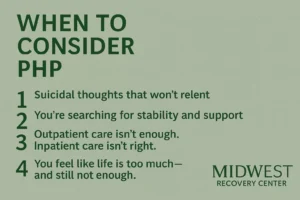
PHP is the in-between. It’s for people who:
- Aren’t actively trying to die—but are barely surviving
- Don’t need overnight monitoring—but can’t function in regular outpatient care
- Are craving connection, structure, and daily support
It’s clinical care without the cold. A reset button without the full break from your life.
If you’re in or near Perrysburg, Ohio or Maumee, and searching for PHP that doesn’t feel like a punishment, we’re close by. And we get it.
What It Actually Looks Like
I remember one client—let’s call her M. She’d been doing “fine” for months. Going to therapy weekly. Holding down a job. Responding to texts with emojis. But then something shifted.
She came in one Monday and said, “I don’t know what happened. I just… don’t care anymore. It’s not even sadness. It’s like I’m watching my life from outside my body.”
She didn’t need inpatient. She needed space to say that without someone assuming she was dangerous. She needed daily support. And she needed to know she wasn’t the only one who’d ever felt that way.
In PHP, she got that.
She came five days a week. Sat through groups, sometimes silent. Took notes she didn’t read. Slowly, she started sitting closer to people. Then talking. Then laughing—once, briefly.
That was enough to start. And we let it be enough.
The Power of Presence Over Pressure
One of the hardest parts about living with suicidal thoughts—especially the kind that don’t scream—is how often you’re expected to explain yourself.
“Why do you feel this way?”
“What triggered it?”
“Have you tried thinking more positively?”
Here’s what we do instead:
We listen. We sit beside you. We let you say, “I don’t know.” We let silence stretch out until something real can breathe in the space.
At Midwest Recovery, PHP isn’t just a set of sessions. It’s a soft landing. It’s clinicians who don’t flinch. It’s a place where your pain doesn’t have to perform to be taken seriously.
You Don’t Have to “Earn” Help
A quiet, persistent lie many clients carry is that their pain isn’t big enough to warrant this level of care.
Maybe you’ve heard that voice, too:
“Other people have it worse.”
“I’m not in danger—I’m just tired.”
“I don’t want to die. I just don’t want to do this anymore.”
You don’t need to be in flames to deserve the fire department. And you don’t need to be in crisis to come to PHP.
We work with people from all over the Toledo area—including Oregon, Ohio—who are stuck in that murky middle: functioning, but hollow. Smiling, but disconnected. Tired of explaining how tired they are.
What PHP Offers (and Why It Matters)
Our Partial Hospitalization Program includes:
- Group Therapy: Peer support that helps dissolve isolation.
- Individual Therapy: Dedicated time to go deeper, gently.
- Medical Oversight: Medication support when needed, without pressure.
- Daily Structure: Five days a week of routine and accountability.
- Real-World Practice: You go home each night. Which means you get to practice living while still getting daily support.
For someone living with passive suicidal ideation, this rhythm can be life-saving—not because it “fixes” you, but because it gives you something to hold onto while the rest feels like it’s slipping.
Choosing Life, One Moment at a Time
No one chooses to feel this way. But you can choose to stay.
Not forever. Just for today.
That’s all we ever ask in PHP. Not that you commit to life in full—but that you let someone hold space for the version of you that’s still trying.
You don’t have to want to be here to deserve to be here.
And if you’re even slightly curious about whether this kind of care might help—you’re probably more ready than you think.
Frequently Asked Questions About PHP for Suicidal Ideation
Is PHP only for people at risk of suicide?
No. PHP supports a wide range of mental health needs. But it does provide an ideal structure for people experiencing suicidal thoughts who aren’t actively at risk but need more support than outpatient care provides.
How do I know if PHP is the right level of care?
If you’re struggling to function, feel emotionally flat or disconnected, or find yourself constantly thinking about not existing—even if you aren’t making plans—PHP may be right for you. Our team can help assess your needs with compassion and clarity.
Can I attend PHP without taking medication?
Yes. While we offer medication management when appropriate, no one is required to take medication to participate in PHP. You’ll work with your clinician to decide what feels right for you.
What’s the difference between PHP and IOP?
PHP offers more structure—usually five days a week, several hours per day. IOP (Intensive Outpatient Program) is typically 3–4 days per week for fewer hours. PHP is often used as a step down from inpatient care or a step up from outpatient therapy.
Will I be safe if I tell someone I’m having suicidal thoughts?
Yes. At Midwest Recovery, we know that having suicidal thoughts doesn’t automatically mean you’re in crisis. We assess safety collaboratively and calmly. Our goal is to keep you supported—not punish or scare you.
How long do people stay in PHP?
It varies. Some clients attend for two weeks. Others stay longer, depending on their progress and needs. You’ll work with your treatment team to determine the right length for you.
What if I already see a therapist? Can I still do PHP?
Yes. We can coordinate with your existing therapist to support continuity of care. PHP can be a temporary deep-dive to stabilize your mental health, after which you return to your regular provider.
Can I work while doing PHP?
PHP typically takes place during daytime hours (often 9am–3pm), five days a week. If your work schedule allows flexibility or you can take leave, it may be doable. We’re happy to talk through logistics with you.
If You’re Still Reading, It Means You’re Still Here
Which means there’s something inside you—however buried—that hasn’t given up.
Maybe it’s stubbornness. Maybe it’s a whisper of hope. Maybe it’s just muscle memory. Doesn’t matter.
You’re still here.
And at Midwest Recovery Center, we believe that’s enough.
If you’re looking for Partial Hospitalization Program options in Perrysburg, Maumee, or right here in Toledo, we’re here to walk with you.
You don’t have to want to be alive forever. Just consider giving yourself tomorrow.
Call (888) 657-0858 to learn more about how we can help PHP in Toledo, Ohio.