
You’re not imagining things.
Your young adult is unraveling in ways you can no longer explain away as “just a phase.” The mood swings. The missed classes. The moments of panic where you’re not sure if they’re safe—physically, emotionally, or chemically. You’ve tried outpatient therapy. You’ve tried long talks and short interventions. You’ve tried giving space. None of it has been enough.
So now you’re here—looking into something called a Partial Hospitalization Program (PHP)—hoping it might do more than just stabilize. Hoping it might actually help your child get their life back.
At Midwest Recovery Center, we help parents like you find hope in what feels like chaos. Here’s how a PHP can support your young adult’s healing—clinically and practically—without stripping away the dignity they’re still fighting to hold onto.
What Is a Partial Hospitalization Program (PHP)?
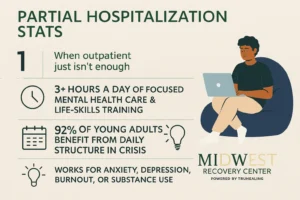
A PHP is an intensive behavioral health program designed for individuals who need serious therapeutic support but don’t require 24-hour supervision. Think of it as the middle ground between inpatient care and weekly therapy.
Your young adult would attend structured treatment during the day—therapy, psychiatric support, group work, and skill building—then return home each evening. It’s immersive without being isolating.
The PHP model is especially effective for young adults who are not in immediate danger but clearly aren’t coping well on their own. It allows them to receive clinical care while staying connected to everyday life.
Clinical Support That Meets the Moment
When your child is in a behavioral health crisis, you need to know that what you’re signing up for isn’t just “talk therapy.” A strong PHP brings serious clinical weight:
- Daily individual and group therapy
- Psychiatric assessment and medication management
- Mental health education
- Trauma-informed approaches
- Support for co-occurring substance use
This isn’t just venting to a therapist. It’s a medically grounded, therapeutically structured environment that meets them where they are—emotionally, neurologically, and behaviorally.
And it’s designed for young adults who are still trying to figure out who they are while dealing with what they’re feeling.
Life Skills: Where Healing Becomes Habitable
Clinical treatment is critical. But real recovery also means knowing how to live. That’s where life-skills training comes in.
In a PHP, your young adult won’t just learn coping mechanisms—they’ll practice how to apply them. That includes:
- How to manage stress without spiraling
- How to handle conflict in relationships
- How to establish a routine that sticks
- How to navigate school or work after emotional disruption
- How to build resilience, not just avoid relapse
We don’t just treat the crisis. We build the capacity to handle the next one.
Structure Without Shutdown
One of the biggest advantages of a PHP is its rhythm.
Each weekday, your young adult steps into a predictable, structured setting where healing is the focus. They process trauma, develop emotional regulation skills, and engage in peer support. And then—they go home.
Why does that matter?
Because growth sticks better when it’s lived, not just learned. Each night they return to the real world—family dinner, personal triggers, digital life—and bring what they’re learning into the places that used to destabilize them.
This is what makes a PHP so effective for young adults: it doesn’t remove them from life. It helps them reenter it with new tools.
Who PHP Helps Most
Parents often ask: “Is my child ‘sick enough’ to need this?”
The better question might be: “Is what we’re doing now helping them get better?”
Here’s who often thrives in a PHP:
- Young adults who’ve been in outpatient therapy but are still struggling
- Those returning from inpatient care who need a structured next step
- Individuals with co-occurring substance use and mental health concerns
- Teens or twenty-somethings who are beginning to lose function—academically, socially, emotionally
- Young people who want help but fear the intensity or stigma of inpatient hospitalization
If your child is still spiraling but still reachable—this level of care may be exactly what they need.
The Role You’ll Play as a Parent
This isn’t a “drop-off” model. Family involvement matters.
During your child’s time in a PHP, you may be invited to:
- Participate in family therapy sessions
- Attend psychoeducation groups for loved ones
- Receive guidance on boundaries, communication, and crisis response
- Get your own support, so you’re not carrying this alone
You’re not just sending them somewhere to be fixed. You’re stepping into a system that includes your perspective, honors your exhaustion, and strengthens your ability to help.
What a Typical Day Looks Like
Every program has its own schedule, but at Midwest Recovery, a typical day might include:
- Morning Check-In – Emotional state, goals, medication check
- Group Therapy – Focused on coping skills, interpersonal growth, emotional regulation
- Life Skills Sessions – Topics like time management, communication, or budgeting
- Individual Therapy – Personalized support and deeper processing
- Family Sessions (as scheduled) – Space for reconnection and boundary-setting
- Afternoon Wrap-Up – Reflection and transition planning for the evening at home
This kind of routine builds consistency—something most young adults in crisis desperately need.
What PHP Isn’t
Let’s be honest about expectations. A PHP isn’t a miracle. It’s not a button you push and everything resets.
It won’t fix everything in 30 days.
But it will give your young adult a way forward that feels doable. It provides the scaffolding needed to rebuild a life that’s been shaken by anxiety, depression, trauma, or addiction. And it gives you—as a parent—confidence that they’re not doing it alone. If you’re in Maumee, Perrysburg, Oregon, Ohio, or Lambertville, Michigan, Midwest Recovery provides programs with that same trusted approach.
Frequently Asked Questions
Can my child still work or go to school during PHP?
PHP is a full-time commitment—typically five days a week for several hours a day. That said, we work with clients and families to plan around academic or employment transitions post-treatment.
How long does a PHP last?
Length varies. Some young adults need three to four weeks; others may need a few months. Progress is regularly assessed, and care is adjusted as needed.
Is this just a “step-down” from inpatient?
Not necessarily. While PHP is often used as a step-down level of care, it’s also a powerful entry point for those who’ve never done inpatient but still need more than weekly therapy.
Will I be involved in their treatment?
Yes. Family involvement is a key component of our program. That might include family therapy, parent support groups, or individualized check-ins to keep you informed and supported.
What if my child relapses or worsens during PHP?
Relapse or regression can happen in recovery. If more intensive care is needed, we’ll work closely with you to transition your child into a higher level of treatment—safely and quickly.
You Don’t Have to Wait for Rock Bottom
You’ve already waited long enough. You’ve watched the struggle, heard the silence, filled in the blanks.
A PHP is not a sign that your young adult is failing—it’s a signal that they’re still reachable, still worthy of support, still capable of healing.
And so are you.
Call (888) 657-0858 or visit Midwest Recovery Center’s Partial Hospitalization Program to learn how we help young adults move from crisis into capacity—with real treatment for real life.