
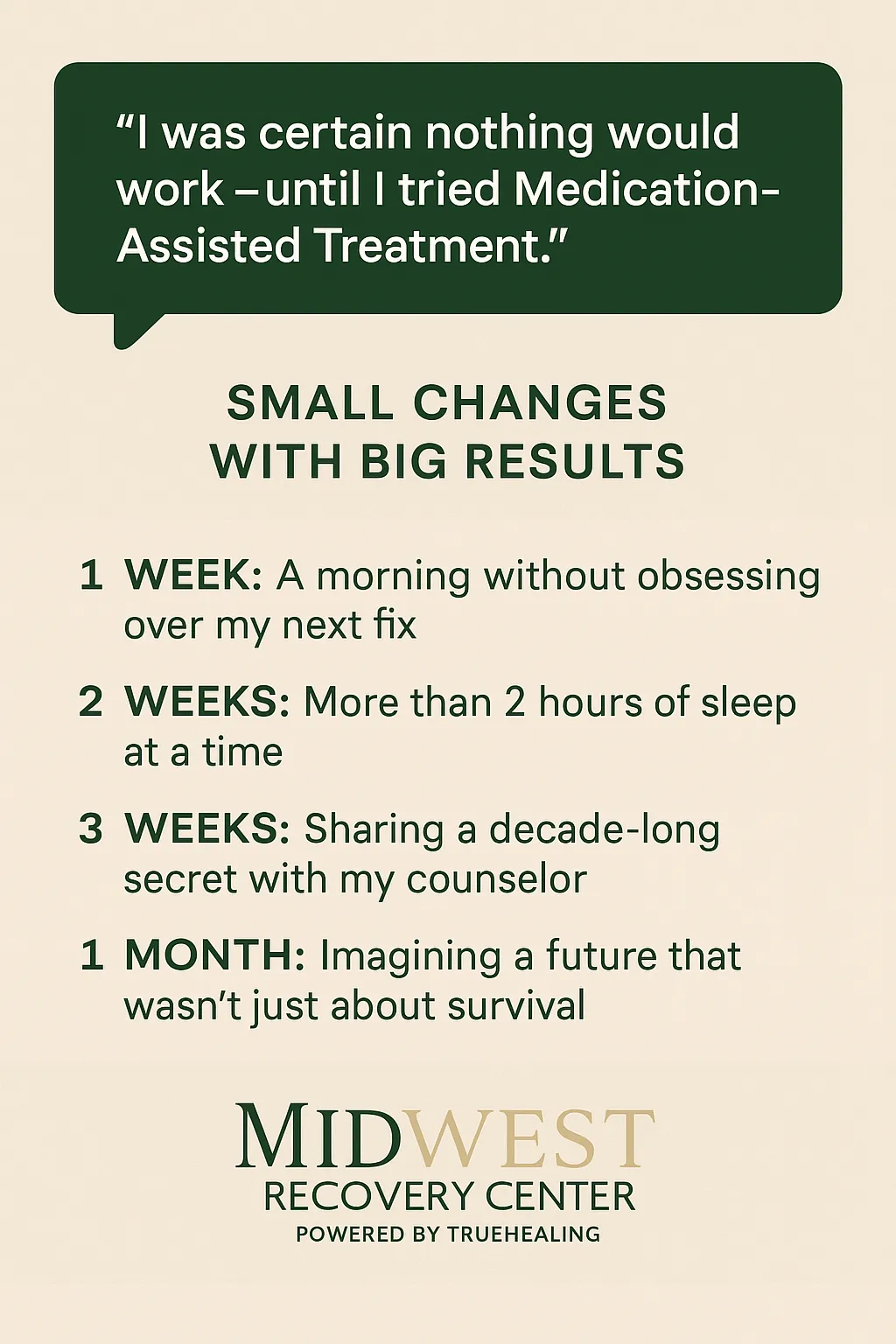
I went into treatment certain of one thing: that nothing would work. I’d been told that before. I’d paid for detoxes and programs and pep talks. I’d shown up, checked boxes, and left with the same hollow feeling. So when someone suggested Medication‑Assisted Treatment, I listened with the same tired skepticism I’d learned to carry around like armor.
What happened next was quieter than I expected. It didn’t feel like a dramatic recovery scene from a movie. It was small: a good night’s sleep, an afternoon that wasn’t dominated by planning how to use, a conversation I had without lying. It was the first time in so long I woke up and thought, not how am I going to survive today, but what do I want to do today?
That was the first time I felt normal again.
Why “Nothing Worked” Felt True to Me
I believed treatment “didn’t work” because, honestly, for me, it hadn’t. I could list the attempts: rehab stints, detoxes, group meetings, promises to family, empty notebooks of self-help notes. Each time I left, the core problem stayed the same. I’d go back because the urge did, because the shame did, because the sleep wouldn’t come. It wasn’t that the therapy or counseling was bad; it was that I kept asking those things to do what my brain chemistry and my body still needed.
When you’ve been told that your options have failed you, you start believing you failed them. So I carried defeat like luggage—heavy and always at my feet.
What MAT Did Differently
Medication‑Assisted Treatment didn’t feel like a magical shortcut. It felt like basic repair. The medications I was given didn’t remove my memories or my grief. They shortened the nights where panic kept me awake. They took the raw edge off cravings enough that I could think straight during therapy. Instead of trying to hold everything at once, I had a little help that let me breathe.
With that breathing came something I hadn’t had in years: the capacity to actually use what therapy asks you to use—time, patience, reflection, practice. I could sit with emotion without the automatic reflex to escape. I could tolerate discomfort long enough to notice a pattern and do something about it. That stability gave me traction.
The Small Changes That Proved It Was Working
The first week, I noticed I could make it through a morning without thinking in loops about my next fix. The second, I slept longer than two hours at a stretch. The third week, I told a counselor about something I’d been hiding for a decade, and I didn’t immediately feel like I was going to fall apart. Nothing huge happened in one day. But those small shifts stacked. They added up into a life that felt manageable. They added up into something that looked a lot like normal.
Normal for me wasn’t sunshine and fireworks. It was being present enough to have a hard conversation and not run. It was remembering things I’d promised someone and following through. It was laughing and not feeling like I owed an apology for it the next minute.
Why I Was Afraid of Medication — and Why That Fear Wasn’t the Whole Truth
There’s a stigma around taking medication in recovery. I’d been taught that sobriety meant resisting everything, that using any drug at all was defeat. So the idea of a medication that actually helped felt like cheating. I worried that using medication to stabilize would mean I wasn’t really sober, that I’d replaced one dependence with another.
The truth? The medication didn’t replace anything. It paused the rewiring my nervous system needed so therapy could actually help. It kept me alive long enough to learn new habits and do the emotional work I kept avoiding because I was always in a crisis of craving. When you’re in that crisis mode, work doesn’t stick. MAT helped me get out of crisis mode — not by masking pain, but by giving my brain the space to heal.
How I Found the Right Team
I didn’t pick a flashy center or chase a reputation. I picked a place that listened. A place that didn’t talk down to me or promise miracles. They explained what the medication would do, how it worked with counseling, and what I should expect physically and emotionally. That straightforward honesty mattered.
When I learned that the program offered Medication‑Assisted Treatment services in Maumee, Ohio, I felt something practical shift inside me: if it was available nearby, then this wasn’t a one-off, desperate move. It was a pathway people could walk and come back from. When I later discovered there were also options for Medication‑Assisted Treatment services in Perrysburg, Ohio, it confirmed that help could be local, not remote — something I could actually use without uprooting my life completely.
The Work That MAT Made Possible
Medication was the scaffolding. Therapy was the building. With the cravings softened, I could finally practice the skills that other programs had taught me but I’d never been able to apply. I re-learned how to sleep. I practiced being honest in small ways. I rebuilt trust with family in small, consistent actions. I learned to name triggers without immediately trying to fix them with substances.
MAT didn’t do these things for me. It gave me the ability to do them. That distinction mattered.
The Day I Realized I Felt Normal
It was a Tuesday. I went to a group meeting, and when the topic turned to plans for the weekend, I didn’t feel the usual hollow panic. I actually had an idea—a small, normal plan: meet a friend for coffee, go for a walk. That little capacity to imagine a weekend without calculating how to survive it was a tiny revolution for me. That’s when I felt normal. That’s when the idea of a future stopped feeling like a threat and started feeling like a possibility.
What I’d Tell the Person Skeptical Like I Was
If you think treatment “didn’t work,” you might be telling the truth. You might have tried things that weren’t enough for what you needed. You might have been given tools to use while still being expected to run a marathon.
Do this instead: consider whether your brain needed time and support to stabilize first. Ask if there’s a combination of supports you haven’t tried — not just therapy, but medication, counseling, group work, and practical case support. You don’t fail when a single approach doesn’t stick. You fail only if you stop looking for what does.
You have the right to demand help that meets both your body and your mind. Medication‑Assisted Treatment is one option that meets both.
Honest Questions People Ask Me — And My Answers
Will I be on medication forever?
Maybe. Some people taper off safely when they and their providers agree it’s time. Others stay on longer because it’s what keeps them stable. The goal is life, not an arbitrary timeline.
Is taking medication weak?
No. It takes strength to accept that you need help and to keep showing up for treatment. Medication is a tool, not a character flaw.
Will people judge me?
Probably. People judge all kinds of recovery choices. What matters is whether the choice keeps you alive and growing. Your life is not a performance for others.
Will it fix my relationships?
Not on its own. Medication helps you be present enough to do relationship work. The fixes come from the work you do while stabilized.
What if nothing changes?
Then you keep trying with your team. MAT isn’t a guaranteed instant cure, but it is a change to the conditions that kept you stuck. If something doesn’t work, your treatment team should pivot with you—not leave you to figure it out alone.
Life After the Shift: Not Perfect, But Real
I still have regrets. I still get sad. I still have to do the work. But now those things exist in a life where I’m not fighting my body all the time. I can grieve without falling into use. I can celebrate without feeling like I owe an apology for enjoying it. I can plan again.
The first time I felt normal again wasn’t the end of the story. It was the beginning of a different one—one where I could be present to write new chapters. Medication‑Assisted Treatment gave me the margin to write them.
If you’re tired of trying the same thing and getting the same result, call (888) 657‑0858 or visit to learn more about our Medication‑Assisted Treatment services in Toledo, Ohio. You don’t have to carry every step alone — help can make the next one possible.