

When you’re thinking about treatment, there’s a quiet question that usually shows up early on: How long will I have to do this?
And it’s not a bad question. In fact, it might be one of the bravest things you can ask—because it means you’re imagining what getting help would actually look like in your real life. Not in theory. Not someday. But now.
At Midwest Recovery Center in Toledo, Ohio, we understand that stepping into treatment for the first time can feel like stepping into the unknown. You’re not weak for wondering how long a partial hospitalization program (PHP) lasts. You’re responsible. You’re considering what it would take—and that’s a big deal.
Here’s what to expect.
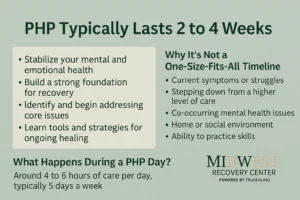
PHP Typically Lasts 2 to 4 Weeks
The standard length of a partial hospitalization program (PHP) is between two and four weeks. This timeframe gives you enough time to:
- Stabilize your mental and emotional health
- Build a strong foundation for recovery
- Identify and begin addressing the core issues driving your distress or substance use
- Learn tools and strategies for ongoing healing
Each person’s journey looks a little different. For some, PHP may extend slightly beyond that window. Others may be ready to step down into a lower level of care sooner. It’s not about hitting a specific number of days—it’s about supporting real progress at a sustainable pace.
Why It’s Not a One-Size-Fits-All Timeline
We don’t treat a calendar—we treat people. That means your PHP timeline is shaped by your needs, not by a rigid schedule.
Factors that influence the length of your PHP:
- Your current symptoms or struggles
- Whether you’re stepping down from a higher level of care (like detox or inpatient)
- The presence of co-occurring mental health issues (like anxiety, depression, or trauma)
- Your home or social environment—do you feel safe and supported?
- Your ability to apply and practice what you’re learning outside of treatment hours
Sometimes it takes time just to start feeling safe. And that’s okay. There’s no “too slow” in recovery.
What Happens During a PHP Day?
A typical PHP schedule includes around 4 to 6 hours of care per day, usually five days a week. But it’s not a repetitive loop of the same therapy sessions over and over. Each day is structured to support different parts of your healing.
What you might do in a single PHP day:
- Group therapy, where you connect with others facing similar challenges
- Individual therapy, to go deeper into your personal experiences and goals
- Psychoeducation groups, focused on topics like emotional regulation, relapse prevention, boundaries, or family dynamics
- Skill-building sessions, such as mindfulness, coping tools, or managing triggers
- Case management support, to help with housing, employment, or legal issues if needed
This variety keeps treatment dynamic, engaging, and comprehensive. You’re not just “going to therapy”—you’re rebuilding your life with real tools.
PHP Offers Structure Without Total Disruption
PHP is often a good fit for people who are overwhelmed, struggling, or unsafe in their current routines—but don’t need 24/7 residential care. It gives you an intensive level of support while still allowing you to:
- Sleep at home
- Stay connected to loved ones
- Begin practicing what you learn in the real world
This balance of structured care and real-life testing is one of the program’s greatest strengths. It allows you to see what’s working—and what’s still shaky—without the pressure of figuring it all out alone.
And if you’re looking for PHP in Maumee, Perrysburg, or Oregon, Ohio, Midwest Recovery supports these communities through in-person and connected care. Explore nearby service areas like Maumee, Ohio and Perrysburg, Ohio for more information.
What Happens When PHP Ends?
We hear this question a lot: “What happens when my PHP is over?”
Here’s the truth: you won’t be dropped or forgotten. At Midwest Recovery, we believe that ending one phase of care should always open into the next phase of support.
Depending on your progress and goals, your next steps might include:
- Transitioning into an intensive outpatient program (IOP), which meets for fewer hours per week but still offers structure
- Continuing with individual therapy, either at Midwest or with a trusted provider in your area
- Participating in alumni support groups or peer mentoring
- Exploring medication-assisted treatment, if appropriate
You won’t be alone in that transition. Your treatment team will help you plan your next step with clarity—not guesswork.
“I Don’t Have Time for This”—And Why That’s Exactly Why It Might Help
It’s okay if part of you is thinking, I can’t do this for weeks. I don’t have the time.
We understand. You might be working, parenting, caregiving, or all three. But here’s something to consider: whatever is keeping you from treatment is probably the same thing that’s costing you your peace.
Struggling takes time, too. So does hiding pain, managing panic, avoiding triggers, repairing relationships, or trying to “hold it all together” without support.
PHP doesn’t demand you abandon your life—it helps you build one that works better. Even three weeks of support can save you months or years of silent pain.
What Clients Say About PHP
“I wasn’t sure about taking time off work, but now I realize PHP gave me back time I didn’t even know I was losing.”
– PHP Client, 2023
“It helped to hear other people say out loud what I’d been feeling for years. I didn’t feel so crazy anymore.”
– PHP Client, 2024
“The routine, the support, the tools—I didn’t even know how much I needed it until I was in it.”
– PHP Client, 2023
FAQs: Common Questions About PHP Timelines
Is PHP five days a week, every week?
Yes, most PHPs run Monday through Friday, typically during daytime hours. Weekends are for rest, practice, and preparing for the week ahead.
What if I start PHP and realize I need more or less time?
That’s completely okay. Your care plan can be adjusted as you go. You’ll have regular check-ins with your team to review your progress and discuss next steps.
Can I still work while doing PHP?
Some people take leave from work during PHP using FMLA or short-term disability. Others work part-time or evenings. Talk to us—we can help you explore your options and provide documentation.
Will my insurance cover the full PHP program?
Most commercial insurance plans and Medicaid cover PHP services. We’ll verify your benefits and explain all costs up front—no surprises, no fine print.
Is there a minimum time I have to stay in PHP?
You’re never “trapped” in PHP. However, we strongly recommend a minimum of two weeks to experience the full benefit of care and support. We’ll never keep you longer than necessary—but we’ll also never rush you out.
What if I live outside of Toledo?
We welcome clients from across the region, including Oregon, Ohio, and nearby towns. Some clients choose to stay with family or temporarily relocate during care.
Do I have to quit everything forever to start PHP?
Not at all. You don’t have to commit to lifelong sobriety or have all the answers. PHP is a place to explore, reflect, and start making intentional choices with support.
You’re Not Too Far Behind. It’s Not Too Late.
If you’re still reading this, there’s a reason. You know something needs to change. And that knowing—no matter how quiet or scared—is the start of real healing.
PHP isn’t about fixing you. It’s about stabilizing you, so you can remember who you are underneath the pain, the pressure, or the patterns.
Call (888) 657-0858 or visit PHP program in Ohio to talk with someone who gets it. You don’t have to be fearless. You just have to be willing.