
When your child is just 20 years old and using opioids again, your heart sinks in a way that words barely touch. You’ve tried to trust, to hope, to believe this time would be different. Now you’re left wondering: What happens next? Is there even a path forward? Where do we start without repeating old mistakes?
These feelings are heavy, and you’re not alone in them. Many parents come to opioid addiction treatment in Toledo with the same exhaustion and fear. The good news is that recovery isn’t a single doorway — it’s a staircase. Each step, called a “level of care,” is designed to meet a person where they are and gradually support them toward independence.
Understanding these levels can help take the mystery out of treatment. Instead of feeling lost, you can see how each stage builds on the last.
Detox: The Medical Starting Point
Detox is often the first level of care for opioid addiction treatment. For someone actively using, withdrawal can feel unbearable: chills, sweats, body aches, nausea, restless legs, and cravings so sharp they drown out reason. On top of that, withdrawal can be risky without medical supervision.
Detox provides:
- 24/7 monitoring by medical staff
- Medications to reduce discomfort and cravings
- A safe environment to stabilize physically
Think of detox as clearing the storm clouds. It doesn’t heal addiction, but it helps your child’s body reset enough to focus on the next stage of recovery.
Residential Treatment: Full Support in a Safe Environment
Once detox is complete, many young adults benefit from residential treatment, also called inpatient care. This is where clients live at the facility and receive around-the-clock support.
For a 20-year-old who may still be vulnerable to triggers or unhealthy environments, residential treatment offers:
- Daily therapy sessions (individual and group)
- Access to medical and psychiatric care
- Skill-building and relapse prevention strategies
- A structured, drug-free environment
This stage is about distance from chaos. It gives your child space to focus entirely on healing, away from the pressures and triggers of everyday life.
PHP: Structure Without 24/7 Stay
The next level is the Partial Hospitalization Program. PHP is highly structured — typically full days of therapy and groups, five to six days a week — but clients return home or to sober living at night.
PHP works well for young adults who:
- Still need intensive daily treatment
- Are ready to begin practicing independence
- Benefit from ongoing family involvement
If you live near Maumee or Perrysburg, nearby PHP options allow your family to remain closely engaged while your child attends treatment.
PHP is often the bridge between the safety of residential care and the realities of daily life.
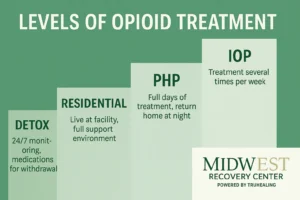
IOP: Intensive Outpatient Treatment
An Intensive Outpatient Program is the next step down in intensity. Instead of attending treatment full-time, clients come several times a week for a few hours at a time. Sessions often happen in the evenings, making it easier to balance recovery with work, school, or family responsibilities.
IOP is where many parents see their children begin to “try on” recovery skills in real life. It’s a proving ground where relapse prevention strategies, coping skills, and emotional regulation are tested outside the walls of treatment.
For young adults, IOP is especially important. It shows them they can rebuild their lives piece by piece while still having consistent accountability and support.
Outpatient Counseling: Long-Term Support
Recovery doesn’t end when IOP is finished. In fact, some of the hardest challenges show up months later, when life feels “normal” again but stress or temptation creeps in.
That’s where outpatient counseling comes in. Outpatient is typically one session per week (sometimes less), but it serves as a lifeline. It keeps the door open for:
- Ongoing therapy
- Mental health support
- Accountability check-ins
- Space to process setbacks or victories
Think of outpatient as a long-term anchor. It helps prevent relapse by keeping recovery tools fresh and accessible.
Why Levels of Care Matter
Each level of care is designed for a reason. Together, they form a staircase of support:
- Detox stabilizes the body.
- Residential treatment stabilizes the mind and environment.
- PHP builds structure with flexibility.
- IOP balances recovery with real life.
- Outpatient counseling sustains progress long-term.
Some young adults will move step by step in order. Others may skip steps or move back up if relapse happens. That flexibility is a strength, not a weakness. Recovery is not a straight line — and the levels of care account for that.
A Story of Hope
One family we worked with had a son who cycled in and out of treatment. He completed detox and residential care, but when he moved into IOP, he began to struggle. Instead of giving up, his treatment team moved him back into PHP for a period of time. That extra structure helped him regain momentum before returning to IOP.
Today, he’s in outpatient counseling, has rebuilt trust with his family, and is working part-time. His story wasn’t perfect, but it was progress. And for parents, that reminder matters: setbacks don’t erase everything. They simply mean another step is needed.
What Parents Can Do
As a parent, watching your child navigate treatment can feel powerless. But there are things you can do that make a difference:
- Learn about the levels. Understanding treatment helps you feel less in the dark.
- Stay connected. Many programs include family therapy — participate when invited.
- Support, don’t smother. Encourage your child’s independence while showing you’re there.
- Remember your own care. Parents need support too. Therapy or support groups for families can be lifesaving.
- Lean on local resources. If you’re in Oregon, Ohio, nearby programs allow you to remain actively involved without overwhelming travel.
FAQ: Levels of Care for Opioid Addiction
Does my child have to complete every level?
Not necessarily. Some people benefit from the full continuum, while others may start at PHP or IOP depending on their assessment.
What if my child refuses treatment?
Resistance is common, especially for young adults. Structured levels like residential or PHP often help engage them more effectively.
How long does treatment last?
It varies. Detox may last 5–7 days, residential often 30 days, PHP around 4–6 weeks, and outpatient can continue for months or longer.
What if my child relapses?
Relapse doesn’t erase progress. It simply means adjusting the level of care — for example, moving back from IOP to PHP for more structure.
Can my child go to school or work during treatment?
Yes, especially at the IOP or outpatient level. These programs are designed to fit with daily responsibilities.
Is family involvement part of treatment?
Absolutely. Family therapy and education are often built into programs because your support plays a critical role.
Is treatment confidential?
Yes. All treatment is protected by privacy laws. Information is only shared with consent or in emergencies.
You Don’t Have to Do This Alone
As a parent, the fear of watching your 20-year-old struggle with opioids again is overwhelming. But there is hope. Recovery isn’t about one big leap — it’s about climbing the staircase of care, one level at a time.
Call (888) 657-0858 or visit Opioid Addiction Treatment program in Toledo, Ohio to find the right level of care for your child and take the next step toward healing.