
You don’t look like someone who needs help.
You get things done. You show up. People count on you—and you deliver. Maybe you’ve even told yourself, “I can’t be that bad… I’m still handling everything.”
But let’s be honest.
You’re not really living—you’re managing. Numbing. Pushing through. Holding it together during the day, unraveling quietly at night. On the outside, it’s high-functioning. On the inside? It’s barely holding on.
That’s not failure. That’s survival mode. And if you’ve been stuck there long enough, it starts to feel normal. But surviving isn’t the same as recovering. It’s not the same as healing.
If you’re wondering whether an intensive outpatient program in Toledo is too much or not for people like you—take a breath. This might be exactly what you need.
High-Functioning Doesn’t Mean You’re Not Struggling
Here’s the thing about high-functioning substance use—it hides in plain sight.
You don’t fit the stereotype. You’re not passed out on sidewalks or missing work. You’re not showing up late or losing custody or crashing cars. But you are:
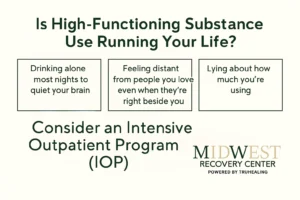
- Drinking alone most nights to quiet your brain
- Popping pills to sleep or to stay alert through another long day
- Lying about how much you’re using—even to yourself
- Feeling distant from people you love, even when they’re right beside you
You’re not alone. We’ve worked with doctors, teachers, engineers, stay-at-home parents, business owners—people who “have it together” but are falling apart on the inside.
And we’ve helped them move from functioning to actually feeling free.
Why Survival Mode Feels Like the Safer Choice
When you’re high-functioning, asking for help can feel risky. What if someone finds out? What if everything falls apart? What if I need this substance to cope?
It’s not about recklessness—it’s about fear.
Fear of being judged. Fear of having to stop. Fear that without the substance, everything else might come undone too.
That fear is real. And valid. But it’s also the exact reason people stay stuck.
An intensive outpatient program doesn’t ask you to abandon your life. It helps you rebuild it from the inside, in a way that feels manageable—not overwhelming.
What an Intensive Outpatient Program Actually Looks Like
IOP isn’t rehab. You don’t move in. You don’t disappear from your life.
Instead, it’s a structured, therapeutic program that helps you work through substance use while still managing your daily responsibilities.
At Midwest Recovery, our IOP offers:
- Group therapy several days a week with people who actually get it
- Individual counseling to unpack stress, habits, triggers, and shame
- Skills-based training for boundaries, coping, and relapse prevention
- Support for co-occurring issues like anxiety, depression, or trauma
You come in, do the work, and go home—carrying tools, not just tiredness.
If you live near Maumee or Perrysburg, Ohio, our intensive outpatient program is designed to fit into your real-world schedule.
Because we know not everyone can step away. But that doesn’t mean you have to suffer alone.
You’re Not “Too High-Functioning” for Help
This is one of the most common things we hear:
“I thought I had to lose everything before I could ask for help.”
No. That’s a dangerous lie.
In fact, IOP might be most powerful when used before things fall apart. When you’re still catching yourself. When you still care that things feel off. That’s the window.
And trust us—IOP isn’t just for those who’ve hit rock bottom. It’s for those who see it coming and want to make a different choice.
Whether you’re managing kids, clients, or chaos, we’ll meet you with respect, not judgment.
Silence Is a Coping Strategy. But It’s Not Healing.
The high-functioning clients we work with? They’re masters of silence. Masters of compartmentalizing. Masters of appearing calm while unraveling inside.
But that silence is costing you.
- It costs you intimacy with your spouse or partner.
- It costs you joy in things you used to love.
- It costs you sleep, peace, presence.
IOP breaks that silence gently—with people who get it, and won’t flinch.
One client told us:
“I didn’t even realize how much pretending was a part of my identity. IOP helped me stop performing and start living again.”
You don’t need to carry this in secret anymore.
What Healing Looks Like for High-Functioning People
Healing doesn’t look like quitting your job and chanting in the woods.
For high-functioning people, healing looks like:
- Saying no when you used to say yes out of guilt
- Going to bed without needing to numb first
- Laughing—and meaning it
- Finally being honest in relationships that matter
Our IOP helps you get there.
If you’re in Oregon, Ohio, and looking for a nearby intensive outpatient program, Midwest offers local care designed for working adults, professionals, and parents who want more than just “managing.”
FAQs About Intensive Outpatient Programs for High-Functioning Adults
Do I have to be in crisis to qualify for IOP?
Not at all. IOP is designed for people who are ready to change before their life falls apart. You don’t need to wait for a crisis to take care of yourself.
How flexible is the schedule?
We offer day and evening sessions. Our IOP is structured but adaptable—so you can keep your commitments while doing the deep work.
Will people know I’m in treatment?
Only if you choose to tell them. Our services are confidential, and we work with you to manage privacy at home and work.
What if I don’t think I’m addicted?
You don’t need to identify as “an addict” to benefit from IOP. If your use is interfering with your peace, presence, or relationships, support can help.
Can I use FMLA to attend IOP?
In many cases, yes. We can help guide you through the paperwork if needed. Some clients choose to use leave time; others schedule sessions around work.
How long does the program last?
Our IOP typically runs for 6–12 weeks, depending on your goals and progress. We personalize your plan to make sure it fits your life, not someone else’s blueprint.
What makes Midwest Recovery’s IOP different?
We see the whole you—not just the symptoms. Our team is trained to work with high-functioning clients who’ve spent years hiding their pain behind performance. We build trust fast, and we honor the courage it takes to ask for help.
You Don’t Need to Break to Begin
Recovery isn’t reserved for rock bottom.
It’s for the person lying in bed at night thinking, “I can’t keep living like this.”
It’s for the high achiever who’s tired of numbing.
It’s for the parent who wants to be present, not just productive.
If that’s you, know this: You don’t have to shatter to start. You just have to pause long enough to let someone help.
You don’t have to fall apart to ask for help.
Call (888) 657-0858 or visit our intensive outpatient program in Toledo to learn how Midwest Recovery Center can help you turn survival mode into real recovery—one honest step at a time.