
I didn’t crash. I didn’t overdose. I didn’t lose my job or my family.
I just… slowly stopped recognizing the person I was becoming.
From the outside, everything looked fine. I was a “high achiever.” Reliable. Functional. Sharp. My calendar was full. My inbox was cleared. I showed up to meetings early and held conversations at dinner without slurring my words.
But behind the scenes? I was unraveling. Quietly. Efficiently.
It started small. A drink after work turned into a few. Weekends blurred into Mondays. I told myself I was managing. That “high-functioning” meant I couldn’t possibly have a problem.
But I did. And the scariest part? I almost convinced myself that pain was just the cost of keeping it all together.
High-Functioning Addiction Doesn’t Look Like a Breakdown
If you’re reading this, maybe you’ve heard the whispers in your own mind:
- “I don’t drink that much.”
- “I still pay my bills.”
- “I’ve never missed work.”
Those were my mantras. My justifications.
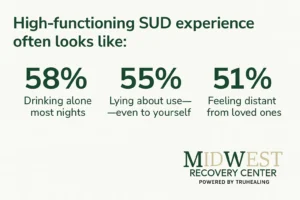
But what I didn’t realize is that high-functioning addiction doesn’t explode—it erodes.
It wears down your energy, your joy, your connection to people you love. It numbs you until even your wins feel hollow. You’re there, but not really there. You’re managing, but you’re exhausted.
That’s survival mode. And you don’t have to live there.
What Made Me Say “Enough”
It wasn’t one big moment. No screaming fight, no arrest, no disaster.
It was the quiet moment after another night of drinking alone—staring at the ceiling, wondering when I’d last felt proud of myself. Wondering how much longer I could fake it. Wondering if anyone else lived like this.
That’s when I found out about Midwest Recovery’s intensive outpatient program.
I hesitated. I wasn’t “bad enough,” right?
But something in me was ready. Not for drama. Just for something different.
IOP Isn’t What You Think
Here’s what I assumed: that IOP meant giving up everything. Work. Family. My routine.
Here’s what I got: a lifeline I could hold without letting go of my life.
An intensive outpatient program is exactly what it sounds like—intensive help, without full-time residential treatment. You attend multiple sessions per week, including therapy, group, and skill-building. But you go home at night. You keep living.
I still worked. Still picked my kid up from school. Still handled life. But for a few hours each week, I had space to finally take care of me.
What Actually Changed Inside IOP
For the first time in years, I told the truth out loud.
I didn’t sugarcoat it. Didn’t downplay it. I sat in a room with people who weren’t shocked by my story. Who nodded. Who said, “Same.”
That moment cracked something open in me.
Midwest’s IOP gave me:
- A schedule that kept me accountable without trapping me.
- A peer group that felt like a mirror, not a microscope.
- A therapist who helped me unpack what I’d been numbing for years.
- Real tools—not vague advice—for boundaries, triggers, and repair.
It didn’t fix me. But it helped me finally stop performing.
And honestly? That was the first step to feeling whole again.
You Don’t Have to Wait for Your Life to Fall Apart
This is the lie that kept me sick the longest: “It’s not that bad.”
But what if “not that bad” is already stealing your joy, your sleep, your peace?
You don’t have to lose everything to want something better.
You can choose IOP before you hit rock bottom. Before your partner gives up. Before your body starts breaking down. Before your job, your kids, or your self-respect slip out of reach.
If you’re in Maumee or Perrysburg, Ohio, and you’ve been wondering if support is “too much” or “too soon,” please hear this: It’s not.
What Recovery Looks Like for High-Functioning Adults
It’s not dramatic. It’s not chaotic. It’s quiet. Intentional.
Recovery, for people like us, looks like:
- Waking up without shame
- Learning how to feel without numbing
- Having hard conversations and staying present
- Redefining success without sacrifice
- Being sober, yes—but more importantly, being honest
IOP taught me that recovery isn’t a finish line. It’s a daily act of self-respect.
And if you’re in Oregon, Ohio, Midwest Recovery offers IOP services designed for exactly this kind of healing—structured, flexible, and stigma-free.
Real Talk: What IOP Felt Like Week to Week
- Week 1: Terrified I didn’t belong. Convinced everyone would judge me.
- Week 2: Realized most people were just like me. Some had lost more. Some hadn’t. But all of us were tired of pretending.
- Week 3: Said something out loud I’d never said before. No one flinched.
- Week 4: Had a craving and told someone before I acted on it. That was new.
- Week 6: Had a tough day and didn’t use. That was everything.
It wasn’t magic. It was movement. And that movement is still saving my life.
FAQs: What People Like Us Usually Ask
Do I have to call myself an addict to go to IOP?
No. You don’t have to label yourself to ask for help. If your substance use is affecting your life—even slightly—you’re allowed to explore support.
Can IOP work for people who haven’t hit rock bottom?
Absolutely. In fact, that’s where IOP shines. It gives structure and support before everything falls apart.
Will I still be able to work while doing IOP?
Yes. Midwest offers flexible schedules so you can attend sessions while still managing your job and responsibilities.
What if I’m still unsure about quitting entirely?
That’s normal. You don’t need certainty to start. IOP meets you where you are and helps you gain clarity through real conversations—not pressure.
What makes Midwest Recovery different?
They understand high-functioning burnout. You won’t be judged. You’ll be heard. Their team treats people with dignity, not shame. And their programming is built for real life.
How long is IOP?
Most programs run 6–12 weeks. Enough time to make real changes—and build a foundation you can carry forward.
Is IOP confidential?
Yes. Your privacy is protected, and Midwest can work with you to maintain discretion at work and home.
If You’re Still Scrolling, You’re Not Alone
You don’t have to be ready. You don’t have to be sure.
You just have to be done with whatever version of your life you’ve been barely surviving in.
IOP isn’t the end of your story. It’s the part where you decide to stop living in pieces.
It’s the moment you choose honesty over appearances.
And it might be the best decision you never thought you’d need to make.
You don’t have to fall apart to start over.
Call (888) 657-0858 or visit our intensive outpatient program in Toledo to learn how Midwest Recovery Center helps high-functioning adults build real recovery—without losing the life they’ve built.