
I was never late to work.
Deadlines? Hit them.
Clean clothes, decent meals, birthday gifts mailed on time.
From the outside, everything looked good.
But behind all of that? I was drinking every night just to quiet the static in my head. Taking pills when the meetings felt too sharp. Googling “am I an alcoholic” at 3 a.m., then deleting my search history like it was something dirty.
I thought: If I ask for help, it’ll ruin me.
I didn’t want to burn my life down. I just wanted a break—from the pretending, the performance, the pressure of holding it all together while quietly falling apart.
That’s where IOP came in.
An intensive outpatient program isn’t rehab in the way most of us picture it. There’s no dramatic exit from your life. No leaving your job or explaining a “leave of absence” to HR. It’s support that fits into your real life, for people like us—who don’t look sick but feel like we’re barely hanging on.
You Don’t Have to Crash to Be in Crisis
One of the cruelest myths about addiction is that it has a “look.”
Passed out. Jobless. Rock bottom.
But many of us are living a quieter kind of crisis. We show up, smile, perform. We pay the bills. We might even be complimented for how “on top of it” we are. But inside? We’re eroding.
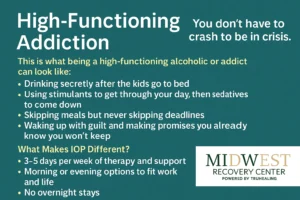
This is what being a high-functioning alcoholic or addict can look like:
- Drinking secretly after the kids go to bed
- Using stimulants to get through your day, then sedatives to come down
- Skipping meals but never skipping deadlines
- Waking up with guilt and making promises you already know you won’t keep
You may not be spiraling out loud, but you’re tired. So tired.
And the worst part? You’re scared that the only way to get better means losing everything you’ve worked for.
What Makes IOP Different?
An intensive outpatient program bridges the gap between no help and too much help. It’s treatment designed to meet you where you are—mentally, emotionally, and logistically.
Here’s what IOP looks like at a place like Midwest Recovery in Toledo:
- 3–5 days per week of therapy and support
- Morning or evening options to fit work and life
- No overnight stays
- Licensed counselors, peer support, and real accountability
- Group and individual sessions
It’s not about leaving your life. It’s about reclaiming it.
For locals near Perrysburg, Ohio or Maumee, the flexibility of IOP means you can start making real changes—without blowing up your calendar, your career, or your reputation.
“I’m Not That Bad”—The Lie That Keeps You Stuck
If you’ve ever said to yourself, “It’s not that bad yet,” I want to ask you something:
How bad does it have to get before you let yourself rest?
High-functioning addiction is good at disguising itself as control. But it’s not control—it’s containment.
You’re not okay, and your body knows it. The anxiety. The shame. The 3 a.m. wakeups with your heart racing and your brain looping in guilt.
You don’t need to be worse to get help.
You don’t need to lose your job, your family, your reputation.
You just need to be tired of living like this.
What IOP Gave Me That I Didn’t Expect
I didn’t go into IOP looking for transformation. Honestly? I just wanted a break from myself.
But what I got was more than a pause. It was a reset.
I met other people who looked just like me—smart, driven, put-together on the outside, unraveling on the inside.
In those rooms, I didn’t have to perform.
I didn’t have to minimize my struggle or pretend it was a bad week instead of a bad year.
Over time, I learned:
- That I could talk about what was real without being judged
- That needing support didn’t mean I was weak
- That healing doesn’t have to be dramatic to be meaningful
- That showing up consistently—even in pieces—was enough
IOP gave me my life back. Not by blowing it up, but by helping me inhabit it again—sober, present, and with my full self in the room.
Signs IOP Might Be the Right Fit for You
Wondering if you’re “bad enough” for IOP? Forget that framework. Ask yourself:
- Do I feel like I’m living a double life?
- Am I using substances more often than I admit out loud?
- Have I tried to stop before—and failed quietly?
- Do I dread getting through the day without something to take the edge off?
- Am I scared that if I stop, everything will fall apart?
If the answer to even a few of these is yes, then it’s not about being “bad enough.”
It’s about being ready for something different.
And if you’re in or near Oregon, Ohio, you’ve got access to confidential, local support that meets you where you are.
Frequently Asked Questions About Intensive Outpatient Programs
What is the difference between IOP and inpatient rehab?
Inpatient rehab requires you to live at the facility, usually for 30 days or more. It’s immersive and intensive. IOP, on the other hand, offers structured treatment while you continue living at home. You attend sessions several days a week but keep working, parenting, and living your life outside of treatment hours.
Will anyone find out I’m in IOP?
Your privacy is protected. Programs like Midwest Recovery Center maintain full confidentiality. You don’t have to notify your employer unless you choose to, and sessions can often be scheduled outside of typical work hours.
Can I keep working while doing IOP?
Yes. Most people in IOP keep their jobs, attend school, or care for their families. The program is built to fit around real-life responsibilities.
What if I’ve tried therapy before and it didn’t help?
That’s okay. IOP is different from traditional talk therapy. It combines individual counseling, group support, education, and accountability. Many people who didn’t feel helped by past therapy find IOP more structured, practical, and impactful.
Do I have to stop using completely?
IOP is a recovery-based program—so yes, sobriety is the goal. But if you’re not there yet, you’re still welcome. You’ll never be shamed for where you’re starting. The focus is on progress, not perfection.
It’s Not About “Fixing” You—It’s About Finally Resting
If you’re still holding it together on the outside while quietly collapsing inside, you don’t need to shatter to get help. You just need a safe place to stop holding your breath.
IOP won’t take away your life—it will help you finally show up for it. With clarity. With support. With the space to stop pretending you’re fine.
So if you’re sitting there, staring at a half-finished drink, or scrolling your phone in another foggy morning-after haze, ask yourself:
What if this didn’t have to be normal?
Ready to breathe again?
Call (888) 657-0858 to learn more about intensive outpatient program services in Toledo, Ohio.