

It’s a strange kind of loneliness.
You’re doing something good for yourself—but it doesn’t always feel good in the moment.
You scroll through your phone, see everyone out, and wonder if you’re missing something… or if they are.
Being sober young can feel like stepping out of the main storyline.
But here’s what most people don’t tell you: it doesn’t stay that way.
With the right kind of support—like a community-based recovery environment—things don’t just get easier. They get more real.
1. You stop feeling like the “odd one out” all the time
At first, everything highlights the difference.
Someone offers you a drink.
You hesitate.
You explain—or don’t—and either way, it feels noticeable.
That “I don’t quite fit here anymore” feeling can follow you everywhere.
But being around people your age who are also choosing something different? That changes the math.
You’re not explaining yourself constantly.
You’re not scanning the room to see if you stand out.
You’re just… part of the group.
And that quiet sense of belonging? It’s a bigger deal than it sounds.
2. You rebuild a social life that doesn’t drain you
A lot of people think the hardest part is stopping.
It’s not.
It’s figuring out how to live after.
What do you do on a Friday night?
Who do you text?
How do you connect without the thing that used to make it easy?
In a supportive environment, you don’t have to force those answers.
You’re around people who are also rebuilding. Conversations happen naturally—sometimes awkwardly, sometimes effortlessly—but always honestly.
No pretending. No performing.
And over time, you realize something: connection feels better when you remember it.
3. You meet a version of yourself you haven’t fully seen yet
This part can be uncomfortable—but also kind of incredible.
Because without substances, there’s nothing buffering your personality.
At first, that might feel like:
- Social anxiety
- Overthinking
- Not knowing what to say
But then, slowly:
You start laughing at things you didn’t expect.
You speak up without rehearsing it first.
You feel moments of confidence that don’t disappear the next day.
It’s not about becoming someone new.
It’s about finally meeting who you’ve been underneath everything.
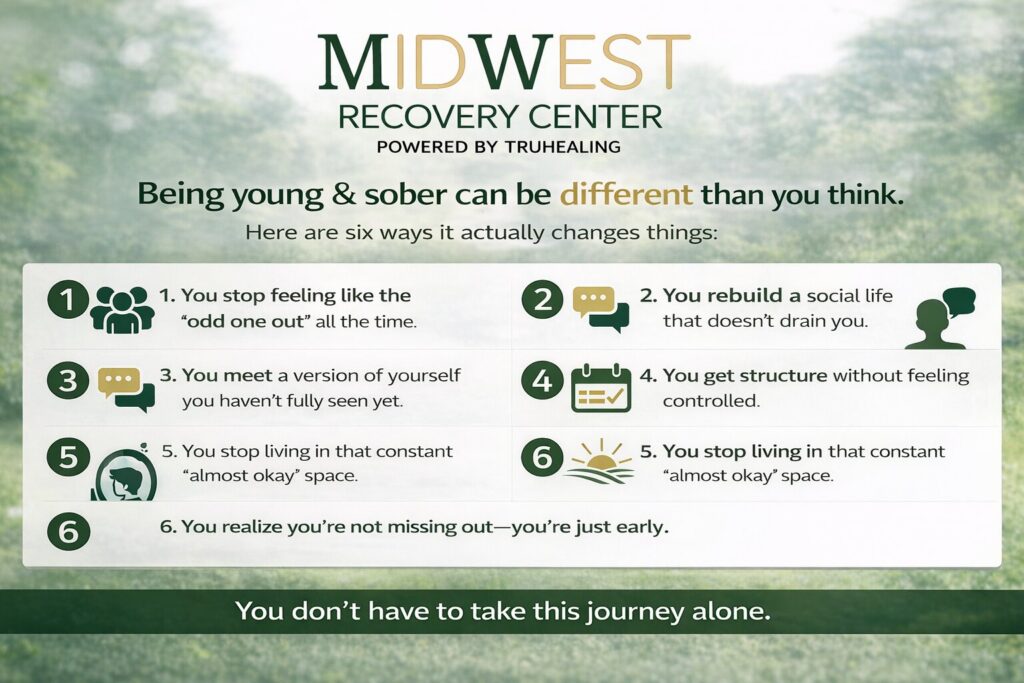
4. You get structure without feeling controlled
A lot of young people resist support because it sounds restrictive.
Like rules. Like loss of freedom.
But the right kind of structure doesn’t box you in—it steadies you.
You start having:
- Days that make sense
- Nights that don’t spiral
- Routines that don’t depend on chaos
There’s accountability, but it doesn’t feel like punishment. It feels like someone’s paying attention.
If you’re looking for help in Youngstown or nearby, having that kind of steady support can take you out of survival mode and into something more sustainable.
5. You stop living in that constant “almost okay” space
This one is hard to explain unless you’ve felt it.
It’s that in-between state where nothing is fully falling apart—but nothing feels solid either.
You’re managing, but barely. Holding it together, but just enough.
Support shifts that.
You’re not constantly recalculating your next move.
You’re not waking up wondering what version of yourself you’ll be today.
Things start to feel… consistent.
Not perfect. But stable in a way that gives you room to breathe.
6. You realize you’re not missing out—you’re just early
This is the perspective shift that takes time.
At first, it feels like you stepped out of something fun too soon. Like everyone else is still enjoying something you had to walk away from.
But then you start noticing things:
- How repetitive that cycle actually is
- How many people are quietly struggling in it
- How different you feel mentally and emotionally
And then one day, it clicks:
You’re not behind. You’re ahead of something.
Not in a competitive way. Just in a clarity way.
Like you chose to wake up a little earlier than the rest.
The part no one prepares you for
Even with all these changes, there will still be moments.
Moments where you feel out of place.
Moments where you question your decision.
Moments where it would be easier to go back.
That doesn’t mean you’re doing it wrong.
It means you’re doing something real.
And the difference now? You don’t have to handle those moments alone.
FAQ: What Young People Actually Wonder About
Do I have to give up my entire social life to stay sober?
No—but your social life will likely change.
At first, it might feel smaller. But over time, it becomes more real, more supportive, and a lot less exhausting.
What if I feel awkward or out of place around other sober people?
Totally normal.
Most people walk in feeling exactly like that. It usually fades faster than you expect once you realize everyone else is figuring it out too.
Will I still be able to have fun?
Yes—but it might look different than what you’re used to.
And honestly? A lot of people find it’s better. More present, less chaotic, and something you actually remember the next day.
What if I’m not sure I’m “bad enough” to need this kind of support?
That thought shows up for a lot of people.
You don’t need to prove anything to deserve support. If something feels off, that’s enough reason to explore your options.
How long do people usually stay in a supportive living environment?
It varies.
Some people stay for a shorter reset. Others stay longer to build stability. There’s no one timeline you have to follow.
What if my friends don’t understand my decision?
That can be one of the hardest parts.
Some will get it. Some won’t. But over time, you’ll start building relationships with people who do—and that makes a huge difference.
Ready to See What This Could Look Like for You?
If you’re in that space where something doesn’t feel right—but you can’t fully explain why—that’s enough to start.
Call (888) 657-0858 or visit our supportive housing and recovery options to learn more about our programs, community housing program oh services in Toledo, Ohio.
No pressure. No labels. Just a real conversation about what might help.