

You don’t drink because you’re reckless.
You drink because your brain won’t stop.
As a clinician, this is one of the most common realities I see in high-functioning adults. People who hold jobs, raise families, meet deadlines, and show up. People others rely on. People who look steady from the outside and feel relentlessly overstimulated on the inside.
Alcohol becomes the off switch.
Not for fun. Not for escape.
For quiet.
If you’re reading this and thinking, That sounds familiar, I want to be clear from the start: nothing here is about judgment. And nothing here assumes you’ve “hit bottom.” This is about understanding why alcohol becomes necessary for people who otherwise appear to be doing everything right — and what Alcohol Addiction Treatment can look like when the goal isn’t collapse, but relief.
Within the first moments of treatment conversations at Midwest Recovery Center, this is often what I hear:
“I just want my mind to stop running.”
The High-Functioning Brain That Never Rests
High-functioning people don’t struggle with motivation. They struggle with deactivation.
Your brain is constantly scanning — for risk, for responsibility, for what needs to be handled next. Even when things are objectively okay, your nervous system doesn’t fully register safety. It stays alert. Busy. On.
Alcohol works because it slows that process. Temporarily.
For a while, a drink at night quiets the internal noise. The mental tabs close. The tension eases. Sleep feels possible. That relief isn’t imagined — it’s neurological. Alcohol dampens certain stress responses and creates a sense of mental narrowing that can feel like peace.
The problem is that your brain learns this pattern quickly.
What starts as occasional relief becomes a requirement. The off switch stops working without help. And over time, alcohol doesn’t just quiet the noise — it creates more of it.
Why “I’m Still Functioning” Can Delay Help
One of the hardest parts of treating high-functioning alcohol use is that there’s often no external crisis forcing change.
Bills are paid. Work performance is intact. Relationships appear stable. From the outside, there’s no obvious reason to intervene. That makes it easy — and understandable — to dismiss internal warning signs.
You may tell yourself:
- I don’t drink in the morning.
- I never miss work.
- Other people have it worse.
- I could stop if I really needed to.
Those statements aren’t lies. They’re partial truths.
What they often mask is the cost of maintaining functionality while relying on alcohol as emotional regulation. The exhaustion of holding everything together. The creeping anxiety about what would happen if you couldn’t drink. The quiet fear that rest is no longer available without it.
As a clinician, I don’t measure severity by chaos. I measure it by dependence.
When Alcohol Becomes a Tool Instead of a Choice
Alcohol use shifts subtly in high-functioning people.
It stops being social.
It stops being celebratory.
It starts being necessary.
You drink to fall asleep.
You drink to calm your thoughts.
You drink to take the edge off irritability or pressure.
And eventually, you drink because not drinking feels worse.
This doesn’t mean you’re weak. It means your nervous system has learned a shortcut — one that works quickly but erodes stability over time. The brain adapts, tolerance increases, and the same amount of alcohol produces less relief. The off switch sticks. The volume creeps back up.
This is often the moment people begin quietly searching for Alcohol Addiction Treatment, even if they don’t use that language yet.
Alcohol Addiction Treatment for People Who Don’t “Fit the Mold”
Many high-functioning adults avoid treatment because they don’t recognize themselves in stereotypical portrayals of addiction.
They imagine loss of control, public collapse, or being talked down to. They worry about being misunderstood or pressured into a one-size-fits-all model that ignores nuance.
Good alcohol addiction treatment doesn’t do that.
Effective treatment is about:
- Understanding why alcohol became useful
- Addressing stress, anxiety, and sleep at the nervous-system level
- Creating alternative ways to downshift that don’t require substances
- Preserving dignity, autonomy, and privacy
For many people, treatment is less about stopping everything and more about learning how to rest without paying for it later.
What Clinicians Pay Attention To (That You Might Not)
In clinical settings, we don’t look for dramatic stories. We listen for patterns that suggest the brain is over-relying on alcohol for regulation.
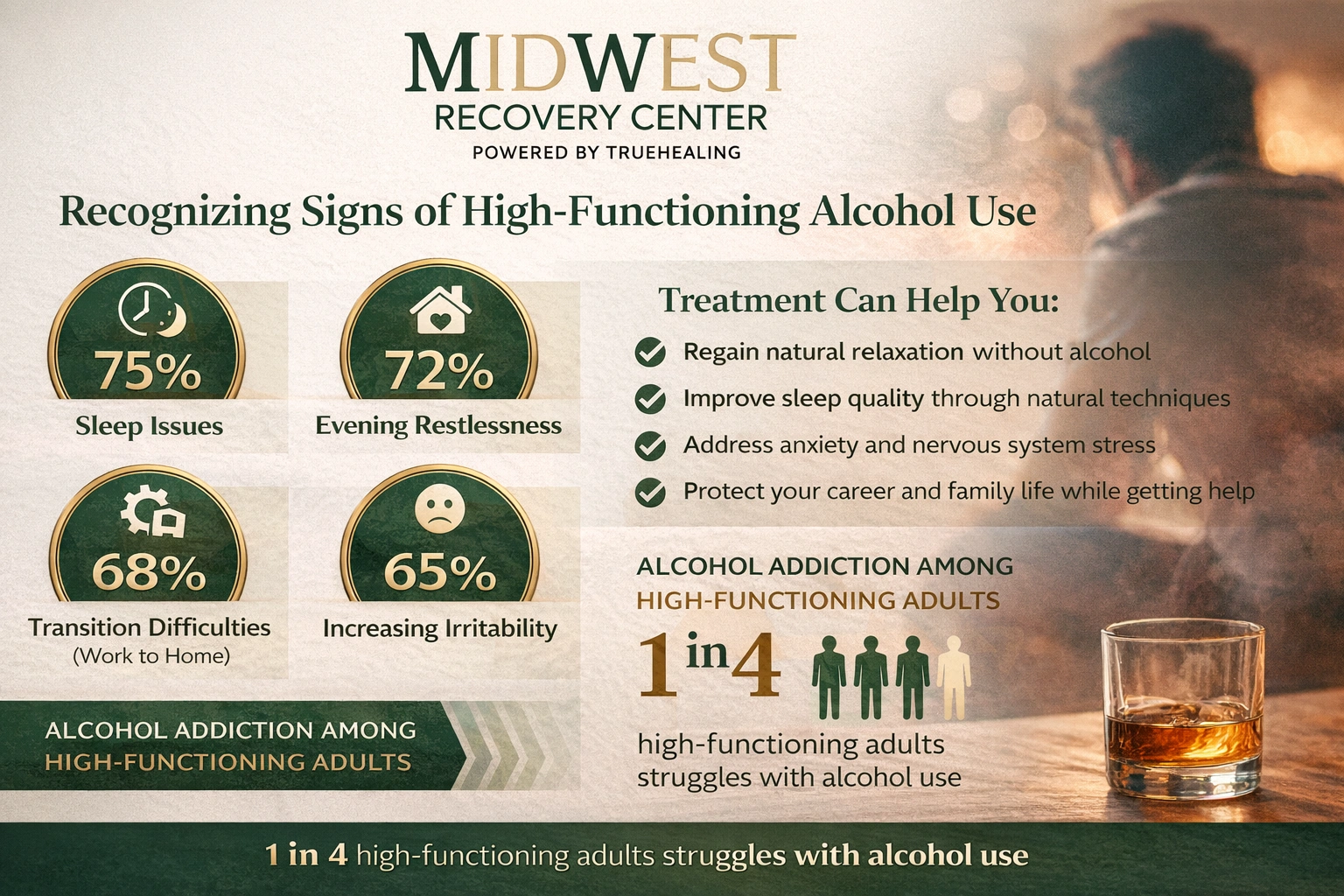
Some of the most telling signs include:
- Feeling keyed up or restless in the evening without alcohol
- Using alcohol to transition between roles (work → home, parent → partner)
- Difficulty sleeping without drinking
- Mental fatigue that doesn’t improve with time off
- Increasing irritability or emotional numbness
These patterns matter even when life appears stable. They indicate that the nervous system hasn’t learned how to shut down on its own anymore.
Treatment Isn’t About Taking Something Away — It’s About Giving Rest Back
One of the biggest fears I hear is, What will I do without alcohol?
That fear makes sense. Alcohol has been performing an essential function — providing relief. Removing it without replacing that function would be cruel and ineffective.
Alcohol addiction treatment works best when it focuses on restoration, not restriction.
Treatment helps people:
- Relearn how to downshift naturally
- Regulate anxiety without numbing
- Improve sleep without chemical dependence
- Address the internal pressure driving overfunctioning
This isn’t about changing who you are. It’s about reducing the load you’ve been carrying alone.
Alcohol Addiction Treatment in Toledo and Surrounding Areas
Access matters. So does familiarity with the pressures people face in their own communities.
At Midwest Recovery Center, alcohol addiction treatment is designed to meet people where they are — including professionals, parents, and individuals who still have significant responsibilities.
Care is also accessible for those looking for help beyond Toledo. Many individuals begin exploring treatment options while searching for Looking for Alcohol Addiction Treatment in Maumee, Ohio or Looking for Alcohol Addiction Treatment in Perrysburg, Ohio, wanting something close enough to feel manageable and discreet.
Location doesn’t change the underlying need: safe, respectful support that understands high-functioning alcohol use without minimizing it.
The Quiet Moment That Often Precedes Change
Most high-functioning people don’t decide to seek help in a dramatic moment.
It happens quietly.
Usually at night.
Usually alone.
It’s the thought you can’t quite shake:
I’m tired of needing this.
Not tired of drinking — tired of depending.
That moment matters. It doesn’t demand action immediately. But it deserves honesty. And often, it’s the beginning of a different relationship with rest, pressure, and yourself.
FAQs About Alcohol Addiction Treatment for High-Functioning Adults
Is alcohol addiction treatment only for people who have lost control?
No. Many people enter treatment while still functioning at a high level. Treatment is about dependence, not disaster. If alcohol feels necessary rather than optional, it’s worth exploring support.
Can I still work while getting alcohol addiction treatment?
Often, yes. Many treatment programs are designed to accommodate work and family responsibilities. A clinical assessment helps determine what level of care fits your situation without unnecessary disruption.
What if alcohol is the only thing that helps me sleep?
This is extremely common. Treatment focuses on restoring healthy sleep patterns without relying on alcohol, addressing both anxiety and nervous-system activation that interfere with rest.
Do I have to call myself an alcoholic to get help?
No. Labels are not required. Treatment focuses on patterns, impact, and goals — not forcing identity terms that don’t resonate with you.
Is treatment confidential?
Yes. Confidentiality is a foundational part of ethical care. High-functioning individuals often prioritize discretion, and treatment programs are structured accordingly.
What if I’ve tried to cut back on my own and couldn’t?
That doesn’t mean you failed. It often means your nervous system needs support beyond willpower. Treatment addresses the underlying mechanisms that make cutting back difficult.
A Clinician’s Closing Thought
If alcohol is the only way your brain knows how to turn off, that’s not a character flaw. It’s a system under strain.
You don’t need to wait for things to fall apart to deserve help. You don’t need to identify with a stereotype. And you don’t need to do this alone.
If you’re ready to explore what real rest could look like — without the cost — Alcohol Addiction Treatment may be the next right conversation, not a final decision.
Call (888) 657-0858 to learn more about our Alcohol Addiction Treatment services in Toledo, Ohio.