
You probably didn’t expect to be asking this question again.
“How long do you actually stay?”
Not in a panicked, everything-is-falling-apart kind of way.
More like a quiet, honest moment where something just… doesn’t feel finished.
If you’ve been through treatment before—or you’ve had some time sober—you already know the basics. You know how to stop. You know what meetings are. You know what people expect recovery to look like.
But knowing all that doesn’t always mean you feel connected to your life.
And that’s where this question hits differently.
The Version of You That Just Wanted to Get Through It
Be honest—when you first went into live-in treatment, you weren’t thinking about “deep healing.”
You were thinking:
- How bad is this going to be?
- How long do I have to stay?
- When can I leave?
You learned the structure. You followed the rules. Maybe you even did really well.
But a part of you was still bracing. Counting days. Waiting to get back to your life.
Because early recovery feels like being dropped into a new language without a translator. Everything is unfamiliar—your emotions, your thoughts, your body.
So of course you focused on getting through it.
That wasn’t wrong. It was survival.
The Shift That Happens Later (And Feels Harder)
Here’s the part people don’t prepare you for:
After some time sober, life gets quieter—but not always fuller.
You’re not in chaos anymore.
You’re functioning.
Maybe even doing well on the outside.
But internally?
There can be this low, constant hum of disconnection.
Like you’re living your life… but not fully inside it.
That’s when the question changes.
It’s no longer:
“How long do I have to stay?”
It becomes:
“Did I stay long enough to actually change?”
So… How Long Do People Stay in Live-In Treatment?
Let’s answer it clearly—without sugarcoating it.
There is no single “right” length of stay.
But there are patterns:
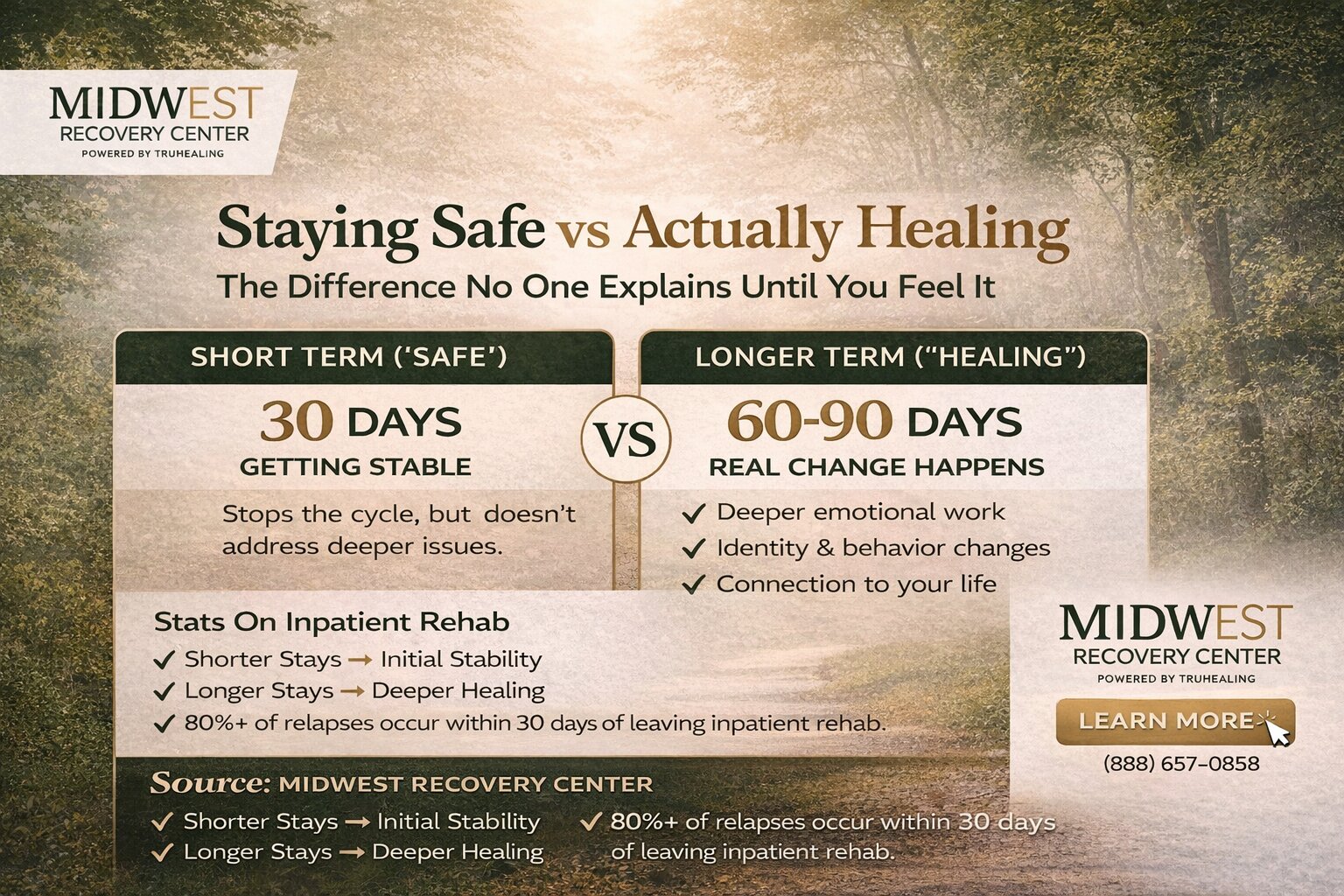
- 30 days → Stabilization, routine, early awareness
- 60 days → Deeper emotional work begins
- 90+ days → Identity shifts, real behavioral change
And here’s the part that matters most:
The longer you stay, the less you can hide from yourself.
Short stays can get you sober.
Longer stays give you a shot at staying that way—and actually feeling different.
If you’re looking into options like residential treatment programs, it’s worth understanding that time isn’t just a number—it’s a layer of depth.
Why 30 Days Feels Like Enough (Until It Isn’t)
A lot of people leave around the 30-day mark feeling strong.
Clear-headed. Focused. Motivated.
And for a while, that holds.
But here’s what often shows up later:
- Emotional triggers you didn’t fully process
- Old coping patterns sneaking back in quietly
- A sense of going through the motions instead of growing
It’s not because you didn’t try hard enough.
It’s because some things don’t surface in 30 days.
Real patterns—the ones tied to identity, trauma, and emotional habits—take longer to unfold.
What Actually Changes in a Longer Stay
This is where the conversation gets real.
Because staying longer isn’t just “more treatment.”
It’s a completely different experience.
At first, you’re focused on:
- Not using
- Following structure
- Getting stable
But with more time, something shifts.
You start noticing:
- The way you avoid certain emotions
- The roles you play in relationships
- The stories you tell yourself without realizing it
And you can’t rush that awareness.
Longer time in live-in treatment gives you space to:
- Sit with discomfort instead of escaping it
- Practice honesty without performing
- Rebuild trust—with yourself and others
- Experience connection in a consistent, real way
At some point, recovery stops being about not using
And starts being about actually living
The Hidden Cost of Leaving Too Soon
Let’s talk about something people don’t usually say out loud.
Leaving early can feel like control.
Like you “beat the system” or proved you didn’t need as much help.
But sometimes, it’s just another version of avoiding discomfort.
And that avoidance has a cost.
It shows up later as:
- Emotional numbness
- Restlessness you can’t explain
- A slow drift away from what helped you
Not dramatic. Not obvious.
Just enough to make you feel stuck.
You’re Not Backtracking—You’re Leveling Up
If you’re considering going back to live-in treatment—or staying longer this time—it can mess with your head.
“I already did this.”
“Why am I here again?”
But here’s a different way to look at it:
You’re not starting over.
You’re continuing where you left off.
The version of you asking this question now is not the same person who first walked into treatment.
You have more awareness.
More honesty.
Less denial.
That changes everything.
A lot of people exploring inpatient rehab Toledo Ohio options aren’t new—they’re just ready for deeper work this time.
That “Flat” Feeling Isn’t Failure
Let’s name it directly.
That feeling of:
- Going through the motions
- Not feeling as connected as you thought you would
- Wondering “Is this it?”
That’s not failure.
It’s a signal.
It usually means there’s another layer of growth waiting—but it requires more space, more time, and more support than you’ve given yourself so far.
And yeah, that’s frustrating.
But it’s also an opportunity most people never get honest enough to see.
You Don’t Get a Medal for Doing This Fast
Recovery culture sometimes quietly pushes this idea:
Faster is better.
Shorter is stronger.
Needing less help means you’re doing it “right.”
That’s not how this works.
There is no prize for rushing healing.
The real goal isn’t speed—it’s depth.
Because depth is what makes things stick.
FAQ: Real Questions About Staying in Live-In Rehab
How long should I actually stay in live-in rehab?
Long enough that you’re not just stable—but honest, aware, and practicing change in real time. For many people, that’s closer to 60–90 days or more.
Is it a bad sign if I need longer than 30 days?
Not at all. It usually means you’re willing to go deeper instead of settling for surface-level progress.
Can I still benefit if I’ve already been to treatment before?
Yes—often even more. You come in with awareness, which allows you to engage differently and go further emotionally.
What if I feel “fine” but still disconnected?
That’s more common than people admit. Feeling “fine” isn’t the same as feeling connected or fulfilled. That gap is often where deeper work happens.
Is going back to treatment a step backward?
No. It’s a continuation. Most people who build long-term recovery have more than one chapter in their treatment story.
How do I know if I left too early last time?
If you notice patterns returning, emotional avoidance, or a sense of disconnection—it may be a sign there was more work to do.
You Don’t Have to Stay Stuck Here
If something in this hit a little too close, that’s not a coincidence.
It’s awareness.
And awareness is where things start shifting again.
You don’t have to wait for things to get worse to take it seriously. You can respond now—while you’re still stable enough to choose something different.
If you’re exploring what more support could look like, you can look into treatment in locations that meet you where you are now—not where you used to be.
Recovery isn’t about getting through it once.
It’s about staying long enough to actually feel like yourself again.
If you’re ready to take that next step, call (888) 657-0858 or visit our residential treatment program services in Toledo, Ohio to learn more.
You don’t have to settle for a version of recovery that feels halfway there.