
You don’t have to hit a breaking point to start questioning things.
Sometimes it’s more subtle than that.
It’s waking up a little more tired than usual.
It’s noticing your mood depends on something outside of you.
It’s that quiet thought: “I don’t think this is working for me anymore.”
If you’re here, you’re not alone—and you’re not behind. You’re just at the part where curiosity turns into consideration.
Let’s talk through the real questions people ask before they reach out.
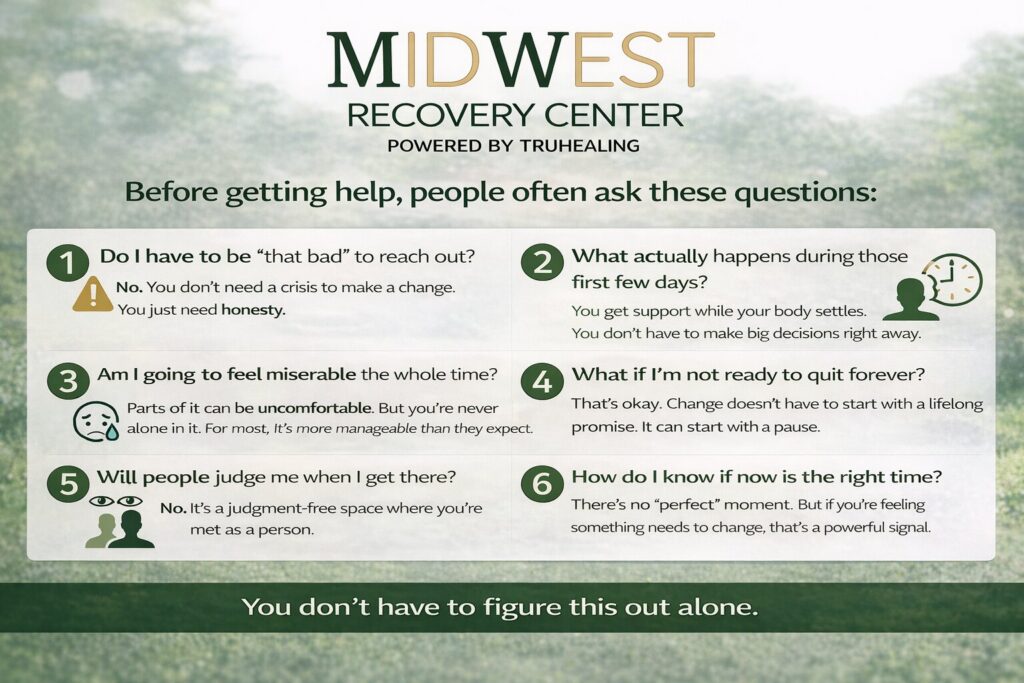
Do I have to be “that bad” to reach out?
No—and this belief keeps a lot of people stuck longer than they need to be.
There’s this invisible line people think they have to cross before they “qualify” for help. But in reality, most people who reach out are functioning. They’re working, showing up, keeping things together on the outside.
It just doesn’t feel sustainable anymore.
If you’ve started negotiating with yourself…
“If I can just cut back this week…”
“If I only drink on weekends…”
That’s already a signal worth listening to.
You don’t need a crisis to make a change. You just need honesty.
What actually happens during those first few days?
This is usually where the fear lives—the unknown.
The early phase is about helping your body settle while you’re supported by medical and clinical staff. There’s structure, but not pressure. You’re not expected to have answers or make big life decisions right away.
You’re allowed to just arrive.
There’s often a rhythm to the day—check-ins, rest, light conversation, support when you need it. Some people sleep a lot. Others feel restless at first. Both are normal.
If you want a clearer, grounded picture of what that experience looks like, you can explore our detox support services and how we guide people through those first steps.
Am I going to feel miserable the whole time?
This is one of the most honest questions—and it deserves an honest answer.
It can be uncomfortable. Your body is adjusting, and that can come with physical and emotional ups and downs.
But here’s what people often don’t expect:
- You’re supported the entire time
- Symptoms are monitored and managed
- You’re not left alone to figure it out
Most people walk in expecting the worst—and leave saying, “That wasn’t easy… but it was manageable.”
And more importantly: it passes.
What if I’m not ready to quit forever?
Then don’t.
You don’t need to solve your entire future today.
A lot of people start here:
“I just need to feel like myself again.”
“I want to see what life feels like without this—for a little while.”
That’s enough.
Change doesn’t have to start with a lifelong promise. It can start with a pause.
Will people judge me when I get there?
This fear is quieter—but just as real.
People worry they’ll be seen a certain way. Labeled. Compared. Judged.
But what actually happens is much simpler: you’re met as a person.
The people around you—staff and peers—aren’t there to evaluate you. They’re there because they understand how complicated this moment can feel.
You don’t have to explain everything on day one.
You don’t have to open up before you’re ready.
You’re allowed to take your time.
What happens after I get through the first stage?
This is where things open up—not close in.
There isn’t just one path forward.
Some people step into structured daytime care for more support. Others choose flexible, multi-day weekly treatment that works around their life. Some take time to reflect before deciding what’s next.
If continuing care is something you’re considering, you can explore treatment in Youngstown to see what support can look like in a real-world setting.
The goal isn’t to lock you into something—it’s to help you find what fits.
What if I start and then change my mind?
That’s allowed too.
This isn’t a contract with your future self—it’s a step toward clarity.
Some people come in unsure and leave more certain. Others come in certain and adjust their plan along the way.
What matters is that you gave yourself the chance to see things more clearly.
How do I know if now is the right time?
There’s almost never a perfect moment.
Life doesn’t suddenly slow down. Responsibilities don’t disappear. Doubts don’t magically resolve.
But there is a shift that happens internally.
It sounds like:
“I can’t keep ignoring this.”
“Something needs to change—even if I don’t know what yet.”
If that’s where you are, this might be your moment.
Not because everything is falling apart—but because something in you is waking up.
The part no one really talks about
The hardest part isn’t always the process.
It’s the decision to begin.
Because starting means admitting something feels off. It means stepping into unfamiliar territory. It means choosing yourself in a way you might not be used to.
But here’s the truth:
You don’t have to wait until things get worse to deserve something better.
FAQ: Real Questions People Still Have
How long does the first phase usually last?
It varies depending on your situation, but most people spend a few days to about a week focusing on stabilization and support.
Can I talk to someone before committing to anything?
Yes. You can ask questions, share concerns, and get a feel for your options without pressure. Sometimes that first conversation is the most important step.
What should I bring with me?
Basic essentials—comfortable clothing, personal items, and anything recommended by the admissions team. You don’t need to overthink it.
Will I be completely cut off from the outside world?
There may be some structure around communication early on, but it’s designed to help you focus and feel grounded—not isolated.
What if I have responsibilities at home or work?
This is a common concern. Many people coordinate timing, leave, or support systems before starting. You don’t have to figure that out alone—guidance is part of the process.
Is it normal to feel unsure right up until the last minute?
Completely. Doubt doesn’t mean you’re making the wrong decision—it usually means you’re making a meaningful one.
Ready to Talk It Through?
You don’t need a perfect reason.
You don’t need certainty.
You just need a place to start.
Call (888) 657-0858 or visit our detox support services to learn more about our medical detox program services in Toledo, Ohio.
We’ll meet you where you are—with clarity, not pressure.