
You don’t have to be in crisis to be here. You don’t have to be “that bad.” And you don’t have to know exactly what you want yet.
A lot of sober‑curious people land on detox pages quietly—late at night, between meetings, or after another morning of thinking, I might need to look at this. You’re not alone in that. And you’re not strange for having questions you’re not ready to say out loud.
This FAQ-style guide is built around the real questions we hear every day at Midwest Recovery Center. Not the polished ones. The honest ones. The ones people ask when they’re curious… but cautious.
For clarity early on: this page links to our medical detox program because detox is often the first step people explore when they’re sober‑curious—not because it’s the right step for everyone, but because it’s a safe place to start asking.
Do I even need a medical detox program if I’m just “thinking about” sobriety?
Thinking about it is often the first signal—not the last.
A medical detox program isn’t only for people who have already decided to quit forever. It’s for people whose bodies may be more dependent than they realized, or whose attempts to cut back haven’t gone as smoothly as planned.
If stopping leads to shaking, anxiety, nausea, insomnia, or emotional swings, that’s not a willpower issue. That’s your nervous system reacting. Detox exists to help you pause safely and understand what’s actually happening in your body, without forcing a bigger decision before you’re ready.
What actually happens in a medical detox program?
At its core, detox handles the parts that are hardest to manage alone.
Medical staff monitor withdrawal symptoms, track vital signs, and use medications when appropriate to reduce discomfort and risk. You’re not guessing whether what you’re feeling is normal. You’re not Googling symptoms at 3 a.m. You’re not white‑knuckling through fear.
But detox isn’t just physical. It’s also emotional containment. Having structure. Having someone check in. Having a place where you don’t have to explain why you’re there.
That matters more than people expect.
What if I don’t use every day—can detox still make sense?
Yes, sometimes.
Frequency isn’t the only factor. Duration, tolerance, and how your body responds to stopping all matter. Plenty of sober‑curious people don’t drink or use daily—but when they try to stop, they feel off in ways they can’t explain.
Detox isn’t about labeling you. It’s about safety and clarity. An assessment can help determine whether medical support is appropriate, or whether another option would fit you better.
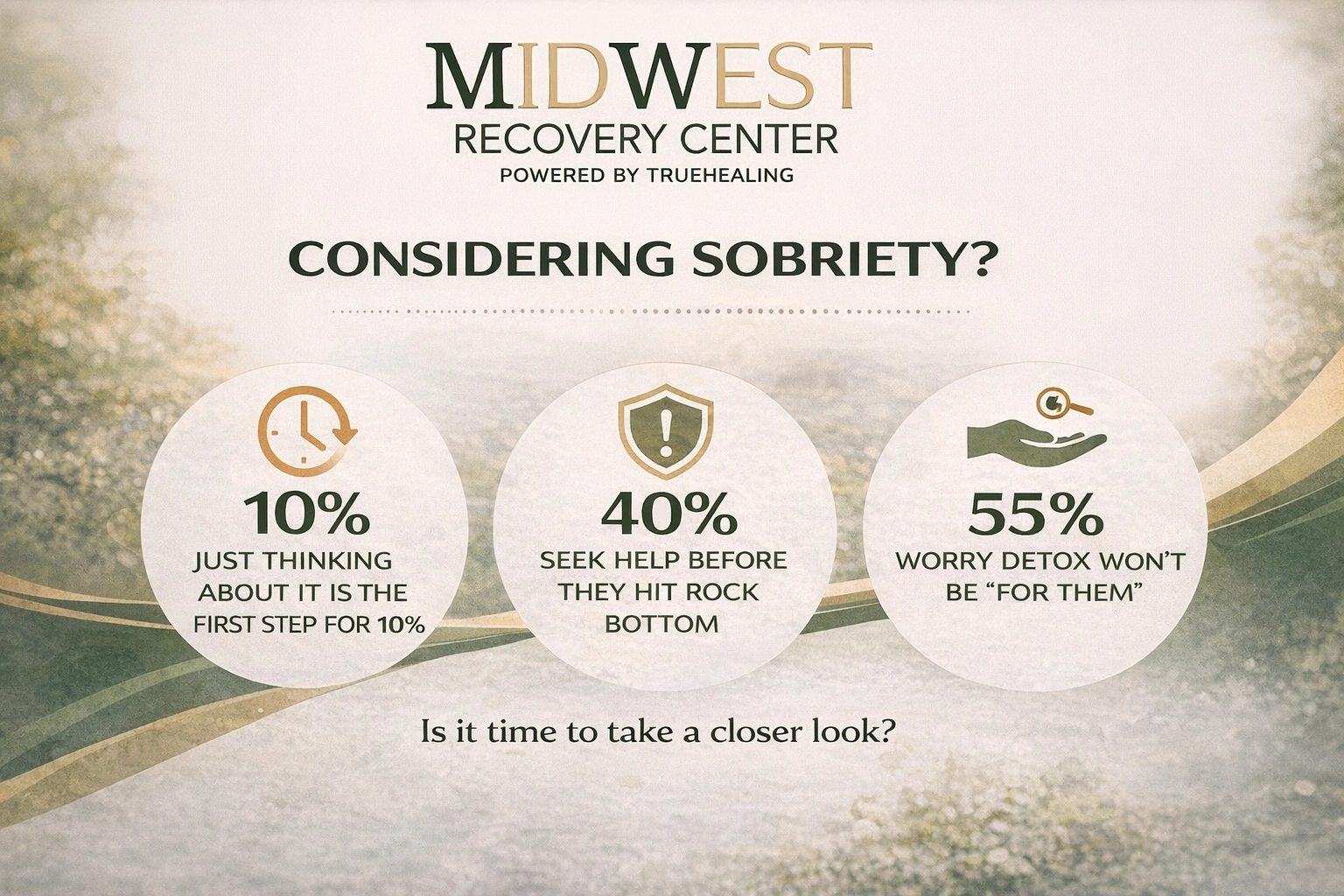
Will I be judged for not “having it as bad” as other people?
No—and this fear comes up a lot.
Detox is not a competition. There is no threshold of suffering you have to meet to deserve care. At Midwest Recovery Center, we see people across the entire spectrum: people scared, people unsure, people exhausted, people simply curious.
Some are coming from years of heavy use. Others are coming because something just feels off, and they don’t want to wait until it’s worse.
Both belong here.
We’ve supported people from Toledo, Ohio who didn’t want to “wait for things to get bad” and wanted clarity early. That instinct—to look before you leap—is not weakness. It’s self‑awareness.
Is detox going to be painful or traumatic?
It doesn’t have to be.
Withdrawal can be uncomfortable, yes. But medical detox exists specifically to reduce pain, prevent complications, and support you through the most unstable phase. Symptoms are addressed as they arise. Medications may be used. Rest is prioritized.
More importantly, you’re not alone with your fear. Someone is paying attention. Someone is responding. Someone is making sure discomfort doesn’t turn into danger.
That alone changes the experience dramatically.
What if I walk in still drinking or using?
That’s normal—and expected.
You do not need to sober up before coming to detox. In fact, attempting to do so on your own can be risky. Medical detox is designed to receive people exactly where they are, not where they think they should be.
No lectures. No punishment. Just care.
Do I have to call myself an addict to be here?
No.
You do not have to adopt an identity, a label, or a storyline. Sober‑curious people often resist detox because they fear being boxed into something they’re not ready to claim.
Detox doesn’t require self‑definitions. It requires honesty about how your body feels and curiosity about what you want next.
That’s it.
What if I change my mind after I start?
You’re allowed to.
A medical detox program is not a trap. It’s not a point of no return. You retain autonomy throughout the process. If fear comes up, if doubt surfaces, if you need to slow down—those conversations are welcome.
Interestingly, many people who feel unsure on Day 1 feel very different by Day 3, once their nervous system settles and their thinking clears. But even if you decide not to continue, the experience still gives you information—and information is power.
Will detox force me into rehab afterward?
No.
After detox, the next step is a conversation—not a mandate. Some people move into residential care. Others choose outpatient support, therapy, or a period of reflection. Some simply gather information and pause.
The goal is not to funnel you somewhere. It’s to help you choose consciously.
If you’re near Youngstown, Ohio, there are also ways to connect with ongoing care in locations that allow you to stay rooted in your daily life while exploring next steps. Detox doesn’t have to mean disappearing from everything you know.
How long does a medical detox program usually last?
Most detox stays range from 5 to 10 days, depending on substances used, medical history, and how your body responds.
The focus is stabilization—not speed. Leaving detox too early can increase risk, which is why the length is guided by how you’re actually doing, not a preset calendar.
Those days are often quieter than people expect. Fewer decisions. Fewer distractions. More space to notice what your body and mind are telling you.
What if I don’t tell anyone I’m doing this?
That’s completely okay.
Detox does not require public announcements. Many people enter quietly, especially those who are sober‑curious and still sorting things out internally. Privacy is respected. Your story is yours.
You can decide later who to involve, how much to share, and when.
What if I’ve thought about detox before and backed out?
That doesn’t disqualify you.
It actually puts you in very good company.
Hesitation is common, especially for people who are thoughtful, high‑functioning, or afraid of overreacting. Sometimes it takes multiple moments of curiosity before someone feels ready to act.
Each time you come back to the question, you’re learning something about yourself. That’s not failure. That’s processing.
Is it weird to feel scared even if I’m the one choosing this?
Not weird at all.
Choosing detox can feel like stepping into uncertainty. Even positive change carries loss—loss of familiarity, routines, coping mechanisms. Fear doesn’t mean you’re doing the wrong thing. It means you’re paying attention.
In detox, fear is expected. It’s met with steadiness, not urgency.
What do people usually say after detox?
Many sober‑curious people don’t say, “I’m cured.” They say things like:
“I can finally think clearly.”
“I didn’t realize how tense my body was.”
“I feel calmer than I have in a long time.”
“I’m glad I didn’t wait longer.”
Detox doesn’t answer every question. But it quiets the noise enough for better questions to emerge.
What if I’m still not sure this is for me?
That’s okay.
You don’t have to be sure to reach out. You don’t have to commit to anything to ask questions. Curiosity is enough to start a conversation.
And conversations—honest ones—are often where change actually begins.
If you’re ready to talk, or even just ready to ask without committing, call (888) 657-0858 to learn more about our medical detox program in Ohio.
You don’t have to decide everything today. You just don’t have to stay alone with the questions anymore.