
You love them. That’s never been the problem.
You’ve stood by them longer than anyone else. You’ve helped them get clean, promised you’d stay, offered one more chance. You’ve done the driving, the damage control, the waiting up, the praying, the hiding, the begging, the forgiving. You’ve watched the person you love disappear behind a version of themselves you barely recognize—and still, you’ve tried to hold on.
And maybe right now, you’re sitting with the quiet question in your gut:
“Am I doing more than I should be?”
“Is love supposed to hurt this much?”
Here’s the hardest truth no one tells you soon enough:
Love can’t fix addiction.
Not because your love isn’t deep. But because addiction is bigger than what any one person can hold. And that doesn’t mean it’s hopeless. It just means your role needs to change.
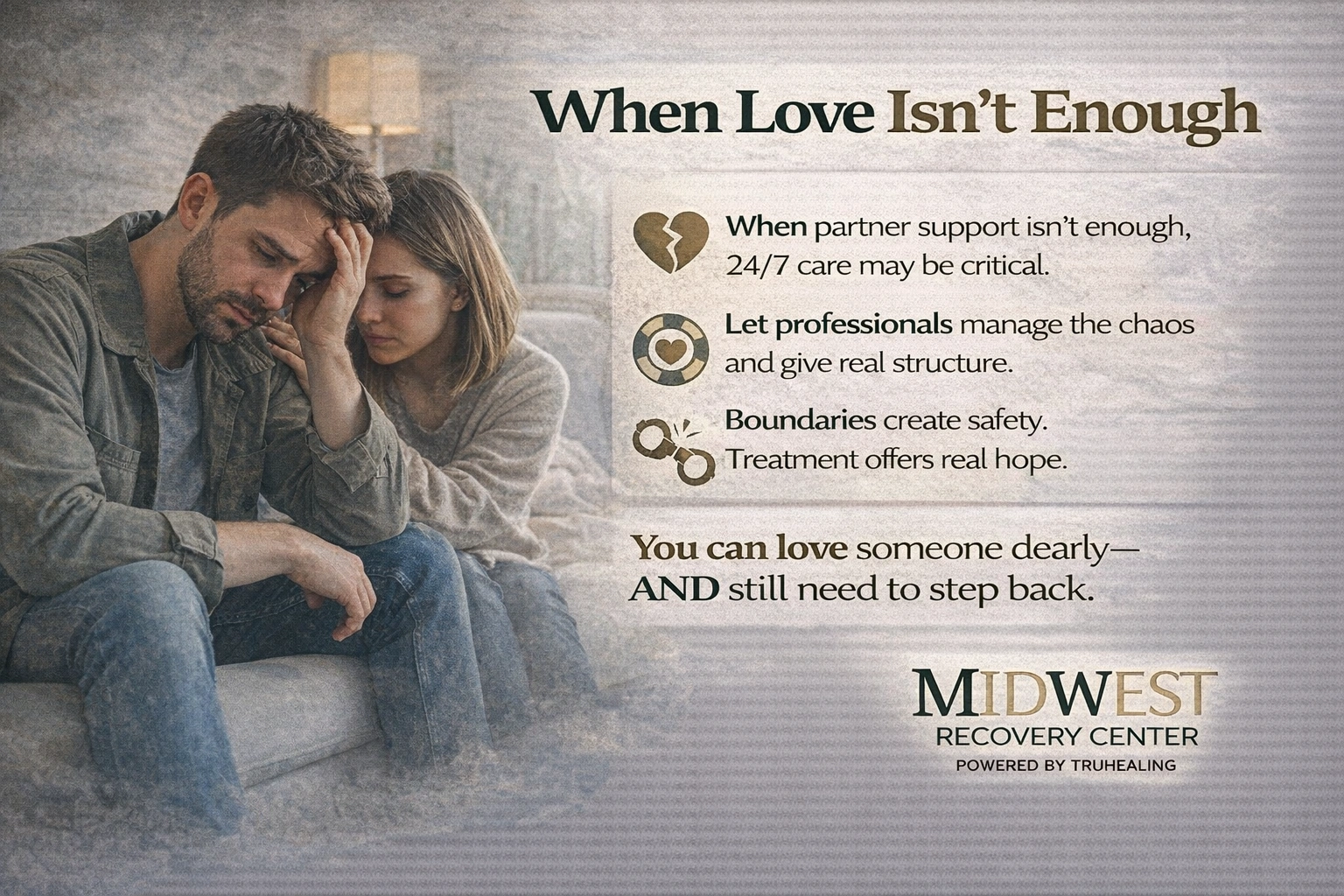
A residential treatment program can offer something you never could—something you were never meant to. It doesn’t replace you. It supports both of you.
At Midwest Recovery Center, we help partners stop drowning in the cycle of help-hope-hurt-repeat—and instead step into healing that’s shared, supported, and structured.
You’ve Been Doing Double Duty—And It’s Too Much
You’ve been their partner and their protector. Their emergency contact. Their accountability buddy. Their reminder. Their alibi. Their lifeline. Their reason to try again.
That’s too many roles for one heart to carry. Even if you’re strong. Even if you’re good at it.
What a residential treatment program does is take those roles off your shoulders and place them into clinical hands. A full team—therapists, case managers, physicians, and support staff—becomes the one holding the day-to-day.
That doesn’t mean they’re taken from you. It means you get to be just their partner again. Not their keeper.
It Creates a Safe Container You Don’t Have to Manage
In residential care, structure isn’t up for debate. It’s built-in.
Clients have schedules. Expectations. Group and individual therapy. Random drug testing. Clinical boundaries. Healthy food. Clean living spaces. Support for withdrawal and cravings.
The chaos—the part you’ve been absorbing—is managed by professionals, not by you. That alone can be life-changing.
In our Austintown, OH location, for example, couples often tell us that the first night their partner entered residential care was the first night they’d slept through in weeks. That’s not selfish. That’s a sign of healing beginning.
It Allows for Real Emotional Work (Without Costing You More)
In love, it’s natural to want to be the one who helps them open up. But when addiction is active, emotional honesty often turns into emotional injury. You ask how they’re feeling—and they lash out. You try to reconnect—and they shut down. You press for change—and they lie.
Inside a residential treatment program, emotional work happens with trained therapists who know how to hold space and hold limits. Your partner can explore shame, grief, trauma, family dynamics, and co-occurring mental health issues—without unloading all of it onto you.
And if you’re invited into family therapy? It happens in a space where you’re protected too. You’re not just there to support them. You’re there to be supported yourself.
It’s a Full System Shift—Not Just a Detox
If all treatment did was get someone sober, it wouldn’t be enough. We’ve seen it a thousand times—white-knuckle detox, followed by a return to the same environment, the same triggers, the same patterns.
That’s why residential care is more than detox.
It’s:
- Trauma-informed therapy
- Psychiatric support when mental health is tangled in
- Coping skills that get practiced in real time
- Group work that exposes isolation and breaks it
- Case management that addresses finances, housing, legal issues
- Life skills that prepare people to live—not just survive—outside of substance use
In our Toledo, OH program, many partners report seeing their loved ones come home not just sober, but re-centered—able to cook meals, hold conversations, handle stress, and engage with life differently than before.
That’s not magic. That’s structured, supported change.
It Protects You While They Do Their Work
You’ve likely been blamed. Manipulated. Lied to. You may have set boundaries and been guilted for them. You may have tried to help and been shut out. You may be so emotionally frayed that even kindness feels dangerous.
Letting them go to treatment is not walking away. It’s putting yourself in safety while they relearn how to be safe to love again.
It means letting go of being the fixer—not because you don’t care, but because you care enough to give this a real shot.
One spouse in our Maumee, OH care network put it like this:
“I thought I had to stay close to prove I loved him. But stepping back saved us both. It gave him space to show up differently—and gave me space to remember who I was.”
What If They Don’t Want to Go?
Let’s talk about the most frustrating part. You might be ready for them to get help—but they’re not.
That’s common. It’s also not the end.
People rarely feel fully ready to change. Fear, shame, denial, and trauma can cloud judgment. But willingness grows in contact with clarity and care—not pressure.
That’s why it’s okay to plant the seed. To say: “I love you. I’m not trying to control you. But I can’t keep doing this. And I believe a place like Midwest Recovery could help—more than I ever could.”
If they’re open even a little, we’ll take it from there.
You’re Allowed to Be the One Who Reaches Out
If your loved one won’t call, you can. Our team is here to answer your questions too—whether that’s about availability, cost, logistics, or how to even bring up the idea.
We work with families across Ohio and can help you explore the right level of care in your location—whether that’s residential, outpatient, or another next step.
Your voice matters in this process. You are not “just” the partner. You are a witness to the struggle—and a key part of the solution.
FAQs for Partners Considering Residential Care
Will they be mad I brought this up?
Maybe. Change is uncomfortable. But many clients eventually thank their loved ones for saying something—especially once they feel supported, not shamed.
Can I visit them during treatment?
Yes. Depending on clinical progress and facility policy, family visits and sessions are often part of care.
What if they say they’re not “that bad”?
You can still set your own limits. It’s okay to say, “This is bad for me now, and I need a change.”
Can I talk to someone even if they haven’t agreed to go yet?
Absolutely. We can support you in crafting the conversation, exploring options, or planning ahead.
Will they be safe in treatment?
Yes. Residential programs like ours are staffed 24/7, with licensed professionals, medical support, and trauma-informed care.
You’ve Done More Than Enough
If you’re feeling stretched thin, scared, guilty, or torn—you’re not alone. Thousands of partners have stood in your shoes.
You can love them and still need space. You can believe in them and still want better. You can say, “This is too much for me” without giving up on them.
Call (888) 657-0858 to learn more about our residential treatment program in Toledo, OH.
Your partner deserves a chance to heal. And so do you.