
You had time under your belt. Real time. Maybe it was 90 days, maybe more. You could breathe again. You were waking up clearheaded, eating real meals, answering the phone without lying. You weren’t just sober—you were rebuilding.
And then… you slipped.
It could’ve been one night or a slow unravel. Either way, it left you with that gut-deep shame no one talks about enough. The shame of having to say, “I relapsed.” Of wondering if you just undid everything. If you’re reading this and feel like you’re back at the bottom—stop. You’re not. You’re here. That matters. And there’s something that can help, without pretending like you’re starting from scratch.
Let’s talk about how a partial hospitalization program (PHP) can meet you exactly where you are: tired, frustrated, and still holding on to hope, even if it’s just a flicker.
Relapse Isn’t the End—It’s a Signal
If you’ve relapsed after some clean time, you already know the basics of recovery. You’ve sat in meetings. You’ve cried in therapy. You’ve probably helped someone else get through a rough week. And yet, here you are—looking for help again. That’s not failure. That’s data.
Relapse means something broke down. Maybe you pushed away your support system. Maybe a trauma response hit you sideways. Maybe life just got too loud and your old wiring took the wheel.
What matters now isn’t why it happened—but what you do next.
A partial hospitalization program gives you a way forward. It’s not about re-learning everything from scratch. It’s about rebuilding from where you are now—with more insight, more tools, and more support.
What PHP Looks Like After You’ve Been Sober Before
PHP hits different when you’ve already done some healing. You’re not a beginner. You’re someone who’s seen both sides—what works, what doesn’t, and how fast it can all unravel.
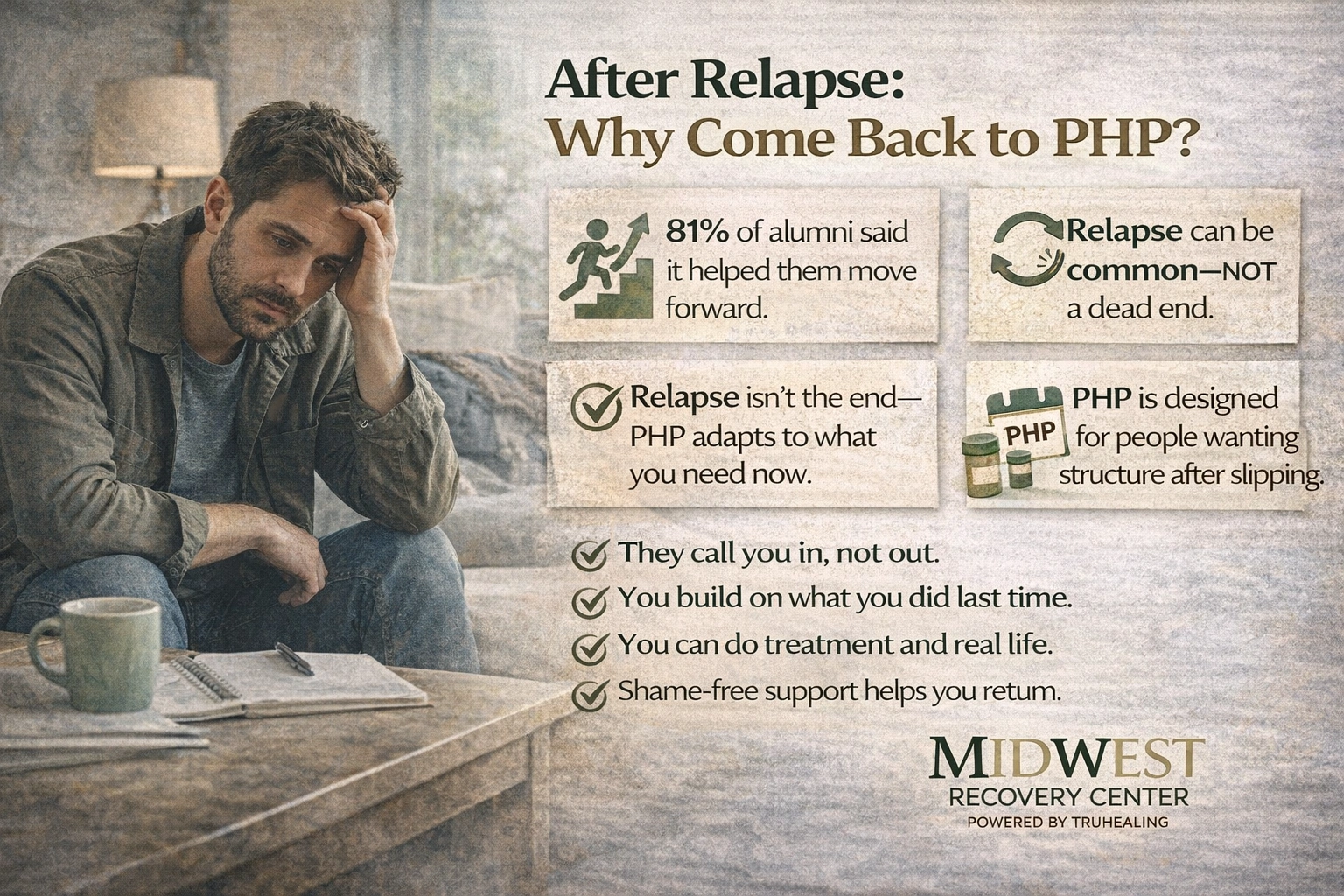
In a PHP setting, you attend treatment five days a week for several hours a day. It’s structured enough to keep you grounded, but flexible enough to let you live your life outside of treatment. You go home at night. You’re trusted to show up. And when you don’t, someone calls—not to punish you, but because you matter.
At Midwest Recovery Center, PHP includes:
- Individual therapy that doesn’t sugarcoat anything but doesn’t shame you either
- Group sessions that go deeper than “check-ins”
- Psychiatric care for when mental health is tangled in the mix (and it often is)
- Life skills work for people trying to manage jobs, bills, court dates, or just getting out of bed
- Optional family involvement—because maybe you’re ready to repair some things, maybe not
We’ve worked with alumni from across Ohio—including Youngstown, OH, where returning to care meant not giving up their home or job. Some came back to PHP in Toledo, OH after ghosting for weeks. Others in Maumee, OH showed up for a second chance, not because they had to, but because they finally wanted to.
Different stories. Same message: You still get to come back.
What Changes the Second Time Around
PHP the second time isn’t about checking boxes. You already know the language. What you need now is clarity, consistency, and space to figure out why it didn’t stick last time.
Here’s what gets real in second-round PHP:
1. You call yourself out faster
You recognize your patterns sooner—ghosting, isolating, playing it cool. PHP helps you break the spiral before it deepens.
2. You say what you need
First time around, you might’ve nodded through sessions just trying to get by. Now, you speak up. You know what triggers you—and what helps.
3. You stop pretending you’re fine
Recovery after relapse strips you down in a good way. You stop performing and start getting honest. That’s where healing happens.
You’re Not the Only One Who’s Been Here
“I didn’t want to call. I thought they’d be mad. I thought I’d get the speech: ‘What happened? Why’d you screw this up?’ But when I finally walked in the door, they just said, ‘Hey, we’re glad you’re here.’ That moment changed everything.”
— Alumni, Returned to PHP
That’s the kind of care you can expect at Midwest Recovery. We don’t do shame. We do second chances.
Why PHP Works—Especially Now
When you relapse, it’s easy to believe you’ve undone all the work. But PHP doesn’t treat you like you’re broken. It gives you structure, not punishment. Accountability, not babysitting.
Here’s what makes PHP effective post-relapse:
- Daily touchpoints keep you from disappearing into the fog
- Therapy targets this relapse, not just your old story
- Flexible structure lets you maintain parts of your life (job, parenting, classes)
- Real-life recovery tools you can apply today, not just in theory
You’re not being asked to prove yourself. You’re being invited to stay in the fight—with more support, not less.
Real Talk: What You Might Be Thinking
You might be thinking, “I already tried this. Why would it work now?” That’s fair. Honestly? It might not “work” the same way it did last time. It might work better. Because now you’re not trying to get clean just to make someone proud or meet a deadline. You’re trying because you know what it feels like to fall—and you don’t want to keep falling.
Recovery isn’t about never relapsing. It’s about learning to return—faster, gentler, wiser—every time you do.
FAQs: What Alumni Ask Before Returning to PHP
Is it embarrassing to come back after relapse?
No. It’s brave. Most of our team has seen relapse up close—either personally or professionally. You’re not a failure. You’re human.
How long will I need to stay in PHP?
Length depends on your needs, but many people benefit from 3–6 weeks. The focus is on stability and clarity—not just checking off days.
Can I work while in PHP?
Yes. Many clients attend PHP during the day and work evenings or weekends. We help you balance both, or we find a plan that fits.
Do I have to start over with paperwork, assessments, etc.?
You’ll go through a new intake, but we already know you. That helps us tailor your treatment faster and more effectively.
What if I live outside of the main clinic?
We support clients in multiple communities across Ohio, including Austintown, Toledo, and Maumee. We’ll help you access the nearest available services or connect you to transportation support if needed.
If You’ve Slipped, You Still Belong
You don’t need to hide. You don’t need to come up with the perfect explanation. All you need to do is decide: Do I want to stay down, or do I want to try again—with help?
The doors at Midwest Recovery Center are open to you. Always.
Call (888) 657‑0858 to learn more about our partial hospitalization program in Toledo, Ohio. We’re here to meet you where you are—and walk with you from there.