

Early recovery isn’t always loud. Sometimes, it’s not the cravings or the triggers that are hardest—it’s the quiet. The kind that creeps in at night or follows you home from a meeting. The kind that lingers in a house where no one calls anymore, where Friday nights don’t come with plans.
If you’re newly sober and feel lonely—not just alone—you’re not doing it wrong. You’re feeling something real, and it deserves compassion, not correction. In this blog, a clinician from Midwest Recovery Center in Toledo answers some of the most common questions people ask about the ache of loneliness after alcohol addiction treatment.
Learn more about our alcohol addiction treatment program in Toledo, Ohio
Why do I feel more alone now than I did when I was drinking?
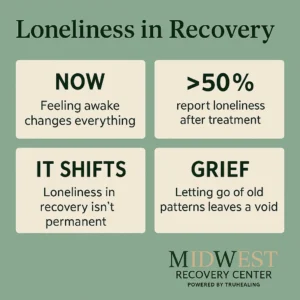
Because now you’re awake—and that changes everything.
Drinking often blurs the edges of pain. It can feel like connection, even when it’s not. It fills empty spaces with noise, people, movement. But recovery strips that away. It brings you back into your body, your heart, your mind. That’s powerful—but it’s also disorienting.
Before treatment, loneliness may have been drowned in the buzz of a bar, in the rhythm of routine drinking, or in chaotic relationships fueled by substance use. You might not have called it loneliness back then. But now, without alcohol muting it, you’re feeling it fully.
And that’s not a step backward. It’s part of what healing looks like.
Is loneliness after alcohol addiction treatment common?
Yes. More than most people admit.
You are not the exception—you’re part of a silent majority. Many people expect to walk out of treatment feeling triumphant. But the truth is, recovery has a middle. And in that middle, things are quiet. Old friends may not fit anymore. Family dynamics may still be tender or strained. Social life may feel uncertain.
In early sobriety, you’re not just letting go of a substance—you’re letting go of patterns, people, and habits that filled space in your life. That leaves a void. And loneliness rushes in. It’s not failure. It’s grief.
Grieving the old life—even if it hurt—is still grief.
Why does it feel like no one understands what I’m going through?
Because not everyone does—but some people do.
Early recovery can feel like living in another language. While others talk about happy hours or weekend plans, you’re just trying to figure out what to do with 7PM. While others unwind with a drink, you’re managing cravings and mental noise.
It’s a strange sort of invisibility—where you’re present, but your reality feels completely different. That can deepen the loneliness.
But here’s the good news: there are people who speak your language. You’ll find them in group therapy. In alumni meetings. In quiet coffee shop conversations with someone who “gets it.”
You just haven’t met all of them yet.
How long does this stage last?
It’s different for everyone—but it does shift.
Loneliness in recovery isn’t a permanent state. But it doesn’t have a fixed timeline either. Some people start building new connections quickly. Others take longer. It depends on a thousand little factors: your social style, your history, your trauma, your environment, your willingness to reach out (even when you don’t feel like it).
The ache doesn’t vanish overnight. But slowly, it softens. The empty spaces begin to fill—not with chaos, but with quieter things: trust, stability, new relationships, even solitude that feels peaceful instead of painful.
Be patient with your pace. Loneliness doesn’t mean you’re doing it wrong—it means you’re doing it honestly.
What are some gentle ways to build connection again?
You don’t need to leap—you can inch toward connection. Here are some ways we’ve seen clients begin reconnecting after treatment:
- Say yes to the safe invites. If someone from group asks to grab coffee, go. Even if it’s awkward. Especially if it’s awkward.
- Show up, even quietly. You don’t have to speak at every meeting. Just showing up is a form of connection.
- Volunteer locally. In cities like Maumee or Perrysburg, small community groups often welcome newcomers. Purpose and people in one place.
- Reach out digitally. Online recovery forums or alumni groups can be less intimidating for some.
- Try structured group activities. Exercise classes, book clubs, creative workshops—sober or not—give you people without pressure.
Connection doesn’t have to be deep right away. It just needs to be real.
What if I feel ashamed to say I’m lonely?
That’s okay—and common. Loneliness can carry shame, especially in recovery circles that celebrate “freedom” and “community.” It can feel like a personal failure, like you’re the only one still struggling.
But here’s what we know from working with hundreds of people in early recovery: nearly everyone feels this at some point.
The trick is not pretending you’re not lonely. The healing begins when you name it—even quietly, even in a whisper. Tell your therapist. Tell someone in group. You don’t have to carry it alone.
I’m not depressed, but this sadness lingers. Is that normal?
Yes. What you’re describing is what we call “sober sadness.”
It’s a low, heavy feeling—not necessarily clinical depression, but still deeply real. It comes from the loss of old patterns. The stripping away of false highs. The sudden stillness.
Alcohol may have created artificial joy. Without it, joy might feel further away—but that’s because now it has to be real. And real joy comes from slow, honest rebuilding.
If you’re unsure whether it’s sadness or depression, talk to a clinician. You don’t have to diagnose yourself alone. We’re here to help sort that out.
What if I miss drinking because it made me feel connected?
That’s one of the hardest truths to say out loud—and also one of the most healing.
Alcohol often provided more than a buzz. It gave social ease. It gave ritual. It gave you something to belong to. Missing that doesn’t mean you want to relapse. It means you’re mourning a version of connection that once worked—until it didn’t.
Missing it is not betrayal. It’s honesty.
And honesty is the root of real recovery.
How do I keep going when the loneliness feels unbearable?
Don’t go it alone. Even in loneliness, you can reach.
Call a peer. Text your sponsor. Walk into a group. Schedule a therapy session. Journal your ache. Pet the dog. Sit outside and let the sun touch your face. All of these count.
And if you’re in or near Oregon, Ohio, or here in Toledo, know that Midwest Recovery Center has real people ready to sit with you through the quiet parts—not just the crisis.
Because the quiet is where healing deepens.
Will I ever feel truly connected again?
Yes. Not overnight. But yes.
Connection in sobriety often looks different than it did in drinking. It’s slower, steadier. It’s based on truth instead of performance.
You’ll meet people who don’t need you to be the life of the party. You’ll build friendships where you can be tired, or sad, or quiet—and still loved. You’ll rediscover what it feels like to be known, not just seen.
It’s not a switch. It’s a return.
And it starts by staying here. Right here. In this moment. With this question. And with the next small step you take.
You Don’t Have to Face This Alone
At Midwest Recovery Center, we understand that recovery doesn’t always feel like a victory lap. Sometimes, it feels like sitting in a room and wondering who still knows your name.
If you’re navigating that quiet ache after alcohol addiction treatment, reach out. We provide compassionate support throughout early recovery—not just during detox or crisis. Whether you’re in Toledo or surrounding communities like Maumee, Perrysburg, or Oregon, Ohio, you are not alone.
Call (888) 657-0858 or visit our Alcohol Addiction Treatment program page to learn how we can support your recovery—not just from addiction, but from loneliness too.