
You’re not broken because treatment didn’t work the first time.
Let’s start there.
Because if you’ve ever walked out of a facility thinking, “That’s it?”—or found yourself back in old patterns within weeks—it’s not proof you’re a failure. It’s proof that what you needed… wasn’t offered.
At Midwest Recovery Center in Toledo, Ohio, we work with people who’ve been through treatment already—and are still searching for something that actually clicks. Something that fits real life, not just a brochure version of recovery.
Our partial hospitalization program (PHP) is designed for people who’ve tried before. Who are skeptical now. Who might not believe this could help, but who haven’t given up completely.
This blog is for you.
If Treatment Didn’t Work, You’re Not the Problem
There’s a silent shame that builds when recovery “doesn’t take.” You start to question yourself:
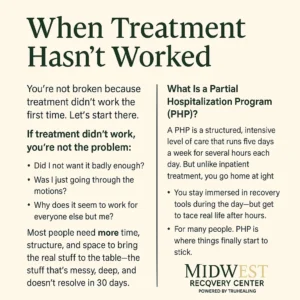
- Did I not want it badly enough?
- Was I just going through the motions?
- Why does it seem to work for everyone else but me?
But here’s the honest truth: treatment isn’t one-size-fits-all. And many programs—especially short-term ones—aren’t built for the complexity of long-term healing.
Most people need more time. More structure. More space to bring the real stuff to the table—the stuff that’s messy, deep, and doesn’t resolve in 30 days.
What Is a Partial Hospitalization Program (PHP)?
A PHP is a structured, intensive level of care that runs five days a week for several hours each day. But unlike inpatient treatment, you go home at night.
Here’s what that means practically:
- You receive group therapy, individual sessions, and psychiatric support.
- You stay immersed in recovery tools during the day—but get to face real life after hours.
- You’re held accountable, supported, and seen—not just processed.
For many people, PHP is where things finally start to stick. Why? Because it meets you in the middle: where you’re ready for more, but not ready to do it alone.
PHP vs. What You’ve Done Before
Let’s break it down. Maybe you did:
- A short-term inpatient detox
- A 30-day residential rehab
- Outpatient therapy or IOP with little follow-up
- A program that only focused on abstinence—not what’s underneath
Those programs might’ve helped stabilize you, but did they give you:
- Enough time to unpack trauma or grief?
- Space to practice boundaries in real-world settings?
- A structure that held you and respected your autonomy?
Probably not.
That’s where PHP comes in—and where it stands apart. It’s treatment that meets the complexity of real life.
Why PHP Might Work—Even If Nothing Else Has
If you’ve tried before, and nothing changed—or worse, things got messier—you’re not alone. But don’t confuse disappointment with defeat. There are reasons PHP might feel different this time around:
1. You’re Not Starting From Scratch—You’re Building From Experience
Even if you “failed” before (your words, not ours), you’ve still learned. You know what didn’t work. You know your patterns. You know what you need to avoid—or face.
That insight? It’s not a setback. It’s a head start.
2. Real-Life Recovery Requires Real-Life Rehearsal
You can’t prepare for triggers in a bubble. PHP gives you the chance to live your life—and then come back the next morning and say, “Okay, this came up. Let’s talk about it.”
That’s powerful. That’s different.
3. You’re Heard Here, Not Just Treated
In our PHP, you’re not talked down to. You’re not rushed through a checklist. You’re seen as someone who already knows what doesn’t work—and deserves a program that starts from that truth.
What Does PHP Look Like at Midwest Recovery Center?
You’ll attend structured sessions five days a week, often from morning to afternoon. Your care plan may include:
- Daily group therapy focused on coping skills, triggers, relationships, and identity
- Weekly individual therapy to go deep on personal goals and past pain
- Psychiatric support if you’re dealing with anxiety, depression, or other co-occurring issues
- Case management to help with housing, legal support, or employment needs
- Relapse prevention and re-integration planning
Importantly, you’ll still be sleeping at home—practicing recovery in your real environment. Whether you’re from Perrysburg, Maumee, or Oregon, Ohio, our Toledo-based PHP is within reach.
You’re Allowed to Feel Burned Out on Treatment
This isn’t about hyping you up with empty promises. Honestly? If you’ve tried and been let down, we expect you to be skeptical.
You might be thinking:
- “Why would this be any different?”
- “I’m tired of explaining myself.”
- “I’m not even sure I want help again.”
Here’s our response: that’s fair. You’re allowed to be tired. You’re allowed to question. But don’t let past programs become a life sentence.
You haven’t failed treatment. Treatment just hasn’t met you yet.
What People Say When It Finally Starts to Click
“I didn’t think anything would work. But PHP gave me just enough structure without making me feel trapped. I needed that.”
— Client, 2023
“Therapy never went deep before. Here, I finally felt safe enough to tell the truth.”
— Alumni, 2024
“I was done pretending. They didn’t ask me to be perfect. Just honest.”
— PHP Graduate, 2022
You Don’t Have to Believe in Treatment. Just Show Up.
Maybe you’re running out of faith. That’s okay.
Maybe all you’ve got left is 10% willingness and 90% doubt. That’s still enough.
PHP isn’t magic. But it is a container. A structure. A place to try again—with fewer masks and more support.
And if you’re willing to show up? That’s where things can start to shift.
FAQ: Partial Hospitalization Program in Toledo, OH
What makes PHP different from residential treatment?
Residential (inpatient) treatment requires you to live at the facility 24/7. PHP offers intensive support during the day but allows you to return home at night—letting you balance treatment and daily life.
How long is the PHP program at Midwest Recovery Center?
Length varies depending on your needs, but many clients participate for 3–6 weeks. Your treatment team will work with you to create a timeline that supports real change—not just fast results.
Is PHP only for people who’ve relapsed?
Not at all. While it’s often a powerful step for people who’ve tried treatment before, it’s also helpful for those who need more structure than traditional outpatient care but don’t require full-time inpatient treatment.
Do I have to stop working to attend PHP?
You may need to take a short leave from work, especially in the early stages. However, our team can support you in planning for that and may help you transition into evening or outpatient care as your stability increases.
Can I access PHP if I live outside Toledo?
Yes. We regularly work with clients from Maumee, Perrysburg, Oregon, and other surrounding areas. If you can commute daily, you can access our Toledo-based PHP services.
Still Not Sure? That’s Okay.
If the only thing stopping you from calling is the fear that you’ll just be let down again—you’re exactly who PHP was built for.
You don’t have to fake enthusiasm. You don’t have to perform healing. You just have to take the next small step.
Call (888) 657-0858 or visit our partial hospitalization program services in Toledo, Ohio to learn how we help people who’ve already tried—and are ready to try differently.