

You can wear success like armor and still be breaking inside.
I’ve seen it time and time again—clients who walk through our doors looking like they have it all together. Sharp outfits. Solid jobs. Big responsibilities. They smile, make eye contact, even crack a joke. But when the room gets quiet and the real conversation begins, the stories come out.
“I only drink at night, but I have to drink at night.”
“I’m not out of control, but I can’t stop.”
“I’ve built my life around looking okay—and I’m so tired.”
That’s what high-functioning addiction does. It doesn’t blow your life up in one dramatic moment. It eats at the edges, quietly. Until one day, even “I’m fine” sounds like a lie you don’t want to hear yourself say anymore.
At Midwest Recovery Center’s IOP program in Toledo, we specialize in helping people at that exact breaking point—not the ones who’ve lost everything, but the ones scared they’ll lose themselves.
What High-Functioning Addiction Really Feels Like
Forget what you think addiction looks like. Most of the people I work with don’t fit the stereotype. They’re not missing work or sleeping on a friend’s couch. They’re getting promotions. Coaching soccer. Holding it all together—for now.
But underneath that performance is a fragile system. A private world built around drinking or using to manage the stress of keeping everything else afloat.
- They drink to decompress.
- They drink to sleep.
- They drink because it’s Tuesday and the pressure hasn’t let up since Sunday night.
And slowly, the “need” grows louder than the reasons.
One client told me,
“I used to drink to take the edge off. Then I started drinking to feel anything at all. That’s when I knew I wasn’t in control anymore.”
Why High-Functioning People Wait Too Long to Get Help
There’s a unique kind of shame that shows up for people who seem like they should “know better.” They think they’re not sick enough to need treatment—but too sick to fix it alone.
They tell themselves things like:
- “It’s not that bad.”
- “I still have a job.”
- “I don’t drink in the morning.”
- “If anyone finds out, I’ll lose everything.”
So they stay silent. They keep managing. And the more competent they look, the harder it becomes to ask for help.
IOP is designed for exactly that moment. It’s not about collapsing your life. It’s about giving you a way to change it without losing everything you’ve built.
What IOP Actually Looks Like (And Why It Works)
IOP stands for Intensive Outpatient Program. But for high-functioning people, it might as well mean: “Introspection, Order, and Permission.”
- Introspection to ask the hard questions you’ve been avoiding.
- Order to break the cycle of chaotic self-management.
- Permission to want a different life—even if yours doesn’t look broken on paper.
IOP offers 3 to 5 days per week of structured therapy. That includes group sessions, individual counseling, psychoeducation, relapse prevention, and practical skills. You go home afterward. You keep working. You keep parenting. But you’re not white-knuckling it anymore.
You’re not doing it alone.
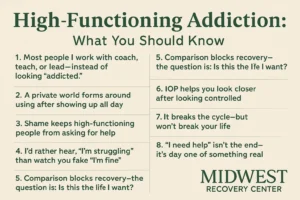
“I Didn’t Crash—I Just Stopped Lying”
That’s how a former client from Maumee, Ohio described her turning point.
She was an accountant, two kids, no missed days at work. But she’d built her entire evening around drinking just enough to blur the edges—and mornings around hiding the consequences. Her partner didn’t suspect. Her friends envied her “balance.”
She knew it was fake. She knew she was slipping.
IOP didn’t just give her strategies. It gave her a mirror. A space where she could say, “This isn’t working anymore” and not be met with judgment or shock.
Today, she’s still a professional, still a parent, but she’s also present—in ways she hadn’t been for years.
Comparison Will Keep You Sick
One of the hardest things to break in high-functioning addiction is the comparison trap.
- “At least I’m not drinking in the morning.”
- “At least I haven’t lost my job.”
- “At least I don’t drink every day.”
Here’s what I always say: If you’re measuring your health by how bad it could be, you’re already in trouble.
The question isn’t, “Is this the worst it could be?”
It’s, “Is this the life I actually want?”
IOP is the answer for people ready to ask that question.
Looking for IOP in Oregon or Perrysburg, Ohio?
If you live near Oregon or Perrysburg, Ohio, you’re not out of reach. Our Toledo-based program draws clients from across the region—people who are quietly carrying a burden that no one else sees.
You don’t have to explain why you’re tired. You just have to be willing to start showing up for yourself.
What Makes IOP So Effective for High-Functioning Adults?
Let’s get blunt. High-functioning people are good at hiding. Good at rationalizing. Good at avoiding change.
IOP works because it:
- Disrupts that pattern in a safe, structured way
- Offers peer feedback that cuts through self-deception
- Builds emotional and behavioral insight—not just abstinence
- Gives you consistent, therapeutic accountability that actually fits your schedule
You won’t be coddled. But you won’t be shamed either. You’ll be challenged in the way high-functioning adults often need to be—firmly, kindly, and consistently.
Frequently Asked Questions
What if I don’t want to quit drinking completely?
That’s okay. We work with people at all stages of change. IOP doesn’t demand abstinence on day one—it asks for honesty and willingness to explore. Many clients begin with a harm-reduction mindset and move toward sobriety over time.
Will I be in a group with people who are totally different from me?
Probably. And that’s a good thing. You’ll find out that the pressure to perform, the fear of failure, the shame of slipping—it doesn’t care what zip code you’re from. Recovery connects people who would never have met otherwise. And it works.
How is IOP different from regular therapy?
Standard therapy is often once a week. It’s reflective and open-ended. IOP is intensive, structured, and focused on substance-related behavior change. It moves faster. It holds you accountable. And it surrounds you with support multiple times a week.
Can I lose my job for being in IOP?
No. In many cases, you’re protected under the Family and Medical Leave Act (FMLA) or state laws. Plus, IOP is scheduled with discretion in mind—most clients find it easy to attend without disrupting their work life. Our staff can help you navigate those conversations, confidentially.
What if I live with someone who doesn’t know I’m struggling?
Many high-functioning clients are in this position. We’ll help you figure out how (or whether) to share that part of your life—and build a support system that works for you, not someone else’s expectations.
When You’re Finally Ready to Say, “I Need Help”
You’ve played the role. You’ve done the dance. You’ve managed everything except your own peace.
Let that change today.
IOP is where high-functioning people stop pretending and start healing. It’s the space between falling apart and living free. It’s the middle lane—between burnout and breakthrough.
Call (888) 657-0858 or visit our IOP program in Toledo, Ohio to start living like you’re actually okay—not just acting like it.