

You walked out once.
Maybe you ghosted a day. Maybe you quit showing up because the world outside collapsed. Maybe you convinced yourself it was “too much” or “not working.”
It happens. Life got messy—and the structure felt like it was supposed to hold, but it didn’t.
Here’s the thing: leaving the program doesn’t mean you failed. It means something in the system of care, your life, or your resources broke down. And you can return. You can stay. You can move forward.
If you’re wondering how to stay in a partial hospitalization program (PHP) when everything in your life is unstable—that’s exactly what we’ll walk through.
1. Acknowledge the Mess Without Shaming It
The chaos you’re in isn’t a sign that you’re weak. It’s a signal that your coping system is overloaded.
You might look around and think: “I messed up again.”
But what you did isn’t a moral failure—it’s a human reaction to stress, pain, and unmet needs.
When you step into a PHP with honesty about where you are—including the fact that you already dropped out—you build from truth, not from expectation.
Truth feels uglier, but it’s sturdier. The structures in a good PHP accommodate mess, not pretend it’s not there.
2. Re‑Clarify Why You Signed Up in the First Place
When life gets messy, your original motivation often gets buried under surviving.
Maybe your reason was: “I don’t want to keep doing this,” or “I want my life back,” or “I’m done losing people I love.”
Pull that reason out. Write it down. Say it when you wake up.
When you’re tempted to skip another day of PHP, whisper your why: “I signed up so I could be free, not just abstinent.”
You don’t have to feel the big emotion today. You just have to remember the cause you committed to.
3. Build Your Week Like an Architect, Not a Victim
In messy seasons, “just show up” becomes too vague. So map your days.
- Monday: Go to PHP. Check‑in at 9:00 a.m. Call therapist.
- Tuesday: PHP 1 p.m. Attend life‑skills group.
- Wednesday: PHP morning slot. Meal prep afterwards.
- Thursday: Mid‑day PHP. Do a peer support community after.
- Friday: Wrap‑up session. Review triggers with clinician.
Structure doesn’t guarantee success—but being specific about it reduces decision fatigue when you’re tired.
When your life outside skips, your PHP attendance can be the one thing you planned.
And if you crash? You don’t skip the next day—you adjust the plan.
4. Communicate with Your Team—Even When You Want to Hide
When life spirals, the easiest move is to go silent.
Your phone rings. You ignore it. The email comes. You delete it.
But staying in a PHP means staying in communication.
Send the clinician a short: “Dropped out yesterday. Feeling unstable today. Can we adjust schedule?”
They’re not going to judge. They want you to stay. They know mess happens.
When you speak up, even in chaos, you keep the relationship alive. That relationship is your safety net.
5. Set Micro‑Commitments, Not Mega‑Demands
You don’t need to promise “I’ll never skip again.” That can feel like a trap.
Instead: “I will attend three PHP sessions next week.”
Or: “If I don’t attend on Wednesday, I’ll call by 6 p.m.”
Small commitments build trust—first with your clinician, then with yourself.
When you keep the small things, the big things become possible.
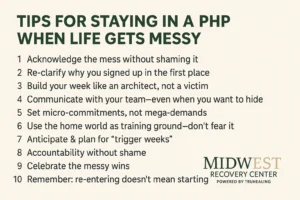
6. Use the Home World as Training Ground—Don’t Fear It
One of the hardest parts of PHP is coming home each night and facing real world triggers—roommates, old habits, debts, social media, boredom.
But that’s the benefit: your recovery isn’t happening in isolation. It’s happening in your life.
When you go to a program near you—say a PHP in Perrysburg, Ohio or Maumee, Ohio—you stay rooted in your environment.
This means you can test what you learn, fail, adjust, test again. That cycle is the work.
The glitches at home are not enemies: they’re labs.
7. Anticipate & Plan for “Trigger Weeks”
Life will always have seasons of extra mess: tax week, family confrontation, breakup, job change, loss.
When you’re in a PHP, you are allowed to flag these ahead of time.
Say: “I’ve got a family situation next week; may need extra support.”
The clinician can prepare you: more check‑ins, lighter content, coping kits.
When you anticipate the storm, you don’t get caught outside without an umbrella.
8. Accountability Without Shame
Accountability doesn’t have to feel like punishment. It can feel like partnership.
Your PHP team is not your enemy. They’re the co‑pilots when autopilot fails.
You miss a session? You tell them. You feel weak? You tell them.
Shame lives in hiding. You move forward in bearing your truth—clumsy, messy, real.
9. Celebrate the Messy Wins
You still show up when you don’t feel like it—that’s a win.
You talk when you wanted to hide—that’s a win.
You apply a skill you learned even though you’re terrified—that’s a win.
Make a list. Keep it somewhere visible.
When life gets messy, noticing wins reminds you: you’re still moving.
10. Remember: Re‑Entering Doesn’t Mean Starting Over
You skipped. You stopped. You thought maybe you were done.
But returning to a partial hospitalization program isn’t “going back to zero.” It’s continuing from where you left off—with more clarity, more grit, and more honesty than before.
Your past attendance, your past efforts—they matter. They equipped you.
Now you’re re‑entering—not from shame—but from strategy.
Frequently Asked Questions
What if I’ve already dropped out multiple times?
Then you’re experienced. You know what didn’t work. Use that info. Talk through with the PHP team the exact reasons you left. Build your plan around them this time.
Will they accept me again if I ghosted before?
Yes. Most programs understand that people leave when life becomes overwhelming. They’ll ask you: “What happened?” not “Why didn’t you?” They’ll make space for your return.
What if I can’t afford to take a full day for PHP because of work or school?
Speak up. Many programs adjust schedules—morning or afternoon blocks. Telehealth check‑in options exist. Your treatment needs to bend around your life, not force you to leave it.
Is missing one or two days going to ruin everything?
No. Compliance matters, but being human is allowed. Missing a few days triggers a check‑in. It doesn’t mean expulsion. It means the team listens, you reconnect, you reset.
How do I stay motivated when nothing seems changed yet?
Motivation fades fast. Leverage discipline instead. Show up because you said you would. Use accountability from your PHP team. Track progress—emotional, relational, behavioral—not just “clean time.”
When you’re ready, you don’t have to go it alone.
Life gets messy. That’s part of the design—you’re human, not a robot.
Staying in a partial hospitalization program during the chaos isn’t impossible—it’s intentional.
It’s choosing to show up with all your cracks showing.
It’s saying: I don’t have it all together, but I still want something different.
Call (888) 657‑0858 or visit Midwest Recovery Center’s partial hospitalization program in Toledo, Ohio to talk about how you can stay in, stay connected, and move toward the next chapter.